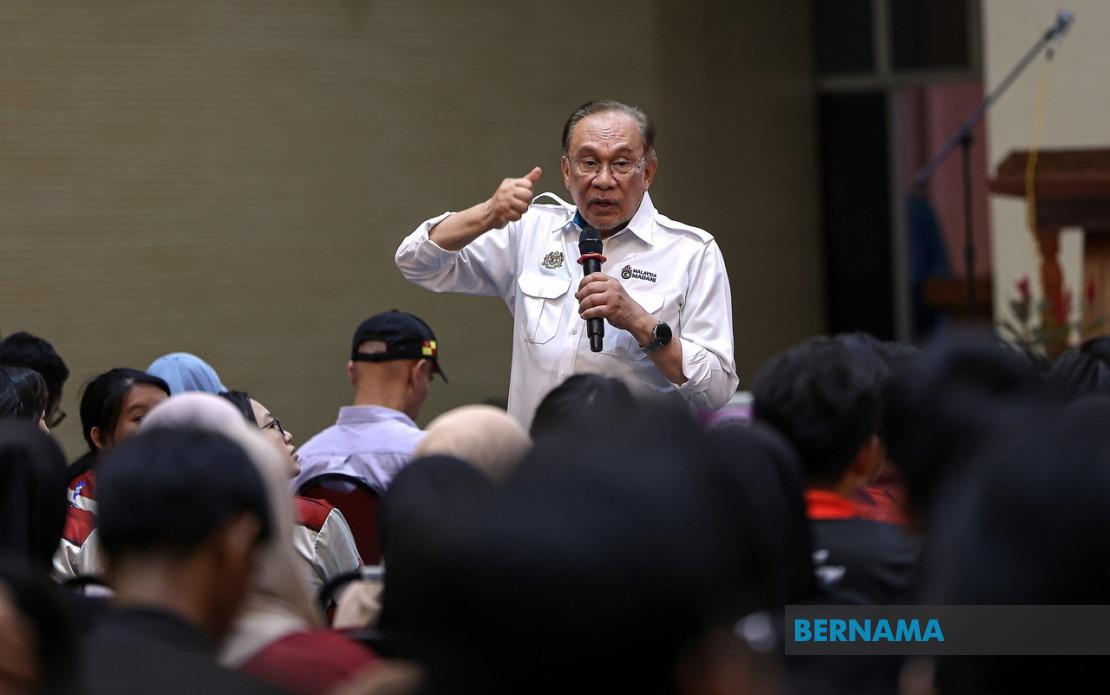
Prime Minister Datuk Seri Anwar Ibrahim has outlined a dual-track admission strategy for Malaysia's matriculation programme that seeks to reward academic excellence while maintaining support systems for students from disadvantaged backgrounds. Speaking at a youth engagement event in Seremban, Anwar emphasised that the government's approach recognises both individual merit and systemic inequality, attempting to navigate the longstanding tension between meritocratic advancement and equity-based affirmative action in Malaysian higher education.
Under the new framework, students who achieve exceptional results in their Sijil Pelajaran Malaysia (SPM) examination—specifically those earning 10As—will be granted automatic admission to the matriculation programme regardless of their ethnic background. This represents a clear commitment to recognising academic excellence as a primary pathway to tertiary education, signalling that high-performing students from any community will face no barriers based on race or other demographic factors. The automatic entry provision applies equally to Chinese, Indian, and Malay students, removing one source of potential discrimination from the selection process.
Simultaneously, Anwar reaffirmed the government's intention to preserve the Bumiputera quota system within matriculation intake, a mechanism that has remained central to Malaysian education policy since independence. Rather than framing this as a concession to political pressure, the Prime Minister articulated the quota as addressing distinct educational challenges faced by specific populations. The system, he explained, accounts for demographic distribution patterns and targets resources toward students from rural and interior regions, including the geographically dispersed communities of Sabah and Sarawak where educational infrastructure and access remain limited compared to urban centres.
This balanced stance reflects broader policy tensions within Malaysia's post-1MDB government. The administration has sought to modernise the social contract on which the nation was founded while maintaining explicit protections for Bumiputera interests, a delicate political calculation that shapes decisions across education, employment, and business policy. By anchoring the matriculation framework to both merit and need, Anwar's government attempts to satisfy multiple constituencies: those advocating for greater meritocracy and those insisting that affirmative action remains essential for addressing historical inequities and geographical disadvantage.
The matriculation programme itself serves as a critical juncture in Malaysia's education system, functioning as the primary pathway for students seeking entry to public universities. Competition for places has intensified considerably over recent decades as tertiary education has become increasingly essential for career advancement, creating pressure on policymakers to ensure the selection process balances efficiency with fairness. The intake system therefore carries significant weight in determining not merely which students access university, but which social and economic trajectories become available to different groups.
Anwar's emphasis on geographical and demographic factors suggests recognition that merit-based selection alone may perpetuate existing disparities. Students from well-resourced urban schools naturally accumulate advantages in examination preparation, access to quality instruction, and familiarity with testing formats—advantages unavailable to their counterparts in rural areas where secondary schools often operate with limited facilities and staffing. By explicitly referencing the needs of interior communities, the Prime Minister acknowledged that raw SPM scores, while important, may not fully reflect potential or capability when students have faced unequal educational circumstances.
The announcement comes at a time when Malaysian education policy faces renewed scrutiny from multiple directions. Parent advocacy groups have increasingly questioned whether existing selection criteria adequately serve their communities, while economists and employers have repeatedly highlighted skills gaps among graduates. University administrators meanwhile contend with balancing intake capacity against demand, managing institutional reputations based partly on student cohort quality. Matriculation intake policy thus sits at the intersection of these competing pressures, making any adjustment inherently contentious.
The framing of automatic entry for 10A achievers represents a notable policy signal. By removing discretionary assessment from the pathway for top performers, the government reduces bureaucratic gatekeeping and creates a transparent, easily understood standard. This approach should theoretically encourage higher effort among SPM candidates across all backgrounds, as exceptional performance guarantees educational progression regardless of other factors. However, it also implicitly suggests that students below this threshold will remain subject to more traditional selection mechanisms where demographic categories retain relevance.
For Southeast Asian observers, Malaysia's approach offers insights into how middle-income democracies navigate affirmative action amid economic competition and social pluralism. Unlike societies with clearly dominant majorities, Malaysia's multi-ethnic composition means education policy necessarily involves explicit negotiation between communities. The government's dual-track approach reflects neither pure meritocracy nor complete protection of group interests, but rather an attempt at synthesis that may satisfy neither purists nor maximalists on either side of the debate.
The practical implementation of these principles will prove as important as their announcement. Whether institutions genuinely process 10A achievers through automatic pathways, how quota spaces are allocated and monitored, and whether rural and interior students actually access improved opportunities will determine the policy's real-world impact. Transparency in reporting these metrics would strengthen public confidence that the system operates as intended rather than as a rhetorical accommodation of competing political demands.
Anwar's comments were made during the "Jelajah Rakan Muda" programme at the Youth and Sports Complex in Paroi, attended also by Youth and Sports Minister Dr Mohammed Taufiq Johari. The youth-focused setting underscores the government's awareness that education policy decisions shape aspirations and opportunities for an entire generation navigating an increasingly competitive regional economy. How Malaysia resolves these tensions around access and merit may influence not just individual trajectories but the nation's capacity to develop its human capital effectively.

