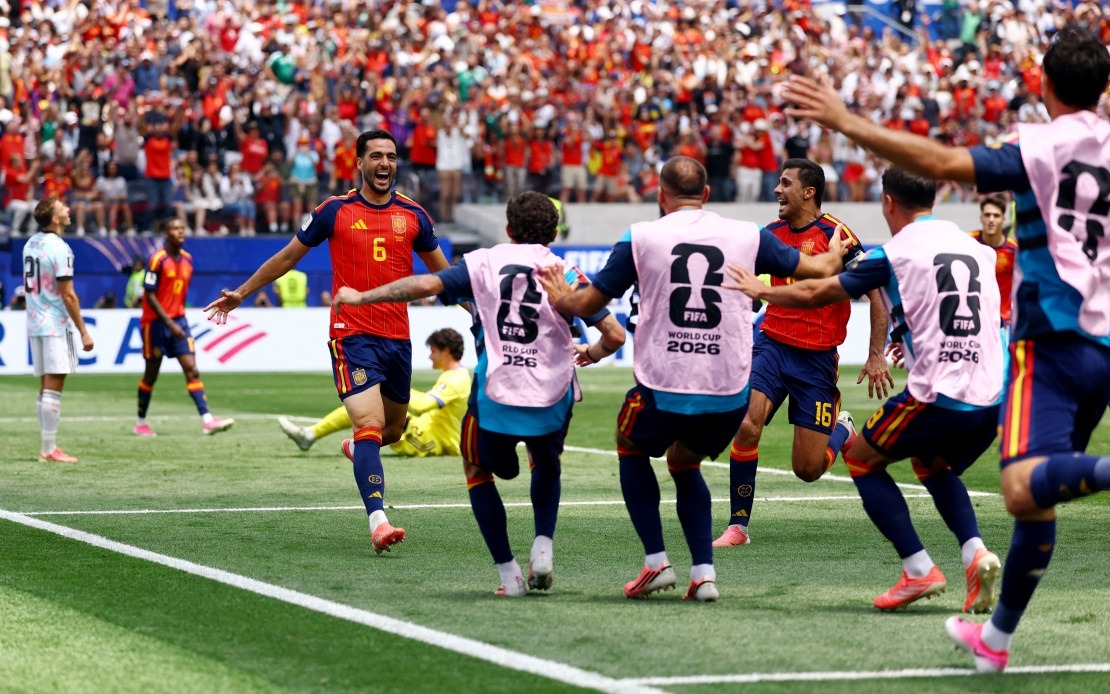
Spain's march toward another major tournament crown gathered fresh momentum in California on Friday, as the defending European champions dispatched a severely weakened Belgium outfit 2-1 to advance to the World Cup semi-finals. The result sets up a compelling encounter against France near Dallas, a rematch of the Euro 2024 semi-final that La Roja dominated. For Spanish football, this represents another opportunity to claim only their second World Cup title since their sole triumph in 2010, a gap that has frustrated the nation's footballing public for over a decade.
Fabián Ruiz opened the scoring for Spain in the 30th minute, establishing control of the match in front of an Inglewood crowd. The goal marked an important psychological boost for a Spanish side seeking to build on their impressive form throughout the tournament. However, the lead proved temporary when Charles De Ketelaere equalised for Belgium, drawing the match level and briefly shifting the momentum. That moment was particularly significant because Unai Simón conceded his first goal after an extraordinary run of 649 minutes without allowing a score across two World Cup campaigns, an achievement that underscored Spain's defensive excellence and the Belgian forward's clinical finishing.
Belgium's cause was severely hampered by circumstances beyond their control. Captain Youri Tielemans was forced to withdraw during the warm-up period, dealing with what appeared to be a hamstring injury that left the side without one of its most influential midfielders. This setback compounded an already difficult injury situation, as midfielder Amadou Onana was already sidelined after suffering a knee ligament tear in earlier matches. These absences stripped Belgium of two critical players in central midfield, undermining their ability to control the game's tempo and structure.
The situation deteriorated further for the Belgian contingent when goalkeeper Thibaut Courtois, a figure instrumental in their recent tournament campaigns, was forced off with an injury in the 71st minute. The goalkeeper's departure was visibly emotional, suggesting the severity of whatever problem had emerged during the match. His replacement was Manchester United's Senne Lammens, a reserve option thrust into an extremely demanding situation against one of the tournament's most attacking sides. The goalkeeper's inexperience at this level would prove telling as the final stages unfolded.
Spain seized the initiative following these substitutions, introducing attacking reinforcements that shifted the tactical balance decisively in their favour. Nico Williams and Mikel Merino were brought into the action, injecting pace and creativity into the Spanish attack. This tactical adjustment proved pivotal in the 88th minute when Merino, continuing his pattern of decisive substitute appearances, finished a move that began with Pau Cubarsi's long-range effort. Lammens spilled the ball from what should have been a routine save, a critical moment of hesitation that Merino ruthlessly exploited by directing the ball into the roof of the net.
Merino's goalscoring intervention represents another chapter in what has been a productive tournament run as a impact player off the bench. His previous decisive moment came during the knockout stage against Portugal, where he again scored as a substitute to progress his side. This ability to produce crucial moments when introduced from the bench demonstrates both his quality and the depth of Spanish talent currently available. For Arsenal, his parent club, such performances in a World Cup environment can only enhance his reputation and marketability within Europe's elite competitions.
The forthcoming meeting with France carries significant weight for both nations, though the implications differ considerably. France enters the semi-final as one of the tournament's pre-match favourites, having reached the final four years previously when they lost to Argentina. As winners of the World Cup in 1998 and 2018, the French carry experience and pedigree in knockout football at the highest level. However, they are likely acutely aware that they have now encountered arguably their most formidable opponent yet in this tournament.
Spain's performance against Belgium, despite the opposition's considerable disadvantages, confirmed their tactical sophistication and attacking potency. The dominance displayed in Los Angeles County demonstrated that La Roja has maintained the passing intensity and structural discipline that have defined their football since their golden era began nearly two decades ago. The ability to maintain control whilst introducing attacking players suggests a squad with sufficient squad depth to rotate without sacrificing quality or coherence.
From a Southeast Asian perspective, Spain's progression holds interest in terms of the broader narrative surrounding European dominance in world football. The continued success of Spanish national teams across multiple tournaments reflects a development model and youth system that has become the envy of many football-producing nations. As Malaysia and other regional federations seek to develop their own pathways for talented young players, the Spanish template of investment in youth development and systematic progression remains instructive.
The Tuesday semi-final near Dallas will take place in an atmosphere heavy with historical resonance. The Euro 2024 semi-final victory by Spain against France remains fresh in memory, suggesting that La Roja possesses both the tactical knowledge and psychological edge required for such an encounter. France will present a different challenge, however, with their own rich pedigree in knockout competitions and proven ability to overcome adversity in such situations. The match promises to be tactically fascinating, with both sides capable of controlling possession and creating opportunities through sustained pressure.

