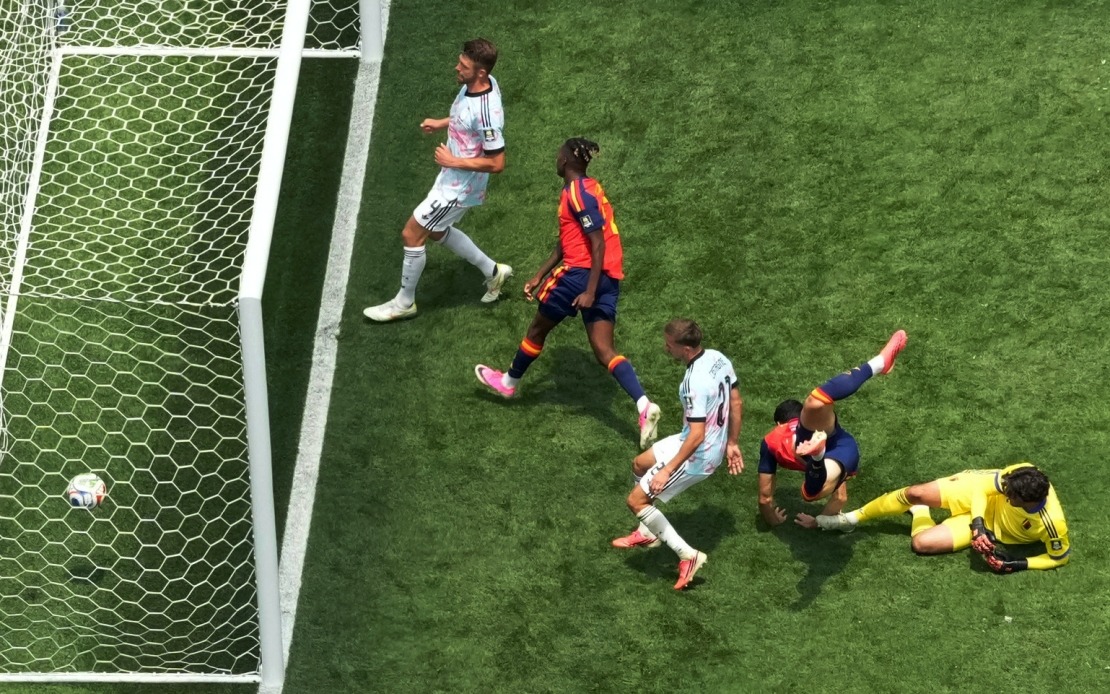
Spain has booked its berth in the FIFA World Cup 2026 semi-finals, ending a 16-year wait to reach the tournament's final four after midfielder Mikel Merino struck in the 88th minute to secure a 2-1 quarter-final triumph over Belgium at Los Angeles Stadium in California on Friday. The match showcased Spain's attacking prowess and resilience, with Merino once again demonstrating why the substitute has become Luis de la Fuente's most reliable finisher in critical moments.
Merino's clutch finishing has become a hallmark of Spain's campaign. The midfielder, who netted the decisive goal in Spain's round-of-16 victory against Portugal just days earlier, proved instrumental in breaking Belgian resistance when the match appeared increasingly contested. His poacher's instinct and composure under pressure have established him as a key figure in La Roja's quest for World Cup glory, elevating him beyond his traditional role as a squad rotation player into a tournament-defining performer.
The opening phase of the encounter reflected Spain's tournament form, with the team controlling possession and dictating the tempo against a Belgian side seeking to exploit set-piece opportunities. Eighteen-year-old sensation Lamine Yamal announced his presence with a curled effort in the 21st minute that sailed narrowly past the left post, signalling Spain's attacking intent and the emerging talent that has captured global attention throughout this tournament.
Fabian Ruiz converted a goalmouth scramble to put Spain ahead in the 30th minute after Belgian goalkeeper Thibaut Courtois produced a crucial save to deny Dani Olmo's initial attempt. Courtois, the 34-year-old custodian, remained a formidable obstacle as he subsequently blocked a Yamal free-kick that appeared destined for the bottom corner two minutes later, demonstrating the veteran's continued importance to Belgium's defensive stability.
Belgium responded with unexpected potency before halftime when Timothy Castagne's right-wing cross found Charles De Ketelaere, whose downward header past Unai Simon levelled the score in the 41st minute. This equaliser marked Spain's first goal conceded in the entire tournament, suggesting that Belgium possessed sufficient capability to trouble La Roja's previously resilient defence and prevent a one-sided affair.
The second period saw Belgium threaten briefly through Maxim De Cuyper's effort that skidded wide of the post, yet Spain gradually reasserted control. Courtois maintained his impressive performance with consecutive saves denying both Yamal and Mikel Oyarzabal within rapid succession, further testament to his individual class and experience at this level of competition. However, Belgium's goalkeeper situation deteriorated when Courtois departed with an apparent leg injury in the 71st minute, with Manchester United's Senne Lammens replacing him for the final stages.
This substitution proved decisive. In the 88th minute, Lammens' handling of Pau Cubarsi's long-range shot proved uncertain, allowing the ball to spill invitingly into the penalty area where Merino demonstrated sharp reflexes to fire home at close range. The goal sent Spanish supporters into rapture and effectively extinguished Belgium's semi-final aspirations, capping an evening where individual errors at critical junctures undermined the underdogs' efforts.
Spain's progression sets up a glamorous semi-final clash against France in Dallas Stadium on July 15. The two-time World Cup champions advanced by defeating Morocco 2-0 on Thursday, establishing themselves as formidable opposition for La Roja in what promises to be a compelling encounter between two European powerhouses. Both nations possess winning pedigrees and attacking prowess that should produce an entertaining spectacle.
The 2026 World Cup's expanded format, featuring 48 teams across the North American co-hosts of Canada, Mexico and the United States, has fundamentally altered tournament dynamics compared to traditional 32-team editions. This larger pool necessitates different tactical approaches and squad management, as demonstrated by Spain's successful reliance on impact substitutes like Merino. The tournament, which commenced on June 11 and concludes on July 19, represents a watershed moment in football's governing body's commitment to growing the sport's global reach and commercial appeal.
Spain's resurgence into the semi-finals marks a significant achievement for a squad that has undergone generational transition while maintaining tactical coherence and offensive capability. The emergence of young talents alongside established performers like Merino demonstrates how de la Fuente has balanced experience with youthful exuberance, creating a team that can adapt to different opposition and challenging circumstances. Their path through the tournament has been marked by clinical finishing and defensive solidity, attributes that will be tested severely against France's attacking abundance and world-class goalkeeper.

