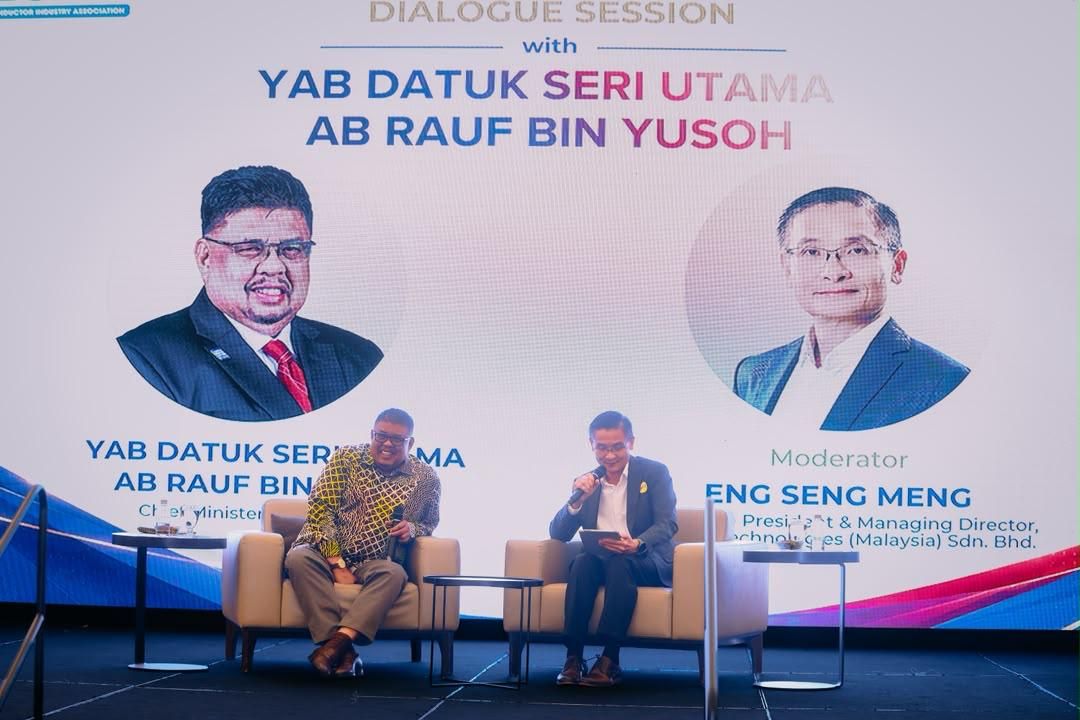
Melaka's semiconductor sector has matured into a RM17.6 billion economic engine, representing one of Southeast Asia's most successful industrial transformations. Chief Minister Datuk Seri Ab Rauf Yusoh revealed this milestone during an engagement with industry leaders, underscoring how the state has leveraged more than five decades of expertise to become a preferred destination for multinational electronics manufacturers. The trajectory from a single small-scale operation to a diversified, world-class industry reflects both strategic positioning and sustained commitment to advanced manufacturing.
The origins of Melaka's semiconductor journey trace back to the early 1970s when an international corporation took a calculated risk by establishing operations in the state. Rather than beginning within purpose-built industrial facilities, the initial venture operated from an Umno building along Jalan Hang Tuah before expanding to Batu Berendam following the inauguration of Melaka's first Free Industrial Zone in 1976. This modest foundation gave way to exponential growth, with what commenced as a handful of dedicated workers evolving into a sophisticated manufacturing ecosystem spanning multiple sectors. The narrative reflects how regional development often springs from individual entrepreneurial courage rather than grand planning.
Today, manufacturing accounts for 36.1 percent of Melaka's gross state product, with more than 400 companies operating across 18 industrial sectors. The semiconductor subsector, however, maintains particular strategic importance due to its technological complexity, export value, and capacity to attract high-skilled employment. Beyond the headline investment figure, the industry's significance lies in the supporting ecosystem it has cultivated—from specialised logistics providers and component suppliers to engineering consultants and technical training institutions. These interconnected activities have created what economists term an industrial cluster, where proximity and shared expertise generate competitive advantages difficult for rival regions to replicate.
Chief Minister Ab Rauf emphasised that Melaka's continued appeal rests upon three foundational pillars: strategic geographic positioning, operational cost competitiveness, and access to skilled talent. Nestled between Kuala Lumpur, Johor, and Singapore, the state provides investors direct connectivity to major regional markets, sophisticated port facilities, and international airports. Crucially, this advantageous location comes paired with lower land and operational expenses compared to neighbouring jurisdictions, a combination increasingly difficult to secure in Asia's developed manufacturing hubs. The state currently maintains more than 2,600 hectares of industrial land available for development, offering multinational corporations the flexibility to expand operations without relocating entirely.
Talent development has become critical as semiconductor manufacturing grows more sophisticated. Melaka is positioning itself as a Technical and Vocational Education and Training hub through 61 institutions producing industry-ready graduates. The emphasis on aligning educational curricula with manufacturer requirements addresses a persistent regional challenge: the gap between academic instruction and practical industry needs. By fostering closer cooperation between vocational institutions and semiconductor employers, Melaka enhances its competitive position against regions competing for similar investments. This human capital dimension often proves decisive in location decisions, particularly for operations requiring precision engineering and quality management expertise.
The confidence of multinational corporations provides tangible evidence of Melaka's industrial maturity. Manufacturers from the United States, Germany, China, Japan, and other advanced economies have sustained operations in the state for more than fifty years, continuously reinvesting and expanding capacity. This durability reflects not merely tax incentives or infrastructure quality but also institutional reliability—the predictability of governance, regulatory consistency, and supply chain stability that global corporations demand. The state recorded RM14.68 billion in investments across 312 projects during 2025, marking the highest annual investment value achieved in twenty-two years and signalling accelerating momentum.
However, Chief Minister Ab Rauf injected a cautionary note regarding competitive pressures emerging within the global semiconductor landscape. Investment decisions made within the next few years will determine the geographic distribution of manufacturing capacity, supply chain architecture, and technology hubs for decades ahead. The semiconductor industry's structural characteristics—high capital requirements, long development cycles, and strategic importance to national technology security—mean that location decisions carry outsized consequences. If Melaka moves slowly in enhancing competitiveness or responding to investor requirements, multinational corporations may redirect investments toward jurisdictions offering faster approvals, superior logistical infrastructure, or stronger technological capabilities.
The prospective loss extends beyond new manufacturing facilities. Ab Rauf warned that delayed action could cost Melaka not only fresh semiconductor investments but also the expansion projects and supporting industries that naturally cluster around established manufacturing hubs. High-skilled employment opportunities—precisely the category of jobs policymakers throughout Southeast Asia seek to attract—would migrate elsewhere. Local small and medium enterprises, many of which have integrated into global semiconductor supply chains, face obsolescence if the foundational manufacturing base erodes. This scenario illustrates how industrial development remains dynamic rather than self-sustaining; competitive advantage requires continuous renewal.
To address these challenges, Melaka is advancing the Semiconductor Strategy 2035, a comprehensive roadmap aimed at securing high-value investments, strengthening indigenous manufacturing capabilities, and ensuring the state remains a preferred destination for semiconductor players. The strategy moves beyond conventional industrial incentives to encompass regulatory streamlining, expedited approval processes, and proactive government engagement throughout project lifecycles. This approach acknowledges that modern investors evaluate not merely financial incentives but the entire business environment, including bureaucratic efficiency, infrastructure reliability, and quality of life factors affecting workforce retention.
Chief Minister Ab Rauf articulated Melaka's comprehensive value proposition: strategic connectivity across Asia's major markets, operational cost structures allowing healthy profit margins, access to technically sophisticated talent, an established industrial ecosystem with proven stability, and a state government actively supporting long-term investment. For Malaysian policymakers observing regional competition intensifying across Southeast Asia, Melaka's experience offers instructive lessons. The state's five-decade trajectory demonstrates that sustainable industrial development emerges from consistency in fundamentals—geographic advantage, human capital development, infrastructure quality, and governance reliability—rather than temporary tax breaks or opportunistic incentives that competitors can easily replicate.
Melaka's semiconductor sector stands at an inflection point. The RM17.6 billion valuation represents historical achievement and foundation for future growth. Yet the state faces the perpetual challenge confronting any successful manufacturing hub: remaining competitive as rivals upgrade their capabilities and as global investors seek incremental advantages. The coming years will determine whether Melaka can consolidate its position as a semiconductor centre of gravity within Southeast Asia or gradually lose share to more aggressive competitors. For Malaysian stakeholders in the technology sector, the state's trajectory merits close attention as it encapsulates broader questions about industrial competitiveness and sustained prosperity within the region.

