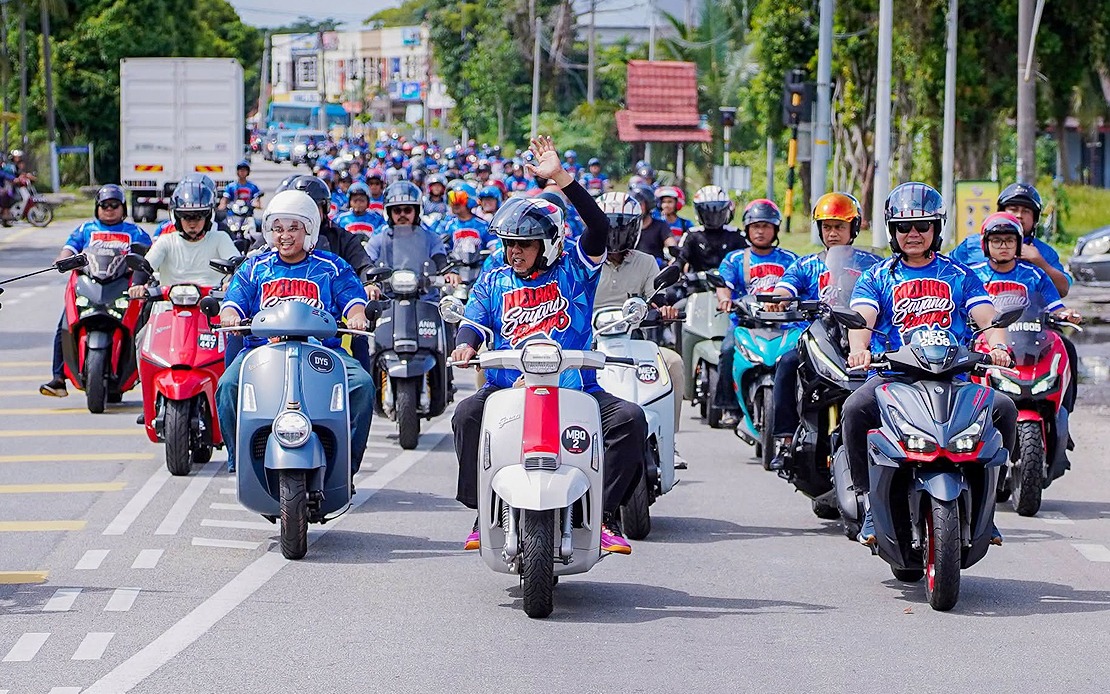
Melaka's Chief Minister Datuk Seri Ab Rauf Yusoh has reaffirmed the state government's commitment to sustained community engagement by expanding the Tangga Batu parliamentary WRUR programme across two distinct phases targeting the Pantai Kundor and Paya Rumput state constituencies. The initiative, unveiled at a recent community launch, underscores a strategic pivot towards institutionalising grassroots consultation as a permanent feature of state governance rather than treating it as an episodic political gesture.
The expanded programme encompasses more than 200 coordinated initiatives spanning welfare assistance, community infrastructure, educational support, youth development, entrepreneurship schemes, and the systematic resolution of accumulated local grievances. By framing WRUR as a continuation of established practice rather than a novel announcement, Ab Rauf signalled that the state administration views direct constituent engagement as an embedded operational mechanism. This positioning is significant within the Malaysian political context, where grassroots programmes are often perceived as campaign-driven activities rather than permanent policy instruments.
The track record presented by Ab Rauf suggests measurable traction in addressing constituent concerns. Across 23 previous implementation cycles, the programme has logged more than 4,000 formal complaints, with approximately 70 per cent achieving successful resolution. Within the Tangga Batu parliamentary constituency specifically, earlier phases conducted in Sungai Udang and Kelebang state constituencies yielded 359 complaints, of which 328 were resolved while 31 remain under active follow-up. These figures, though incomplete closure rates, demonstrate a functioning complaint-handling infrastructure capable of routing grievances through government agencies and tracking outcomes.
Material assistance distributed during the sixth phase implementation totalled more than RM150,000 across twenty distinct aid categories, reflecting the programme's breadth of coverage. Fishermen and maritime workers received RM22,000 distributed among 220 individuals, while five boat owners affected by sinking incidents obtained RM1,500 in emergency assistance. Small and medium enterprise operators benefited from RM14,000 in distributed business equipment supporting ten entrepreneurs. Beyond economic sectors, funding extended to religious education institutions, houses of worship, students requiring educational support, and homeowners facing hardship, indicating a deliberately inclusive approach to constituency welfare.
Infrastructure remediation has assumed urgency following recent weather-related disasters. The Department of Irrigation and Drainage has mobilised RM50,000 for cleaning and maintenance operations at Sungai Seberang Gajah, addressing flooding that inundated 73 houses in Pantai Kundor. Completion is targeted for the following week, representing rapid response to acute local needs. Beyond immediate remediation, the same department has initiated procurement processes for RM100,000 in improvement works at Sungai Lereh, signalling medium-term infrastructure hardening in flood-prone areas.
Larger-scale infrastructure projects underscore state ambitions for systemic flood mitigation. The Public Works Department has sought federal approval for an RM16 million project upgrading the crossing culvert structure along Jalan Tangga Batu-Tanjung Minyak, a critical choke point in the constituency's road network. This scale of investment—substantially exceeding emergency response budgets—indicates that flood management is being addressed through capital-intensive structural solutions rather than solely through maintenance operations. The requirement for federal approval signals coordination between state and national governments on significant infrastructure commitments.
From a governance perspective, the programme's emphasis on quantified outcomes and systematic complaint tracking reflects international best practices in citizen-responsive administration. By publishing resolution rates and specific assistance figures, the state administration creates transparency mechanisms that theoretically enable constituents to monitor performance. However, the 70 per cent resolution rate warrants contextualisation: without understanding complaint categories and resolution definitions, the figure alone cannot confirm whether resolutions represent genuine problem-solving or administrative closure. Malaysian readers familiar with state bureaucracy will recognise that some complaints may be classified as resolved through referral rather than material intervention.
The Tangga Batu constituency represents a particular governance challenge due to its geographical and demographic composition. The constituency encompasses both Pantai Kundor and Paya Rumput state seats, both of which face recurring flood vulnerabilities owing to proximity to water courses and low-lying topography. Communities in these areas have experienced cumulative grievances related to drainage inadequacy, emergency response delays, and damage compensation mechanisms. By concentrating infrastructure spending and complaint resolution efforts in this parliamentary division, the state government is demonstrating prioritised attention to constituencies experiencing persistent service delivery shortfalls.
The political economy of grassroots engagement in Melaka merits consideration. As a state with historically competitive electoral contests and shifting political coalitions, sustained community engagement serves multiple functions simultaneously: it addresses genuine governance gaps, demonstrates administrative responsiveness to potential swing voters, and builds institutional capacity for future electoral mobilisation. The programme's continuation across multiple electoral cycles suggests it has become embedded in state political strategy rather than representing temporary crisis response.
For Southeast Asian readers, this model of institutionalised grassroots engagement offers a case study in how state governments attempt to bridge persistent gaps between citizen expectations and administrative capacity. Rather than wholesale service delivery reform—often constrained by resource limitations or bureaucratic resistance—Melaka has adopted a hybrid approach combining targeted financial assistance, visible infrastructure investment, and systematic complaint documentation. Whether this approach satisfies constituent needs or merely creates documentation systems requires longitudinal assessment, particularly regarding whether beneficiaries experience improved service quality beyond initial assistance.
Moving forward, the programme's sustainability depends on several factors. Continued federal funding cooperation on major infrastructure projects remains essential, particularly for projects requiring RM10 million-plus commitments. The complaint resolution pipeline must avoid becoming backlogged; the 31 unresolved cases from earlier Tangga Batu phases suggest that some grievances resist straightforward administrative solutions. Additionally, expanding the programme across two state constituencies simultaneously tests administrative capacity; successful implementation requires coordinating multiple departments, processing hundreds of applications, and executing infrastructure projects on compressed timelines.
The broader significance extends beyond Tangga Batu. If Melaka's WRUR model generates measurable improvement in constituency satisfaction and demonstrates sustainable resource management, other Malaysian state governments may adopt analogous frameworks. Conversely, if resolution rates stagnate or unmet expectations accumulate, the programme risks becoming associated with failed promises rather than genuine responsiveness. For constituencies across Malaysia experiencing similar flood vulnerabilities and infrastructure deficits, this initiative represents a template worth monitoring as a potential benchmark for state-level governance performance.

