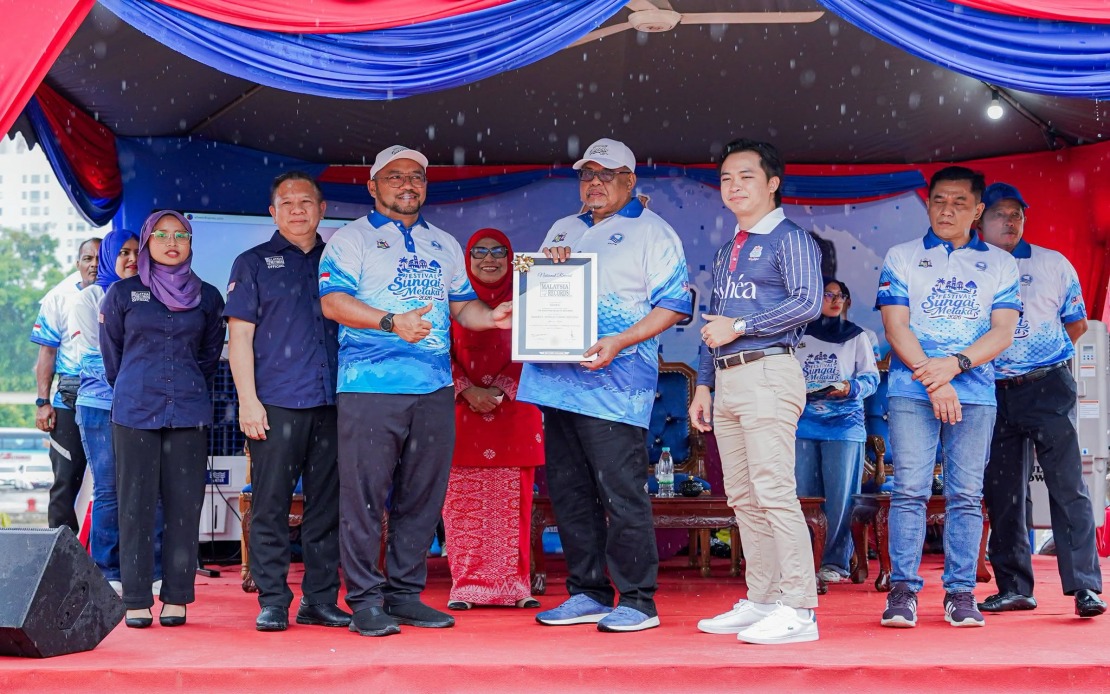
Melaka has joined a select group of Malaysian destinations by securing four Malaysia Book of Records (MBOR) recognitions within a compressed three-year timeframe, underscoring the state's accelerating push to establish itself as a competitive tourism hub in Southeast Asia. Chief Minister Ab Rauf Yusoh announced the latest addition to this collection during the MBOR Certificate Presentation and Prize Giving Ceremony held at Dataran Pengkalan Rama, repositioning the recognition not as a final achievement but as a catalyst for continued innovation in the region's tourism product development.
The significance of Melaka's record haul lies deeper than the framed certificates themselves. Ab Rauf Yusoh articulated a philosophy that distinguishes forward-thinking state administrators from those content with ceremonial accomplishments, explicitly rejecting the notion that these awards exist merely as decorative wall ornaments. Instead, he positioned each recognition as a springboard for generating fresh tourism concepts, experiences, and packages designed to sustain visitor interest and encourage extended stays. This approach reflects growing recognition among Malaysian policymakers that tourism competitiveness increasingly depends on continuous product innovation rather than one-off attractions.
The state's strategy centers on leveraging its primary waterway as an economic and cultural anchor. The 17th iteration of the Sungai Melaka Festival, which served as the backdrop for the awards ceremony, exemplifies this broader vision of transforming the Melaka River into a multifaceted tourism and community asset. By embedding the river within diverse programming initiatives distributed across the state's three districts, officials are attempting to decentralize tourism benefits and prevent the concentration of visitor spending in limited areas—a pattern that creates bottlenecks and diminishes local economic multiplier effects.
A particularly instructive component of this year's festival programming is the freshwater angling competition, which attracted 1,123 participants from both within and beyond Melaka's borders. The competition's RM30,000 prize purse, headlined by a RM10,000 first-place award, demonstrates a calculated investment approach: substantial enough to motivate serious participation but structured to encourage broader participation across skill levels. The geographic diversity of competitors, many traveling specifically for the event, suggests dormant demand for niche tourism experiences that state authorities have only recently begun to systematize.
Ab Rauf Yusoh's recognition of fishing's untapped tourism potential reflects broader shifts in global leisure travel patterns, where experiential and adventure-oriented activities increasingly command premium pricing and attract repeat visitation. Fishing competitions and angling tourism remain underdeveloped across much of Southeast Asia despite demonstrated international demand, particularly from aging demographics in developed markets seeking low-intensity but engaging outdoor experiences. Melaka's positioning of freshwater fishing as a scalable tourism product aligns with this global trend while remaining culturally grounded in the state's riverine heritage.
The Chief Minister's explicit commitment to enlarging and enhancing the fishing competition in future iterations signals recognition that initial success generates momentum for expansion. This iterative approach to tourism product development—starting with pilot events, measuring response, then progressively increasing scale and investment—represents a marked departure from the grand infrastructure projects that historically dominated Malaysian tourism planning. The pragmatism embedded in this methodology reduces financial risk while maximizing stakeholder engagement and community buy-in.
Melaka's record accumulation also carries implications for inter-state tourism competition within Malaysia. As other states observe Melaka's success in leveraging MBOR recognitions for media attention and tourism promotion, competitive pressure mounts to identify and formalize unique attractions worthy of record status. This dynamic, while potentially driving healthy innovation, also risks trivializing the MBOR process if states pursue records for marginal or manufactured distinctions lacking genuine tourism appeal. The sustainability of Melaka's approach depends on ensuring that record-seeking enhances rather than distorts authentic tourism product development.
The role of institutional partners like Melaka River and Beach Development Corporation (PPSPM) reflects a broader maturation in how Malaysian states coordinate tourism governance. Rather than fragmenting authority across multiple agencies, consolidated development corporations enable coherent strategy execution, facility management, and stakeholder coordination. PPSPM's involvement in the festival and certificate ceremony underscores the importance of specialized management entities in translating high-level policy objectives into tangible community experiences and visitor services.
For Malaysian readers, Melaka's tourism trajectory offers instructive lessons applicable to other states and communities seeking to enhance regional competitiveness. The state's emphasis on leveraging underutilized natural and cultural assets—a river system present in many Malaysian cities—suggests that tourism success depends less on unique geography and more on creative activation and sustained investment in experience design. Additionally, Melaka's apparent success in generating organic participation and interstate visitor interest through structured programming indicates that destination appeal can be built through consistency and quality rather than requiring massive infrastructure development or international celebrity endorsements.
The broader economic implications of Melaka's tourism push extend beyond immediate hospitality sector revenues. Extended visitor stays, premium pricing for experiential activities, and secondary spending across food, retail, and accommodation sectors create multiplicative effects throughout state economies. If the fishing competition attracts 1,100-plus participants annually and generates associated family and friend visitation, the cumulative economic impact substantially exceeds the prize fund investment, creating sustainable employment and business development opportunities across rural and urban areas.
Looking forward, Melaka's challenge lies in maintaining this innovation momentum while avoiding the pitfall that besets many successful tourism initiatives: over-commercialization that alienates local communities and degrades authentic experiences. The Chief Minister's emphasis on community-focused activities and inclusive programming suggests awareness of this risk, though sustained execution requires vigilant governance and continued stakeholder consultation as commercial pressures mount.

