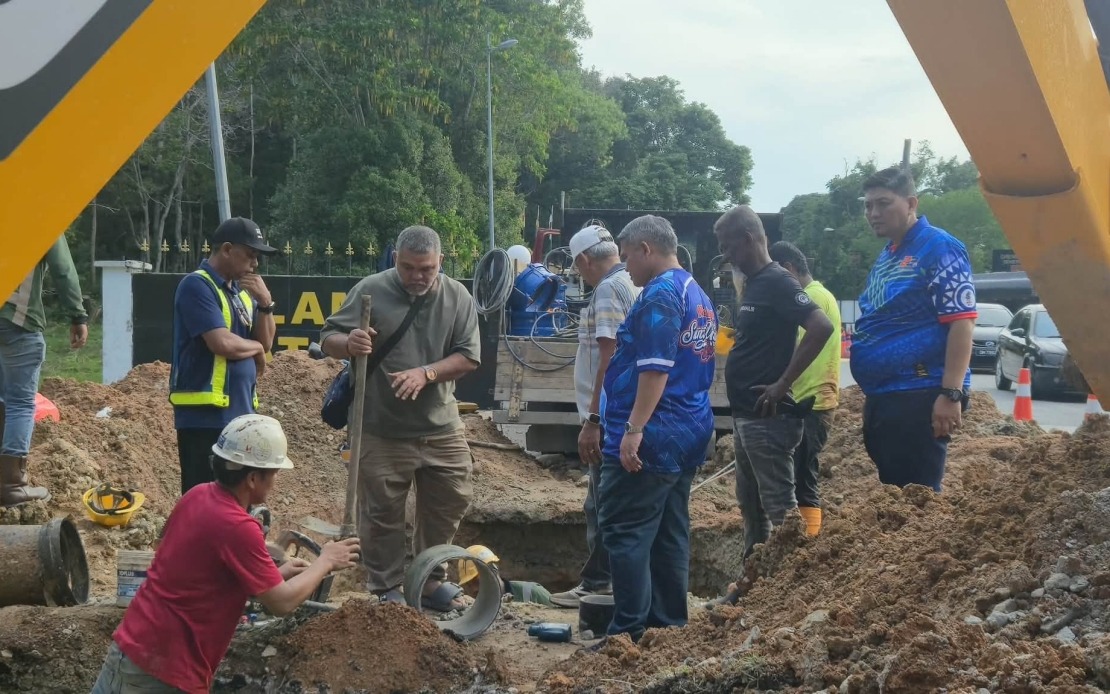
Melaka's government has unveiled plans to install a temporary water tank at Kem Terendak in Sungai Udang as an interim solution to persistent water supply problems plaguing the military camp. The proposal, championed by the state through water utility Syarikat Air Melaka Berhad (SAMB), represents a pragmatic response to disruptions that have left thousands without reliable access to clean water. However, the initiative remains subject to approval from the Ministry of Defence, underscoring the complex jurisdictional arrangements governing infrastructure at military installations across the country.
According to Datuk Rais Yasin, the state exco member responsible for housing and local government matters, the temporary tank serves as a stopgap while authorities await the completion of a comprehensive Development and Upgrade of the Water Reticulation System project at the camp. That major overhaul is not expected to be operational until April 2028, leaving a significant gap during which residents and military personnel will continue to face vulnerability to supply disruptions. Rais, who represents Sungai Udang in the state assembly, acknowledged that while the water infrastructure at the military installation formally falls under the purview of both the Public Works Department and the Ministry of Defence, the state remains committed to alleviating the immediate crisis affecting both civilians and armed forces personnel within the camp's boundaries.
The timing of this proposal comes in the wake of a severe disruption that affected approximately 2,000 military personnel and civilian households, along with five educational institutions including a MARA Junior Science College. The latest crisis stemmed from a significant pipe fracture along Jalan Kampung Payasum in Sungai Udang, a break substantial enough to disrupt supplies across the sprawling camp for five consecutive days. While initial repairs were expected to conclude by evening, complete restoration of normal supply pressures and flow rates would require an additional one to two days, leaving residents without full service for more than a week.
The state's response has centred on emergency water distribution, with SAMB mobilising an extensive fleet of tanker vehicles to deliver much-needed supplies. Since the onset of the crisis, the utility has been transporting 25,000 gallons daily using 25 tanker lorries, a logistics operation that represents substantial mobilisation of resources and personnel. Despite these efforts, officials concede that the volume remains inadequate relative to the needs of the affected population, particularly given that the camp houses military barracks, family quarters, and educational facilities simultaneously.
As an immediate gesture of support, SAMB has handed over two 5,000-litre water tanks directly to Kem Terendak authorities, a symbolic and practical contribution that provides some buffer capacity during emergency periods. The handover ceremony drew participation from Terendak Garrison Headquarters commanding officer Lt Col Annuar Kaliman and SAMB chief executive officer Datuk Mohd Saleh Jusman, signalling high-level engagement with the situation. Additionally, the utility has distributed water containers to schools within the camp to ensure that educational activities can continue without further disruption.
Rais's acknowledgement of the burden placed on residents reflects growing awareness that military camps, while technically under federal jurisdiction, exist within state-governed territories and depend significantly on state-level infrastructure and resources. The proposal to submit a formal request to the Ministry of Defence for the temporary tank installation represents an attempt to navigate this administrative boundary, securing permission before proceeding with construction. The state has also committed to deploying mobile water tankers as a complementary strategy, suggesting a multi-layered approach rather than reliance on a single infrastructure solution.
From a broader policy perspective, this situation highlights longstanding challenges in water security across Malaysia's infrastructure network. Military installations, like many institutional facilities, sometimes operate with aging or inadequately maintained supply networks that become vulnerable during periods of demand stress or aging-related failures. The five-year gap until the major upgrade project comes online suggests that the temporary tank and mobile tanker strategy may need to become a sustained operational model rather than a truly temporary measure.
The incident also underscores the interconnectedness of military, civilian, and educational communities within such camps. With 2,000 residents and five schools affected, the disruption extends well beyond military barracks to encompass family quarters and academic institutions, making water security a matter that transcends purely defence considerations. Schools, in particular, face distinct challenges during supply interruptions given their role in serving the broader camp community.
Looking forward, the success of this proposal depends on coordination between multiple stakeholders—the state government, SAMB, the Ministry of Defence, the Public Works Department, and the Terendak Garrison command. Such multi-agency challenges often move slowly through bureaucratic channels, making it unlikely that formal approval and tank installation will occur with great speed. In the interim, the emergency water distribution operation will likely remain the primary intervention mechanism, even as planners work toward longer-term solutions.

