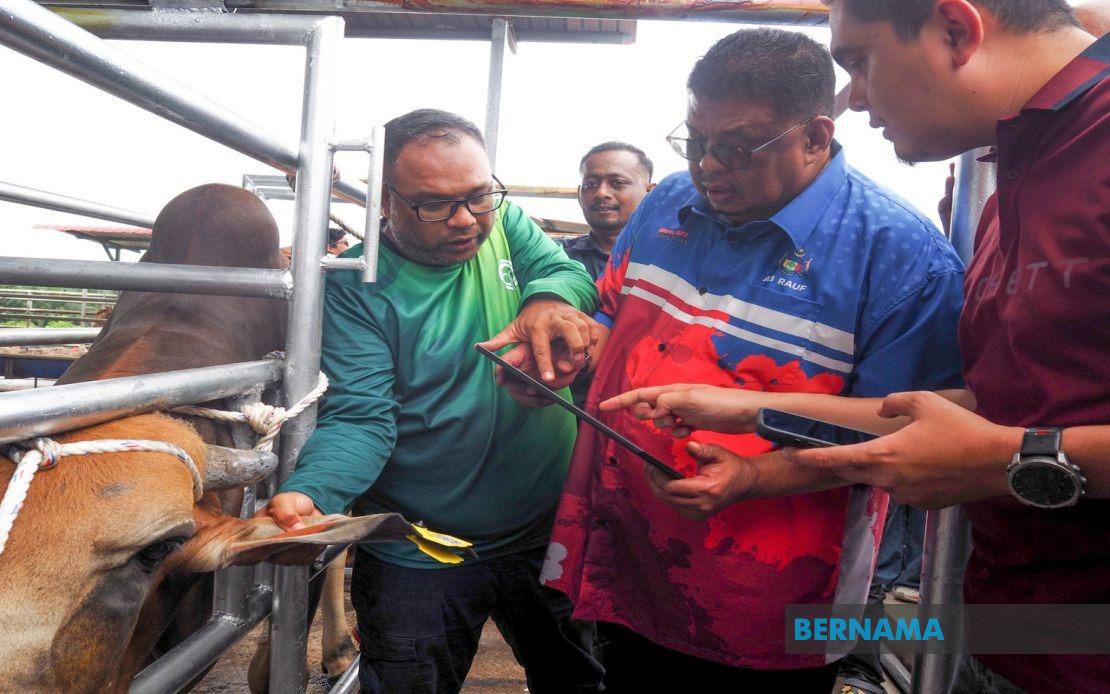
Melaka's state government has rolled out an innovative digital identification scheme for livestock, embedding quick-response codes into physical tags that can be scanned by smartphones to instantly retrieve ownership and farm details. The Livestock QR Tag system represents a significant technological leap in how the state manages its estimated 32,000-plus registered cattle and buffalo, offering authorities a rapid method to trace owners during incidents while simultaneously strengthening the accountability framework for breeders across the state.
The initiative, developed collaboratively between the Melaka Chief Minister's Department and the state's Veterinary Services Department, originated from Chief Minister Datuk Seri Ab Rauf Yusoh's vision to incorporate digital solutions into livestock governance. According to Mahathir Mustafa, chief assistant secretary of the Local Government Unit under the Chief Minister's office, the system aligns with broader state ambitions to transform Melaka into a smart and sustainable community where technology enhances public safety and administrative efficiency. This project sits within the government's wider digitalisation strategy, which seeks to modernise service delivery across multiple sectors simultaneously.
The mechanics of the system are straightforward yet effective. Each livestock fitted with a QR tag receives a unique identification number that serves as a permanent marker throughout the animal's lifetime. By scanning this code using a mobile device, authorities can access critical farming information including the breeder's name, premises identification number, and exact farm location. This instantaneous access to ownership data fundamentally alters how livestock-related incidents are investigated and resolved, eliminating the delays that previously hampered emergency response and enforcement actions.
Progression toward full implementation has been methodical. As of early June 2024, approximately 2,000 animals had already received tags, with the state government planning a phased rollout to encompass the entire registered livestock population. The expansionary timeline reflects both the scale of the undertaking and the importance of ensuring breeders understand and adopt the new system willingly. Early feedback from farming communities has been encouragingly positive, with many breeders recognising the scheme as protective of their interests and potentially beneficial to the livestock industry's public perception.
The urgency driving this initiative stems from deteriorating stray animal situations that have increasingly threatened public safety. Between 2023 and the present, Melaka recorded 835 traffic accidents attributable to livestock and fielded more than 50 formal complaints concerning stray animals. These figures underscore a genuine crisis requiring systematic intervention. Stray cattle and buffalo present multifaceted hazards: they endanger road users through unexpected collisions, destroy private property through trampling and consumption of crops, and create substantial policing and animal welfare challenges for local authorities. The traditional reactive approach of managing incidents after they occur has proven insufficient given the frequency and severity of problems.
Movement monitoring and disease control capabilities embedded within the QR system extend its utility beyond simple identification. State veterinary officials gain unprecedented ability to track livestock movements across premises, a functionality essential for managing infectious disease outbreaks and ensuring epidemiological safety for both animal and human populations. During periods of heightened animal health concerns, this transparency becomes invaluable for containing potential zoonotic threats and coordinating rapid response measures. The system thus serves simultaneous public health and animal welfare objectives.
Ownership transfer provisions have been thoughtfully designed to maintain data accuracy despite the dynamic nature of livestock husbandry. While the physical QR tag remains permanently attached to an individual animal, the digital record can be updated within the eVetPermit Malaysia system whenever livestock change hands. This separation of permanent physical identification from updating ownership records prevents administrative confusion and ensures that enforcement agencies always possess current contact details for responsible parties. Breeders need only update information in the digital platform rather than replacing tags, reducing operational costs and minimising animal stress from repeated handling.
Financial considerations have been structured to encourage rapid adoption during the crucial early implementation phase. The Melaka government is absorbing the complete installation cost of RM6.50 per tag through the end of 2024, providing substantial incentive for breeders to voluntarily register their livestock with the Veterinary Services Department. This subsidisation period effectively removes initial financial barriers that might otherwise delay participation. Beginning in 2027, after the introductory phase concludes, new tag installations and replacements will shift to a breeder-funded model at RM5 per head, establishing a sustainable long-term cost structure while still remaining economically reasonable compared to the value of liability protection and regulatory compliance.
The collaborative framework underpinning the system deserves particular attention, as successful implementation depends critically on seamless coordination between the Chief Minister's Local Government Unit, the Veterinary Services Department, and municipal authorities at ground level. These three institutional layers must function cohesively to register livestock, install tags, update systems, respond to incidents, and enforce regulations. The state government's explicit acknowledgement of this interdependency suggests serious commitment to breaking down administrative silos that might otherwise undermine the initiative. Regular communication channels and shared performance metrics will likely prove essential for maintaining momentum.
For Malaysian and Southeast Asian observers, Melaka's livestock management innovation offers instructive lessons about integrating mobile technology into rural governance. The system demonstrates how QR codes and smartphone accessibility can bridge rural-urban divides in administrative reach, enabling small-scale farmers to participate in standardised identity schemes without requiring extensive technical infrastructure or training. Similar approaches might be adapted for livestock tracking in other Malaysian states or Southeast Asian jurisdictions facing comparable stray animal challenges, particularly in rapidly urbanising regions where agricultural activities persist amid growing residential populations.
The broader implications extend to how governments across the region approach the intersection of traditional farming practices and digital governance. Rather than imposing technology as an external mandate, Melaka has framed the QR tag system as protective of breeder interests and supportive of industry reputation. This messaging has generated voluntary compliance and positive community perception. As other sectors contemplate technological modernisation—from fisheries management to vegetable supply chains—this model of portraying digital systems as solutions benefiting existing practitioners rather than surveillance apparatus may prove transferable and effective.
Moving forward, the system's success will depend on consistent enforcement of breeder compliance, rapid incident response utilising the new identification data, and continuous refinement based on operational experience. The state government's commitment to absorbing costs during 2024 and establishing sustainable fee structures thereafter suggests long-term confidence in the model's viability. Monitoring the system's effectiveness in reducing stray animal incidents and accelerating owner identification will provide empirical evidence about whether technological innovation can meaningfully address this persistent challenge to public safety and community wellbeing in Malaysian agricultural regions.

