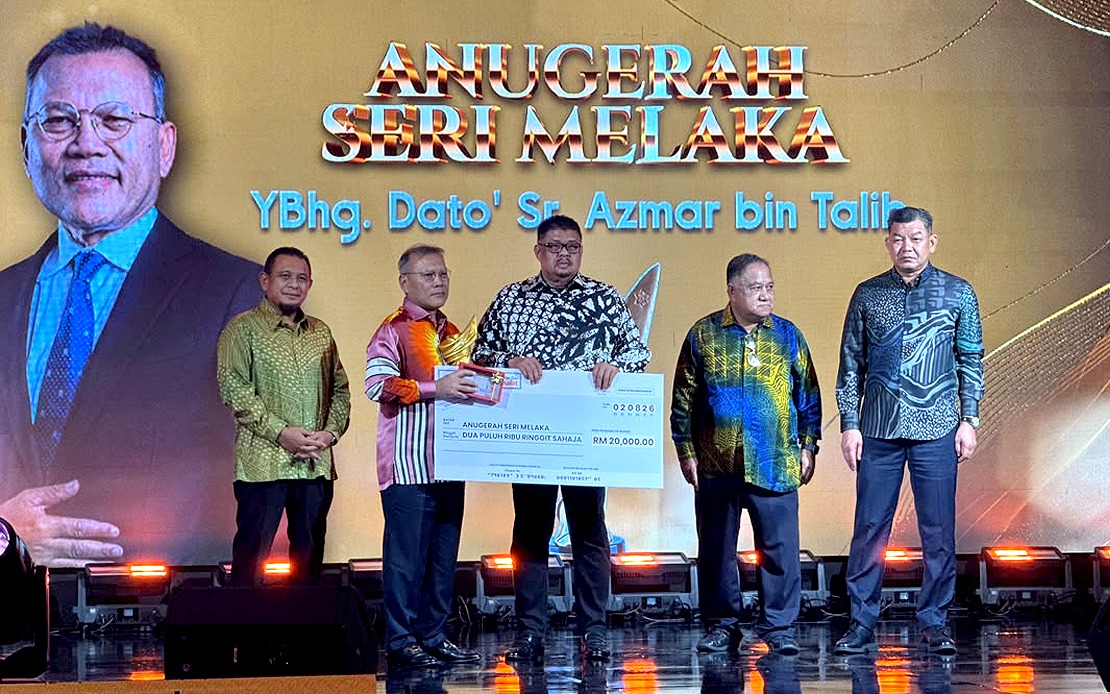
Melaka's Chief Minister Datuk Seri Ab Rauf Yusoh has made an ambitious pitch to the state's most accomplished citizens, urging them to leverage their success as a vehicle for regional advancement. Speaking at the Anugerah Seri Melaka (ASM) awards gala held at the Melaka International Trade Centre in Ayer Keroh, Ab Rauf called for distinguished Melakans to transcend personal achievement and become active agents of opportunity creation for the younger generation. His remarks reflect a deliberate strategy to convert individual excellence into institutional capacity-building, a model gaining traction across Malaysian states seeking to retain and mobilise their talent pools.
The initiative, branded as Melaka Sayang Rakyat (MeSRa), represents the state government's attempt to systematically document and publicise the accomplishments of its native sons and daughters. Rather than allowing success stories to remain isolated personal triumphs, Ab Rauf envisions a collaborative ecosystem where established professionals voluntarily share accumulated knowledge, professional networks, and practical experience with aspiring individuals. This approach recognises a persistent challenge in Malaysian economic development: the tendency for talented individuals to migrate to larger economic centres, depriving smaller states of knowledge transfer and mentorship pathways.
The structural framework of ASM encompasses four distinct categories reflecting diverse sectors of achievement. Public Service, Corporate, Sports, and Arts and Culture tracks were established to cast a sufficiently wide net across Melaka's professional landscape. The response has been substantial, with more than two hundred nominations received, suggesting genuine engagement from both nominating bodies and the broader community. This volume of applications indicates that Melaka harbours considerable talent across multiple disciplines, a resource that remains largely underdeveloped in terms of regional knowledge-sharing infrastructure.
The award recipients announced at the ceremony underscore this diversity. Datuk Azmar Talib, chief executive of TRX City Sdn Bhd, claimed the prestigious Corporate category award, representing the private sector's capacity for wealth and employment generation. Aaron Chia's recognition in Sports acknowledges Melaka's contribution to Malaysia's international sporting representation, particularly in badminton where the state has produced competitive talent. These selections demonstrate intentional curation across economic, social, and cultural domains rather than concentration in any single field.
The Public Service and Arts and Culture categories round out the award structure with equal significance. Datuk Zamri Misman, director-general of the Legal Affairs Division at the Prime Minister's Department, exemplifies successful bureaucratic ascension and governance expertise. Lokman Abd Ghani's selection for directing performing arts recognises cultural contributions that often receive marginal attention in development narratives focused primarily on economic metrics. Dr Saiful Anuar Singar's receipt of the Special Category award for international medical science research highlights Melaka's participation in cutting-edge research and global knowledge production, countering perceptions of the state as primarily commerce-oriented.
Financial incentives attached to the awards reflect governmental commitment to recognising achievement substantively. The overarching ASM award recipient receives RM20,000 in cash alongside a trophy, while individual category winners receive RM10,000 and identical recognition. These sums, whilst not transformative for recipients likely earning substantially more through their primary endeavours, serve symbolic functions: validating achievement through material acknowledgment and signalling state prioritisation of excellence. The trophy mechanism adds ceremonial weight, creating commemorative objects that reinforce identity and belonging to Melaka's distinguished circle.
Ab Rauf's framing of these awards transcends mere celebration, instead positioning excellence as a responsibility. He explicitly articulated his expectation that recipients would reciprocate recognition through active mentorship and knowledge transfer. This contractual understanding, though informal, suggests the state government views the award less as culminating honour and more as activation event—a moment where individual achievement is mobilised toward broader developmental objectives. Such reciprocal frameworks are increasingly common in subnational talent strategies across Southeast Asia as states compete to retain high-performing citizens.
The implicit concern underlying Ab Rauf's remarks concerns brain drain and the structural disadvantage smaller states face in competing for talent retention. Melaka, whilst historically significant and reasonably prosperous, experiences ongoing migration of university graduates and professionals toward Kuala Lumpur and other major commercial hubs. By creating formal recognition mechanisms and explicitly requesting that successful individuals invest time and networks in state development, the government attempts to reconstruct emotional attachment to place and duty toward co-citizens. This strategy acknowledges that economic inducements alone prove insufficient for talent retention.
The documentation mandate within MeSRa represents an underappreciated innovation in Malaysian talent development discourse. By systematically recording the journeys, methodologies, and networks of accomplished individuals, the state creates accessible knowledge repositories that reduce information asymmetries facing aspiring professionals. Young Melakans can examine documented pathways to success within their own state, identifying mentors, understanding sectoral requirements, and recognising that achievement within their home state remains viable. This institutional memory function transforms ephemeral excellence into structural capacity.
Ab Rauf's emphasis on legacy and intergenerational transmission carries particular weight given Malaysia's demographic transitions and emerging concerns about meritocratic equity. By framing individual achievement as responsibility to younger cohorts, he reorients achievement narratives away from purely personal advancement toward stewardship models. This philosophical repositioning may prove more culturally resonant in Malaysian contexts where collective and family obligations remain significant motivators alongside individual aspiration. The articulation thus bridges contemporary economic development imperatives with culturally embedded values concerning mutual responsibility.
The practical implications of this initiative remain partially uncertain. Formalising mentorship relationships between award recipients and emerging talent requires institutional mechanisms beyond annual ceremonies and documentation—mentorship programmes, matchmaking platforms, and dedicated funding for knowledge-transfer activities. Whether the state government has developed complementary infrastructure supporting these aspirations remains unclear from current announcements. If ASM functions primarily as an award ceremony without embedding winners into structured developmental activities, its transformative potential remains constrained.
Regionally, Melaka's approach merits attention from other Malaysian states seeking talent retention strategies aligned with local capacity. The framework avoids expensive inducements or infrastructure megaprojects, instead leveraging existing talent as development catalyst. This scalability makes it potentially applicable across Peninsular Malaysia's smaller states facing persistent talent emigration. Should subsequent cohorts of award recipients demonstrate measurable engagement in mentorship and opportunity creation, ASM could constitute a replicable model for subnational talent strategy throughout Southeast Asia.

