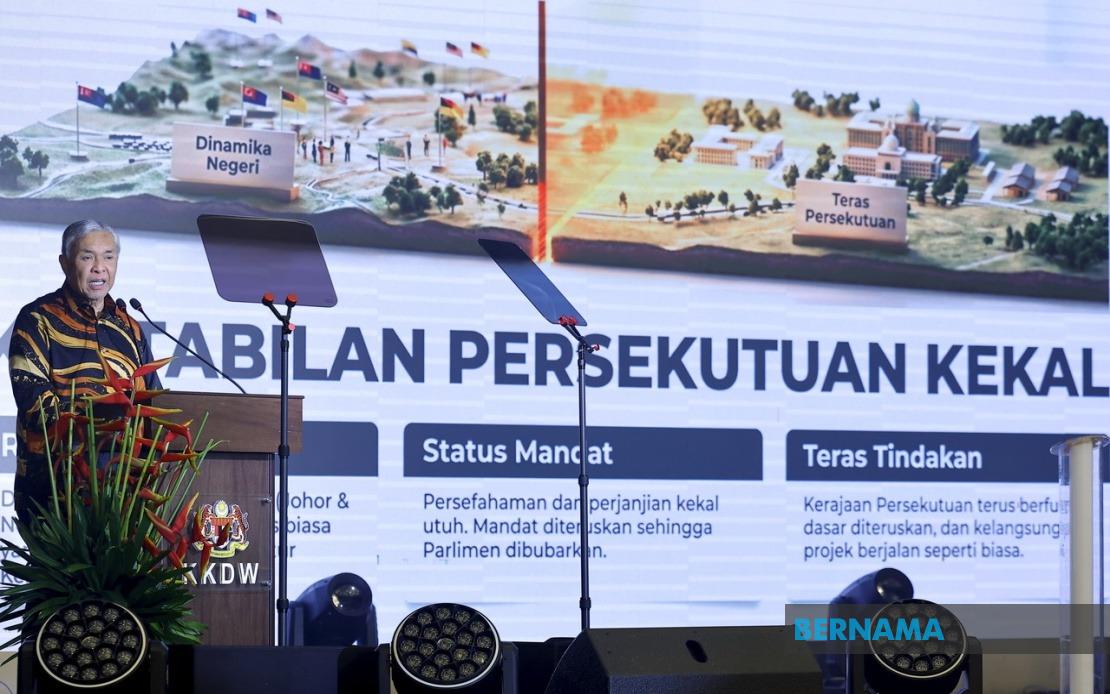
Barisan Nasional's leadership has set its sights on a complete electoral victory in Melaka, aiming to retain every single one of the 21 state assembly seats it presently controls in the looming 16th state election. The coalition's resolve to hold onto its dominant position in the southern state was underscored by BN chairman Datuk Seri Dr Ahmad Zahid Hamidi, who relayed the ambitious target after a meeting of the Rural and Regional Development Ministry in Putrajaya on August 6.
The drive to preserve BN's stronghold in Melaka reflects the coalition's confidence in its grassroots machinery and performance record in the state. State chief minister Datuk Seri Ab Rauf Yusoh, who simultaneously holds the position of Melaka BN chairman, has been instrumental in conveying this objective internally. According to Ahmad Zahid, Ab Rauf has expressed his determination to maintain all 21 seats, signalling that the state leadership views this election as a critical opportunity to vindicate its governance record and consolidate political dominance in the region.
Yet despite this aggressive electoral posture, BN has left the door open to strategic cooperation with other political parties. The coalition's approach suggests a calculated balance between competitive ambition and pragmatic coalition-building. Ahmad Zahid clarified that while the party remains receptive to exploring understandings with potential partners, any formal agreements would be subject to careful deliberation at the coalition's highest echelons. This caveat reveals the complex internal dynamics within BN, where different state chapters may hold different views on collaboration.
The chief minister's publicly stated openness to discussions indicates that Melaka's BN leadership recognises the value of dialogue with other political actors. This willingness to negotiate, if necessary, suggests that while holding all 21 seats remains the preferred outcome, BN is not entirely rigid in its approach. Regional political cooperation in Malaysia's multi-party system often requires such flexibility, particularly when smaller parties command significant electoral influence in specific constituencies.
Central to any eventual compromise would be the approval of BN's central command, which reserves the authority to ratify or reject agreements negotiated at the state level. This hierarchical decision-making structure ensures that the coalition maintains consistency in its broader political strategy across the nation. The central leadership's involvement would likely weigh broader national political considerations against purely local Melaka interests, potentially tempering more adventurous state-level negotiations.
Melaka holds particular significance within Malaysia's political landscape as a compact state where BN has maintained substantial influence for decades. The 21-seat state assembly represents a manageable electoral battlefield compared to larger states, making a complete party victory theoretically feasible if campaign strategy and ground organisation prove effective. A full BN sweep would not only secure the state government's continuation but also provide symbolic affirmation of the coalition's renewed political vitality after recent electoral setbacks elsewhere in the country.
The upcoming 16th state election will serve as an important gauge of voter sentiment in Melaka. The region's economic profile, encompassing heritage tourism, manufacturing, and port-related activities, gives the state distinct characteristics that influence electoral behaviour. Voters in Melaka have demonstrated responsiveness to tangible developmental achievements and effective service delivery, making performance-based governance appeals particularly relevant to the BN campaign narrative.
Setting such an ambitious electoral target carries inherent risks. If BN achieves the complete 21-seat sweep, it would constitute a decisive validation of the state administration's five-year record and a powerful demonstration of renewed coalition cohesion. Conversely, falling short of this target could be portrayed as underperformance, potentially triggering internal recriminations and questions about the coalition's broader electoral prospects. The high-profile nature of Ahmad Zahid's announcement therefore stakes significant political capital on the outcome.
For Malaysian political observers, Melaka's election will function as a crucial bellwether preceding other potential state contests. The state's voting patterns and coalition performance will offer valuable insights into broader voter preferences and the durability of BN's support base. Success in Melaka could energise the coalition's national machinery and provide momentum for forthcoming electoral challenges, while disappointment might necessitate strategic recalibration across the peninsula.
The coalition's position also reflects BN's broader rehabilitation efforts following years of electoral turbulence. Demonstrating resurgent strength in traditionally reliable constituencies like Melaka contributes to the narrative of coalition renewal and reinstatement of stable governance. Regional political actors across Southeast Asia observe Malaysian electoral trends closely, as outcomes often signal shifts in broader democratic patterns and coalition politics across the region.
Moving forward, the specific constituencies within Melaka's 21 seats will become focal points for intensive campaigning. Particular attention will likely concentrate on marginal seats where victory margins proved narrow in previous elections, as these represent the most contested terrain. Both BN and its political opponents will invest substantial resources into these battleground constituencies, making them pivotal to determining whether the coalition achieves its stated objective.

