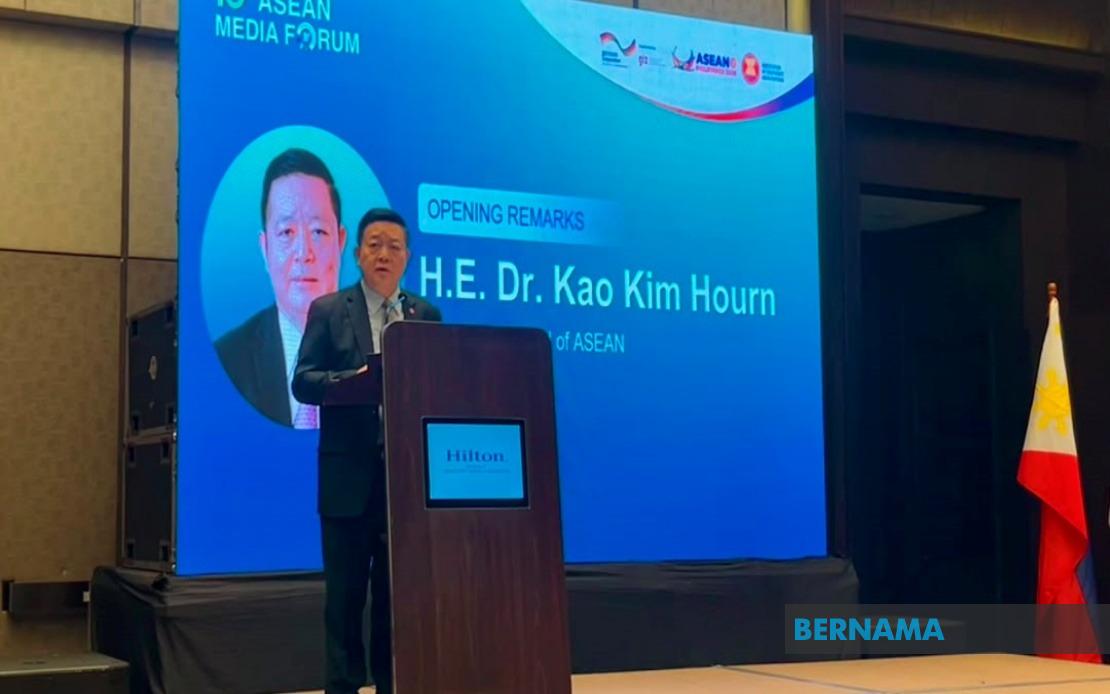
The media landscape faces a transformative moment as ASEAN pursues deeper regional integration, according to ASEAN Secretary-General Dr Kao Kim Hourn, who stressed journalism's indispensable role in connecting citizens across the bloc to the organisation's evolving priorities. Speaking at the 10th ASEAN Media Forum in Manila on Wednesday, Kao argued that press professionals and editors represent far more than chroniclers of regional developments—they are essential partners in constructing a cohesive Southeast Asian identity capable of navigating twenty-first century challenges. With the ASEAN Community Vision 2045 framework now guiding the association's trajectory, the media's capacity to translate complex policy decisions into narratives that resonate with ordinary citizens becomes crucial to securing public buy-in for regional initiatives.
The communications environment has undergone radical upheaval in the past decade, Kao observed, with digital platforms, social media ecosystems and generative artificial intelligence fundamentally reconfiguring the pathways through which news and information circulate. These technological shifts have democratised content creation and expanded access to information across geographical boundaries. Simultaneously, however, they have created conditions favouring the rapid spread of misinformation, disinformation, miscommunication and algorithmically-amplified false narratives that can distort public understanding across borders. The challenge is particularly acute for a regionalism project like ASEAN, which requires sustained mutual understanding and shared commitment across ten diverse nations with distinct linguistic, cultural and political contexts.
Genative AI technologies present both substantial opportunities and genuine risks for news production and distribution across the region. These systems enable newsrooms to enhance operational efficiency, expand real-time multilingual coverage capacity and reach audiences through previously inaccessible channels. Simultaneously, they introduce novel complications surrounding editorial accountability, content authenticity, intellectual property protections and the prospect of deepfakes—manipulated synthetic media that can erode public confidence in visual and audio evidence. The proliferation of sophisticated fake content, Kao cautioned, elevates the stakes considerably. Once public trust deteriorates, rebuilding credibility demands extraordinary effort, rendering journalistic integrity one of the profession's most valuable yet fragile commodities in an age of automated content generation.
In this context, professional journalism anchored in rigorous verification protocols, contextual understanding and transparent ethical frameworks becomes non-negotiable. The ASEAN Secretary-General argues that editorial standards grounded in these principles represent a bulwark against information chaos. Newsrooms must invest consciously in fact-checking infrastructure, source authentication and explanatory reporting that helps audiences navigate competing claims and understand underlying policy rationales. For ASEAN's regional project to succeed, journalists must serve as cultural bridges who translate technocratic decisions into human terms and connect Brussels-style institutional frameworks to the lived experiences of farmers in the Mekong Delta, small business owners in Jakarta and workers across Malaysian manufacturing sectors.
The Philippines' representation as current ASEAN Chair emphasises this expansive vision of journalism's contribution to regional development. Undersecretary for Foreign Affairs Leo M. Herrera-Lim positioned media engagement as integral to all three pillars of the Community Vision 2045—the Political-Security, Economic and Socio-Cultural dimensions. From this perspective, responsible journalism operates across security architecture discussions, trade facilitation initiatives and cultural exchange programmes with equal importance. The underlying principle, Herrera-Lim stressed, is straightforward yet profound: an ASEAN that communicates with the same deliberation it brings to decision-making. This formulation reframes journalism from a peripheral observer function into a central institutional role, suggesting that regional cohesion ultimately depends upon how effectively information flows through media channels.
Geopolitical complexity in Southeast Asia has intensified dramatically, with global powers competing for influence, maritime disputes generating friction between member states, and transnational challenges from climate change to pandemics demanding coordinated responses. Against this backdrop, the demand for credible, contextually-grounded journalism has become genuinely consequential rather than merely aspirational. Philippine policymakers regard media professionalism as directly contributing to regional stability and prosperity. When journalists provide rigorous analysis of trade negotiations, explain security cooperation frameworks in accessible language and interrogate environmental policies with appropriate scepticism, they strengthen the informational foundations upon which democratic societies can evaluate their governments' regional commitments.
The 10th ASEAN Media Forum itself represents an institutional recognition of journalism's centrality to regional governance. Originally convened in Manila during August 2017 to commemorate ASEAN's fiftieth anniversary, the forum has evolved into a permanent regional platform where journalists, editorial leadership and government officials gather to exchange expertise, coordinate collaborative approaches and deepen mutual understanding. The gathering provides structured space to examine ASEAN's successes and shortcomings alongside broader regional and international developments, creating opportunities for journalists to sharpen their analytical frameworks while policymakers gain insight into how their decisions register in public discourse.
The forum's format—bringing together practitioners from multiple countries and sectors—addresses a longstanding structural challenge within Southeast Asian journalism: the relative isolation of individual news organisations and the limited infrastructure for cross-border professional collaboration. By creating regular opportunities for reporters, editors and media executives to interact directly with ASEAN officials and with counterparts from other countries, the forum builds professional relationships and shared professional norms that transcend national boundaries. These personal connections often translate into improved quality of regional coverage as journalists develop deeper contacts, enhanced contextual understanding and greater appreciation for complexities within neighbouring countries.
Organisational support from the ASEAN Secretariat and financial backing from the German government through GIZ underscore international recognition that Southeast Asian regional integration depends partly upon journalistic capacity. Germany's institutional investment reflects understanding that democratic societies require informed citizens capable of evaluating their governments' regional policies, and that such citizenship depends upon quality journalism. This external support also signals to governments within the region that journalism strengthening is not merely parochial professional interest but an element of regional stability and prosperity that justifies resource commitment.
For Malaysian media practitioners and policymakers, the forum's emphasis on journalistic standards and regional engagement carries particular relevance. Malaysia's sophisticated media landscape and prominent regional role position the country as a potential centre of excellence for ASEAN journalism collaboration. Malaysian journalists and editors have comparative advantages in multilingual capacity, commercial media experience and access to both resource-rich domestic markets and the broader ASEAN ecosystem. By strengthening professional standards and cross-border collaboration through forums like the AMF, Malaysia can amplify its constructive influence on regional narrative formation while ensuring that Southeast Asian integration benefits from genuinely rigorous public communication.
The underlying argument advanced by ASEAN leadership—that journalism represents an essential rather than peripheral element of successful regionalism—constitutes an important assertion in our contemporary moment. As populist movements across Southeast Asia sometimes frame international engagement as threatening to national sovereignty or cultural integrity, journalists equipped with analytical rigour and commitment to verification can help communities understand both genuine benefits and legitimate concerns surrounding regional integration. This is not about propaganda or persuasion toward predetermined conclusions; rather, it concerns ensuring that public deliberation about ASEAN's future occurs on the basis of accurate information, contextual understanding and good-faith engagement with competing perspectives. From this standpoint, investing in journalism quality, protecting editorial independence and strengthening professional networks across ASEAN becomes an investment in the region's democratic health and long-term viability.

