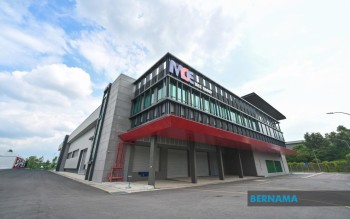
MCE Holdings Bhd has officially opened the MCE Auto Hub, a RM50 million state-of-the-art manufacturing facility in UMW High Value Manufacturing Park, Serendah, signalling significant confidence in Malaysia's automotive sector and the company's expansion ambitions. The facility, which spans 5.52 hectares, was inaugurated by Investment, Trade and Industry Minister Datuk Seri Johari Abdul Ghani, underscoring the government's backing for domestic automotive electronics capabilities.
The launch represents the opening salvo of MCE's aggressive expansion strategy, with the company committing up to RM200 million in total investment as part of its long-term growth roadmap. This phased approach allows the company to scale its operations methodically while maintaining manufacturing excellence and quality standards across its growing product portfolio. The facility's establishment is particularly timely given Malaysia's push to develop a more robust local supply chain for next-generation mobility solutions, including electric vehicle components and advanced automotive electronics.
MCE has established itself as a serious player in Malaysia's automotive supply ecosystem over more than three decades. The company began in 1990 with a modest contract to supply remote alarms and central locking systems to the domestic market, but has since evolved into a comprehensive tier-1 automotive electronics supplier offering both original equipment manufacturing and original design manufacturing capabilities. This trajectory demonstrates the potential for Malaysian companies to compete in sophisticated manufacturing domains when they invest continuously in technology, talent, and process improvement.
The MCE Auto Hub's design reflects contemporary manufacturing philosophy, incorporating Industry 4.0 principles throughout its operations. Clean room production areas and tightly controlled manufacturing environments enable the facility to handle increasingly complex automotive electronics destined for both internal combustion engine vehicles and electric vehicles. This dual-track capability is strategically important as the global automotive industry undergoes its energy transition, requiring suppliers to maintain competence across traditional and emerging technologies simultaneously.
With the hub now operational, MCE's workforce has expanded to 680 employees, including 90 engineers distributed across facilities in Johor Bahru, Port Klang, and Serendah. This concentration of engineering talent strengthens the company's capacity to manage a diversifying portfolio of programmes spanning both ICE and EV segments, enabling more sophisticated product development and faster time-to-market for innovations. The engineering depth also positions MCE to serve as a knowledge hub for the broader Malaysian automotive supply chain, particularly smaller companies seeking to upgrade their technological capabilities.
Minister Johari's participation in the launch underscores government recognition that Malaysia's automotive competitiveness depends on fostering tier-1 suppliers capable of delivering sophisticated electronics and mechatronic solutions. In an increasingly contested global market where manufacturing excellence and technological innovation are prerequisites for survival, companies like MCE provide concrete evidence that Malaysian enterprises can achieve world-class standards. The minister's remarks emphasised the need for local suppliers to pursue continuous improvement in engineering expertise, innovation, and technology adoption—themes that resonate across Southeast Asia's manufacturing sectors.
MCE group managing director Dr Goh Kar Chun articulated an ambitious vision for Malaysia's role in automotive electronics, arguing that the country possesses sufficient engineering talent, manufacturing capabilities, and industrial infrastructure to compete internationally. The company now serves customers across Malaysia, ASEAN, and the United States, supplying increasingly sophisticated solutions that demonstrate Malaysian capability extends beyond simple assembly or component supply into higher-value design and development work. This evolution from traditional automotive components to advanced electronics and mechatronic systems reflects a maturation of the local supply base.
The facility's emphasis on supporting greater localisation within Malaysia's automotive industry carries broader implications for economic development. By strengthening local suppliers' capacity to design and manufacture advanced components domestically, Malaysia reduces its dependence on imports while creating opportunities for smaller technology companies, semiconductor firms, and electrical and electronics manufacturers to participate in automotive value chains. This ecosystem approach to industrial development amplifies the impact of flagship investments like the MCE Auto Hub.
Dr Goh stressed that MCE's future strategy depends on fostering collaboration among carmakers, tier-1 suppliers, and ecosystem players including semiconductor and electronics companies. This collaborative framework is essential for developing Malaysian-originated technologies that can be integrated into automotive applications and global supply chains. Such partnerships are particularly valuable during periods of technological transition, when the collective knowledge of multiple organisations accelerates the pace of innovation and reduces individual company risk.
The MCE Auto Hub's establishment also strengthens Malaysia's positioning as a regional hub for automotive electronics manufacturing and design. Southeast Asian nations are increasingly competing to attract high-value manufacturing activities, and facilities like this one demonstrate that Malaysia possesses the institutional infrastructure, skilled workforce, and technological capabilities to support sophisticated production and development work. This regional positioning generates downstream benefits through technology spillovers, talent development, and ecosystem strengthening that extend beyond any single company's operations.
Looking forward, the success of MCE's expansion will depend on several factors including the company's ability to recruit and retain skilled engineers in a competitive regional market, its capacity to maintain quality standards as production volumes increase, and its willingness to continue investing in R&D to remain ahead of technological curves in both traditional and emerging vehicle technologies. The RM200 million investment commitment suggests management confidence in these elements, but sustained success will require continuous attention to talent development, innovation pipelines, and customer relationship management.
The MCE Auto Hub launch arrives at a pivotal moment for Malaysia's manufacturing sector. As global automotive companies grapple with electrification, autonomous systems, and supply chain resilience, demand for capable local suppliers is rising. Companies demonstrating manufacturing excellence and technological sophistication like MCE can expect to compete successfully for expanded roles in regional and global supply chains. The facility represents not merely a single company's expansion, but evidence that Malaysian enterprises can maintain competitive relevance in advanced manufacturing despite global headwinds and supply chain disruptions.

