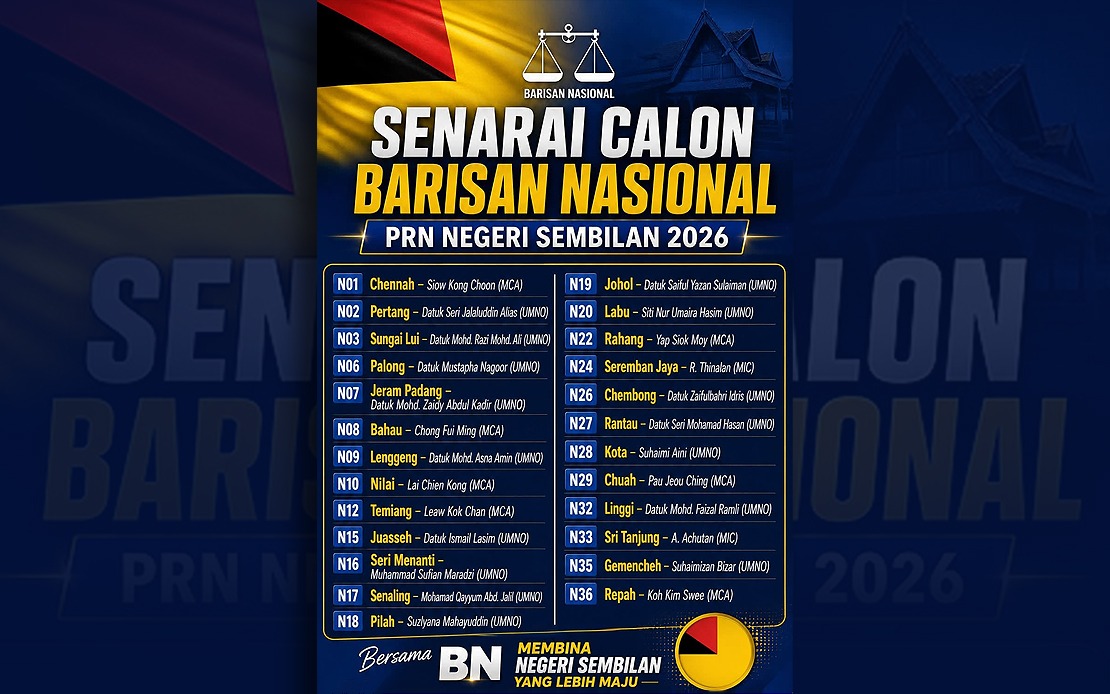
The Barisan Nasional coalition has finalised its seat allocation for the 16th Negeri Sembilan state election, assigning seven State Legislative Assembly seats to MCA and four to MIC, announced BN chairman Datuk Seri Dr Ahmad Zahid Hamidi in Seremban on July 15. The distribution reflects BN's strategic positioning ahead of polling day on August 1, with the coalition attempting to consolidate its presence across the state's legislative districts through its component party representatives.
Ahmad Zahid, who simultaneously serves as Deputy Prime Minister, explained that the seat-sharing arrangement emerged from a careful assessment of each candidate's electoral prospects within their designated constituencies. The methodology prioritises the likelihood of victory rather than equal representation, acknowledging that certain areas favour particular party candidates based on demographic composition, historical voting patterns, and grassroots support networks. This pragmatic approach has become standard practice within BN's internal negotiations across state-level and national elections.
The BN chairman held substantive discussions with prospective candidates at Wisma UMNO Negeri Sembilan, during which participants formalised their commitment to the coalition through signed undertakings and personal pledges of allegiance. Such ceremonies underline the formal obligations candidates assume when representing BN in public contests, establishing clear lines of accountability between party leadership and electoral representatives. Ahmad Zahid characterised this protocol as routine procedure, employed consistently during state elections, by-elections, and general elections to maintain party discipline and candidate alignment.
The formal announcement of BN's complete candidate slate will occur later that evening at Stadium Tuanku Abdul Rahman Paroi, culminating a day of internal party deliberations. This public presentation marks the transition from backroom negotiations to open campaigning, when coalition parties commence their organised electoral activities across constituencies. The timing places BN's announcement within the official election calendar established by the Election Commission.
Election authorities have structured the campaign timeline precisely, designating July 18 as nomination day when candidates officially register their candidatures. Early voting will take place on July 28, enabling citizens with scheduling constraints to participate in the democratic process prior to the main polling date. This compressed schedule compresses the campaign period significantly, demanding that parties mobilise resources and messaging strategies rapidly to maximise voter engagement.
Negeri Sembilan's electoral landscape has shifted considerably since the 15th state election held previously. The outgoing assembly comprised 14 BN seats, 17 Pakatan Harapan seats, and five Perikatan Nasional seats, demonstrating that the opposition coalition holds a substantial majority. This composition reflects broader patterns visible across Malaysian state governments following the 2022 general election, where Pakatan Harapan expanded its foothold beyond peninsula strongholds. BN's task in the upcoming contest involves reversing setbacks in specific constituencies whilst defending existing strongholds.
For MCA specifically, contesting seven seats represents a meaningful presence within BN's contingent, acknowledging the party's continued importance to the coalition despite declining overall electoral significance compared to historical periods. The party's performance in Chinese-majority and mixed constituencies directly influences BN's aggregate results. MIC's allocation of four seats reflects the Indian-origin community's demographic concentration in specific electoral districts, where the party traditionally commands substantial support among voters identifying with its communal platform and development agenda.
The seat-distribution methodology carries implications extending beyond immediate electoral arithmetic. By prioritising viability assessments, BN leadership navigates the delicate balance required to maintain coalition cohesion whilst allocating slots that maximise aggregate vote-winning potential. This approach potentially satisfies component parties that their representation correlates with realistic electoral prospects rather than artificial equality, though it simultaneously creates pressure on underrepresented partners seeking expanded allocations. The tension between equitable burden-sharing and strategic optimisation will likely resurface in post-election analysis regardless of outcomes achieved.
Negeri Sembilan occupies strategic significance within peninsular Malaysian politics, serving as a bellwether state reflecting broader voter sentiments regarding national governance. The state's diverse economic base spanning mining heritage, agriculture, and light manufacturing creates a cross-sectional electorate. Urban centres like Seremban exhibit modernising preferences, whilst rural constituencies maintain more traditional voting patterns. BN's performance in this intermediate terrain consequently influences interpretations of national political trajectories and coalition prospects approaching potential future general elections.
The coalition's preparation process demonstrates the structured choreography underlying competitive electoral democracy in Malaysia. Although nominally routine, these internal negotiations involve substantive power-balancing between parties possessing divergent interests, regional strongholds, and demographic constituencies. Ahmad Zahid's stewardship of these dynamics as BN chairman positions him centrally within contemporary Malay-Muslim electoral politics, particularly given his concurrent role as Deputy Prime Minister, which intertwines party management with government apparatus. The Negeri Sembilan election consequently functions as a test case for BN's organisational capacity and voter appeal under current national administration.
Looking forward, the August 1 polling represents an inflection point within Malaysian subnational politics. Victory would reinvigorate BN confidence following extended opposition dominance, whilst defeat would amplify questioning regarding the coalition's electoral viability and policy relevance. Either outcome will reverberate through subsequent political calculations affecting potential federal elections, state-level coalition adjustments, and component party positioning within the broader BN framework. The campaign period separating announcement from voting day will reveal whether the seat allocation formula translates into corresponding electoral dividends for the coalition.

