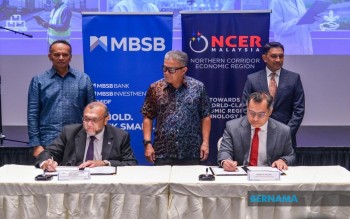
Malaysia's financial sector has moved to strengthen support mechanisms for small and medium enterprises operating in the country's northern tier, with MBSB Bank Bhd and the Northern Corridor Implementation Authority signing a memorandum of understanding in Petaling Jaya on July 17 to mobilise up to RM1 billion in dedicated financing. The partnership represents a targeted effort to catalyse business expansion and economic activity across the four-state Northern Corridor Economic Region, which encompasses Perlis, Kedah, Penang and Perak.
According to MBSB Bank chairman Datuk Wan Kamaruzaman Wan Ahmad, the agreement creates a structured pathway for enterprises to access capital at a critical juncture for regional development. He emphasised that access to affordable financing remains a persistent constraint for many growth-focused businesses, particularly those seeking to scale operations or integrate into regional and global value chains. The RM1 billion facility is specifically designed to address this gap by offering SMEs the working capital and investment funds necessary to expand production capacity, secure positions within major supply networks, and contribute meaningfully to the region's longer-term prosperity.
The initiative takes on particular significance given the Northern Corridor's established trajectory as one of Malaysia's most dynamic economic zones. Over the past decade, the region has attracted substantial investment flows into electrical and electronics manufacturing, advanced industrial production, logistics infrastructure, agri-food processing, digital services and renewable energy projects. This concentration of high-value activity creates both opportunities and competitive pressures for smaller enterprises seeking market access and operational scale. MBSB Bank's financing scheme effectively positions the bank as a key enabler of regional participation, lowering capital barriers that would otherwise constrain local SME participation in these expanding sectors.
The formal signing was conducted by MBSB Bank group chief commercial banking officer Noor Mohamed Amin and Northern Corridor Implementation Authority chief operating officer Hasri A Hassan, underscoring the institutional commitment from both organisations. Such ceremonial endorsement signals to market participants that the financing facility carries serious backing and institutional weight, likely to encourage application volumes and participation among eligible businesses. The involvement of senior operational leadership suggests that implementation frameworks are already under development.
MBSB Bank group chief executive officer Rafe Haneef outlined the bank's strategic positioning within this arrangement, noting that the institution intends to prioritise export-oriented enterprises capable of competing in international markets. This orientation reflects broader Malaysian policy objectives centred on boosting manufacturing exports and developing global supply chain competitiveness. By selectively targeting companies with export potential, the partnership creates incentives for businesses to pursue higher-margin international markets rather than remaining confined to domestic consumer bases, thereby multiplying the economic impact of each ringgit deployed.
The bank has also secured alignment with Santander Group, a major European banking institution, to establish cross-border financing and trade facilitation platforms. This international linkage amplifies the value proposition available to participating SMEs, as they gain access not merely to Malaysian capital but to established networks for identifying export opportunities, managing currency exposure, and securing trade finance across European and broader global markets. For Malaysian companies seeking to diversify geographic revenue streams, such institutional connections represent material competitive advantages that would be difficult to replicate independently.
Northern Corridor Implementation Authority chief executive Datuk Mohamad Haris Kader Sultan contextualised the partnership within Malaysia's broader development framework, positioning it as a cornerstone initiative under the 13th Malaysia Plan. This national planning context is important for understanding how the arrangement fits within overarching government economic strategy. The NCER itself operates as a designated economic zone with dedicated governance structures and development incentives, and anchoring SME financing initiatives within this framework ensures alignment across state governments, federal agencies and private sector participants.
The authority identified six strategic growth pillars targeted by the financing arrangement: electrical and electronics manufacturing, advanced production methodologies, integrated agri-food value chains, modern logistics infrastructure, digital economy services and green technology development. These sectors collectively represent Malaysia's emerging competitive advantages and areas where the country possesses growing technical expertise and market positioning. By channelling capital specifically toward enterprises operating within these domains, the partnership creates concentrated investment effects that reinforce sectoral clustering and knowledge spillovers.
The Northern Corridor Implementation Authority itself functions as a statutory development agency tasked with comprehensive economic planning and catalysing private investment across the four northern states. As a formal government entity with mandate and resources dedicated to regional development, NCIA brings administrative capacity and policy coordination capabilities that complement MBSB Bank's financial intermediation function. This institutional pairing combines private sector efficiency in capital allocation with public sector coordination of broader enabling conditions including infrastructure, regulatory environments and skills development.
The Northern Corridor's established record as one of Malaysia's fastest-expanding regional economies provides a compelling foundation for this financing initiative. The region has consistently demonstrated capacity to attract both domestic and foreign capital into capital-intensive manufacturing and infrastructure projects, indicating underlying structural competitiveness and investor confidence. Yet regional growth has tended to concentrate among larger established enterprises with existing capital bases and banking relationships. The new SME financing facility explicitly targets the gap between these large-scale anchors and smaller businesses, potentially enabling a more inclusive growth model that distributes economic opportunity across broader business communities.
For Malaysian policymakers, this arrangement exemplifies a strategic approach to regional economic development that leverages private financial intermediaries as implementation partners rather than relying solely on government budgets or development banks. MBSB Bank brings sophisticated credit assessment capabilities, risk management expertise and operating efficiency that specialised development institutions may lack, while NCIA contributes sectoral expertise, market intelligence and regulatory coordination. The partnership model also provides a template that could potentially be adapted across other Malaysian regional development corridors or sectoral priorities, multiplying the policy leverage available to development authorities.
The implications for SME operators across the northern states are tangible and substantial. Businesses meeting the eligibility criteria can access capital on terms specifically calibrated to regional development priorities, potentially on more favourable terms than standard commercial banking would offer. The explicit targeting of export-oriented enterprises creates incentives for growth-minded proprietors to pursue international markets, while connection to Santander Group's international networks offers practical pathways to executing export strategies. For Malaysian enterprises seeking to integrate more deeply into global value chains, particularly in high-technology manufacturing and services sectors, the initiative provides essential financial infrastructure previously concentrated in more developed regions.

