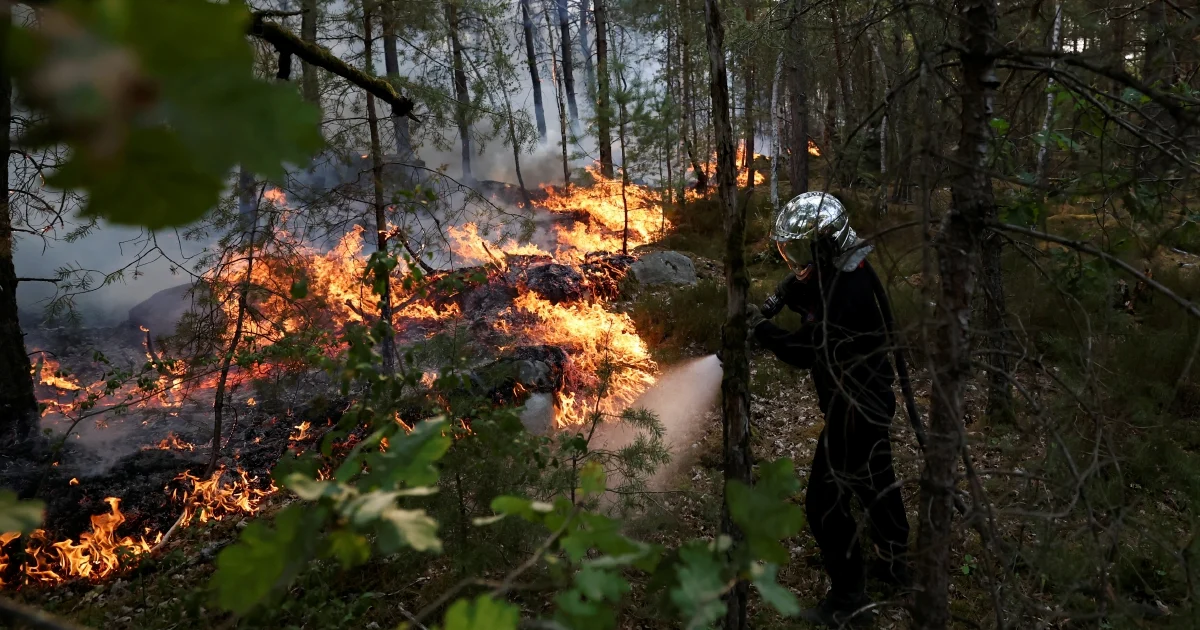
Firefighting crews across France confronted a dual crisis on Monday as two separate wildfires tore through a significant expanse of forest in Arbonne-la-Forêt, a region located south of the capital. The combined blazes consumed over 1,300 hectares, marking a substantial loss of what officials described as ecologically precious woodland. The scale of destruction has intensified focus on forest preservation in a nation increasingly vulnerable to extreme fire seasons, particularly as climate patterns shift across Europe and Mediterranean regions experience prolonged heat waves.
The timing of the incident underscores the vulnerability of France's forested areas during summer months. Historic forests such as those near Paris face mounting pressure from rising temperatures and drier conditions that create ideal circumstances for rapid fire spread. Environmental scientists have documented how shifting weather patterns have extended fire seasons across the continent, allowing blazes that once occurred sporadically to now emerge with troubling regularity. The 1,300-hectare loss represents not merely an environmental setback but also a challenge to biodiversity and carbon storage in a landscape shaped by centuries of human activity and natural evolution.
Police investigations revealed a criminal element to the disaster. Authorities arrested two individuals suspected of deliberately igniting at least one of the fires, transforming what might have been an accidental emergency into an intentional act of destruction. The decision to pursue arson charges signals that investigators found evidence linking the suspects to the fire's origins. Such incidents of deliberately set wildfires have become a growing concern across Mediterranean Europe, where forensic teams now routinely examine burn sites for signs of human involvement. The arrests illustrate how environmental crimes can have cascading consequences that extend far beyond the immediate financial cost of suppression efforts.
The response to the dual fire emergency mobilised significant resources from regional and national authorities. Firefighting teams deployed across the affected zone in Arbonne-la-Forêt, working under conditions that often prove hazardous due to extreme heat, poor visibility, and unpredictable fire behaviour. Such operations demand coordination between municipal services, regional departments, and national agencies, testing the infrastructure France has developed for crisis management. The intensity of the effort reflects both the serious threat posed by uncontrolled flames in densely vegetated areas and the imperative to prevent fires from spreading toward populated zones or critical infrastructure.
For Southeast Asian observers, particularly those in Malaysia, the incident offers instructive parallels. Malaysia faces its own seasonal fire challenges, particularly during the dry season when peatland and forest fires can spread rapidly, generating transboundary haze that affects multiple countries. The French experience demonstrates how forest fires represent not merely local environmental concerns but issues requiring sophisticated interagency coordination and, increasingly, investigation into deliberately set blazes. The Malaysian context shares certain similarities: both regions contain forests of ecological significance, both experience periods of heightened fire risk, and both have grappled with fires deliberately set for land-clearing purposes.
The environmental implications extend beyond immediate habitat destruction. Historic forests accumulate carbon sequestration value over centuries; their destruction releases stored carbon into the atmosphere while eliminating future carbon absorption capacity. For a continent committed to climate targets, such losses compound the challenge of achieving net-zero emissions. The forest near Paris likely contained established ecosystems supporting diverse wildlife and plant species, many of which cannot quickly recolonise burned areas. Restoration efforts, when undertaken, require decades to restore ecological function comparable to mature forest systems.
The economic dimensions warrant consideration beyond environmental metrics. France's tourism industry depends partly on the preservation of its natural landscapes, particularly in regions accessible to Paris. Forest degradation affects recreational access, water quality in surrounding areas, and the aesthetic appeal that draws visitors to particular regions. Insurance costs, firefighting expenses, and potential agricultural losses in surrounding zones compound the immediate damage. The 1,300-hectare destruction represents not merely environmental loss but also economic disruption across multiple sectors dependent on a stable natural environment.
The arson arrests point toward an emerging enforcement challenge across Europe. Deliberately set fires demand investigation capabilities that many regions are only beginning to develop systematically. France's capacity to identify and prosecute fire-setting suspects reflects institutional experience and resources not universally available. In developing regions and smaller nations, deliberately set fires often go unprosecuted, either due to investigative limitations or insufficient legal frameworks. The French response thus establishes a standard toward which other jurisdictions might aspire in treating environmental crime with appropriate seriousness.
Looking forward, the incident raises questions about fire prevention infrastructure and early detection systems. Modern Europe increasingly employs satellite monitoring, drone surveillance, and ground-based sensor networks to detect fires at early stages before they expand beyond control. The question of whether such systems operated effectively in this instance remains relevant to understanding whether prevention gaps contributed to the scale of destruction. Similarly, forest management practices—including controlled burns, vegetation clearing, and strategic access routes for emergency response—influence how quickly fires can be contained once detected.
The broader European context includes evolving climate patterns that threaten to make such incidents more common rather than exceptional. Projections from climate research institutions suggest that Southern Europe and regions at the Mediterranean fringe will experience intensified fire seasons. France's northern forests have historically been somewhat protected from the most severe Mediterranean fire dynamics, yet this incident suggests that protection may be eroding. For Malaysia and Southeast Asia, such developments in distant regions provide cautionary evidence of how environmental pressures mount as global temperatures rise, emphasising the necessity for robust preparation and prevention strategies before crises emerge.

