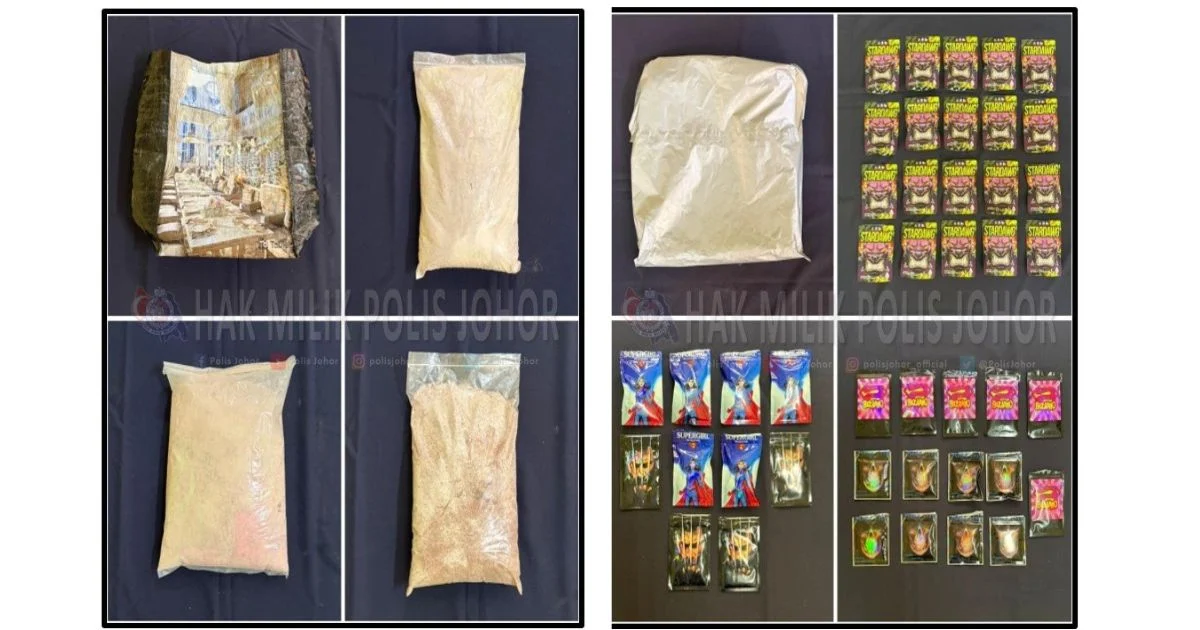
Johor police have successfully dismantled a drug distribution network operating in Kulai, culminating in the arrest of a married couple and the seizure of controlled substances valued at approximately RM3.59 million. The operation represents a significant intervention by state authorities against organised narcotics trafficking, which continues to pose a substantial public health and security threat across the southern corridor.
The apprehension of the couple during a coordinated police operation highlights the evolving patterns of drug distribution in Johor, where family-based networks have become increasingly common among mid-to-high-level traffickers. Intelligence-driven policing operations have proven effective in identifying and disrupting such domestic supply chains, which often operate through residential properties and private distribution channels, making them harder for authorities to detect than traditional street-level dealing.
The RM3.59 million valuation of the seized narcotics reflects both the quantity of drugs recovered and their estimated street value once distributed throughout regional markets. Such large seizures typically comprise multiple substance types, ranging from methamphetamine and heroin to synthetic drugs and cannabis-derived products. The composition of seized drugs provides investigators with valuable intelligence about trafficking routes, supplier networks, and consumer demand patterns within Johor and neighbouring states.
Kulai's prominence in this drug bust underscores its strategic position within Johor's geography. Located midway between Johor Baru and Kluang, Kulai serves as a critical transit point along major highways and rail corridors, making it attractive to trafficking networks seeking to distribute substances across Peninsular Malaysia and potentially into Singapore and Brunei. The district's industrial and residential mix creates operational opportunities for criminals operating clandestine labs and storage facilities.
The involvement of a married couple suggests a pattern increasingly observed by narcotics enforcement units throughout Malaysia, where intimate partners collaborate in drug operations to increase operational security and exploit familial trust networks for distribution purposes. Such arrangements complicate investigation and prosecution, as evidence collection must establish individual roles within the conspiracy while addressing the personal dynamics influencing their participation in criminal activity.
This operation underscores ongoing resource commitments by Johor's police contingent to combat narcotics trafficking. Successful operations depend upon sustained intelligence gathering, community reporting, and inter-agency coordination between federal and state law enforcement bodies. The Federal Narcotics Bureau often collaborates with state police in major cases involving large quantities of controlled substances, particularly when international trafficking networks are suspected.
The seizure contributes significantly to national drug interdiction statistics, though Malaysian law enforcement acknowledges that such operations address only a fraction of total drug trafficking activity within the country. Street-level enforcement captures the visible dimension of drug distribution, while mid-to-high level trafficking networks often operate with sophisticated counter-surveillance measures and corruption mitigation strategies.
For Malaysian readers, this bust carries implications for personal safety and community wellbeing within Johor. Residential areas harbouring drug operations attract ancillary criminal activity including robbery, money laundering through legitimate businesses, and exploitation of vulnerable individuals as drug couriers or users. The dismantling of such networks reduces the supply of harmful substances within local communities and restricts the economic base supporting criminal organisations.
The charges and prosecution procedures initiated against the arrested couple will progress through Malaysian courts under the Dangerous Drugs Act, which carries severe penalties including lengthy imprisonment and mandatory rehabilitation programmes. Conviction typically results in sentences ranging from five to twenty years imprisonment, depending upon substance type, quantity, and evidence of trafficking intent versus personal consumption. Such legal consequences reflect the serious approach Malaysian authorities maintain toward narcotic offences.
Looking forward, this operation demonstrates the ongoing need for sustained enforcement investment and community awareness regarding drug trafficking risks. Residents observing suspicious activities within residential neighbourhoods—unusual visitor patterns, suspicious deliveries, strong chemical odours, or unusual electrical usage—are encouraged to report concerns to the anti-drugs hotline maintained by the Narcotics Bureau. Intelligence from the public frequently initiates investigations leading to major dismantling operations like that in Kulai.
State police will likely use this case to refine further intelligence regarding broader trafficking networks, identifying supplier connections, distribution patterns, and potential downstream trafficking relationships. Financial investigations accompanying the drug seizure may reveal money laundering activities and unexplained wealth sources requiring separate investigation by anti-corruption and tax authorities.
The successful operation reflects evolving police capabilities in identifying and dismantling mid-level trafficking networks, although Malaysian authorities continue emphasising that sustained reduction in drug trafficking requires complementary efforts in demand reduction, rehabilitation, and international cooperation targeting source countries and transit routes. Regional cooperation through ASEAN framework agreements has strengthened cross-border enforcement, though drug trafficking remains a persistent challenge throughout Southeast Asia.

