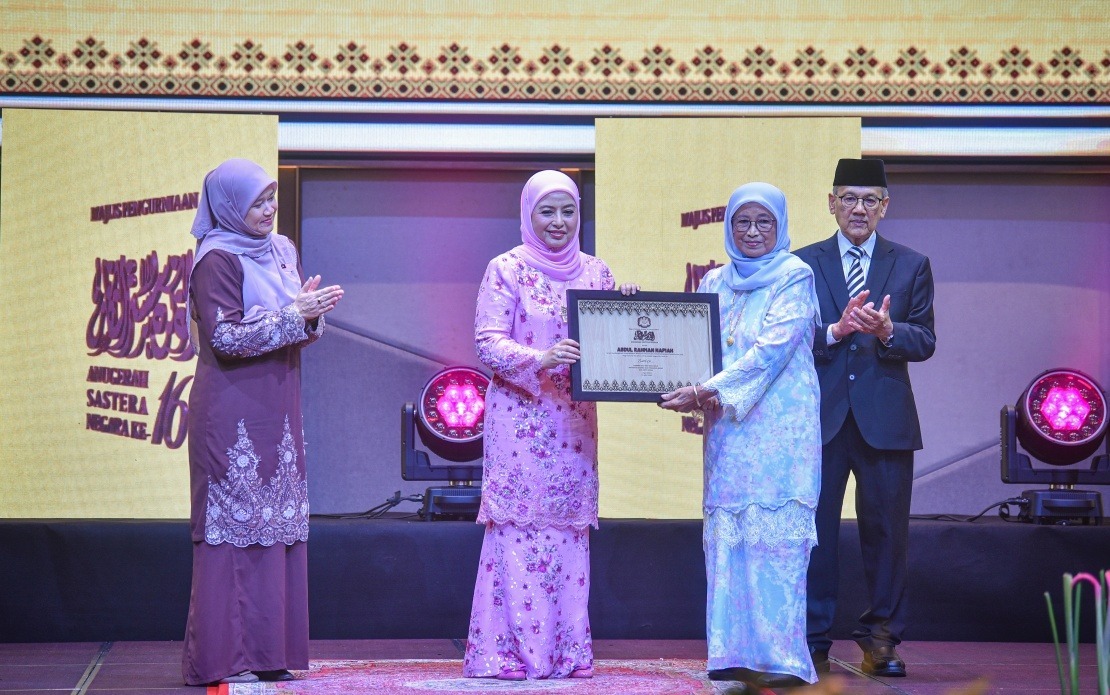
The Malaysian government has conferred its highest literary honour on the late Dr Abdul Rahman Napiah, known professionally as Mana Sikana, recognising him as the nation's 16th National Laureate. The award, presented during a ceremony in Kuala Lumpur on August 6, was received by his widow, Salmah Ali, from Her Majesty Raja Zarith Sofia, Queen of Malaysia. This posthumous recognition arrives four months after Mana Sikana's death in May 2025 at age 80, following complications from heart disease.
The National Laureate designation represents the government's pinnacle acknowledgement of literary achievement, reserved exclusively for writers whose sustained output and innovative contributions have fundamentally shaped Malaysian letters. The selection committee, chaired by Education Minister Fadhlina Sidek, evaluated Mana Sikana's exceptional body of work spanning more than a century of creative output, which fundamentally altered the landscape of Malaysian writing and critical discourse.
Fadhlina highlighted during her remarks how Mana Sikana's extensive catalogue cultivated consciousness around social issues, nurtured compassion among readers, facilitated meaningful conversation between cultural communities, and emphasised ethical principles. His literary output provided comprehensive perspectives into Malaysia's intricate multicultural fabric, offering readers windows into the nation's diversity that extended far beyond surface-level storytelling. The minister underscored how his prolific contributions instilled confidence in the quality and sophistication of Malaysian literary production on regional and international stages.
Beyond his creative achievements, Mana Sikana exerted remarkable influence through multiple channels that extended writing itself. His theoretical frameworks, critical analyses, university teaching appointments, and scholarly publications shaped how subsequent generations approached literature both as readers and creators. Fadhlina identified three particularly consequential contributions: his pioneering expansion of narrative techniques and stylistic approaches, his insistence that literary work engage readers intellectually and philosophically rather than merely entertain, and his deliberate cultivation of emerging writers, academics, and literary commentators through institutional platforms.
Mana Sikana's academic journey began in Bagan Serai, Perak, where he was born on October 9, 1946. After establishing himself as an educator in secondary schools, he transitioned into university scholarship, holding positions at prominent Malaysian and regional institutions. His career encompassed appointments at Universiti Kebangsaan Malaysia, where he earned his doctorate, as well as at Nanyang Technological University in Singapore and Universiti Pendidikan Sultan Idris. These academic roles provided platforms from which he influenced literary education and scholarship throughout Southeast Asia.
His professional accomplishments accumulated substantial recognition long before the National Laureate designation. Mana Sikana previously received the Malaysian Literary Prize, reflecting peer recognition of his creative excellence, alongside the Malaysian Perdana Literary Prize, which acknowledges literary works addressing significant national concerns. Regional recognition came through the Perak Laureate Award, honouring his connections to his native state, and the Darul Ridzuan Lifetime Literary Achievement Award, which celebrated his comprehensive contributions to Malaysian cultural life. These honours established him among the nation's most celebrated literary figures well before his death.
The National Laureate award encompasses tangible recognition beyond ceremonial honour. Mana Sikana receives a formal letter of national recognition, a monetary prize of RM60,000, and an allocation for publication reaching up to 50,000 copies or RM500,000 in value. This publishing provision ensures his works undergo comprehensive distribution throughout Malaysia's institutional infrastructure, reaching schools where students encounter his literature during their education, public libraries preserving his texts for community access, and government departments and agencies utilising his work for cultural and educational purposes. The distribution mechanism represents governmental commitment to ensuring a National Laureate's legacy reaches the widest possible audience.
Mana Sikana's elevation joins a lineage of Malaysian writers whose careers transformed the nation's literary culture. The National Laureate programme, now at its sixteenth recipient, honours individuals whose legacies extend across decades and whose innovations remain relevant to subsequent literary generations. For Malaysian readers and writers, Mana Sikana's recognition validates the sophistication and importance of local literary production, signalling that writing emerging from Malaysia's specific social contexts and employing Malaysian languages and perspectives deserves the highest national distinction.
His posthumous honour carries particular significance for Malaysian literary studies and pedagogy. Universities throughout Malaysia and the region now examine his theoretical contributions alongside his creative achievements, ensuring his analytical frameworks continue shaping how scholars approach Malaysian literature. His influence on literary criticism established methodologies that subsequent critics continue applying, while his mentorship of younger writers created networks of literary practitioners whose own works bear Mana Sikana's imprint. This intergenerational transmission of literary approaches demonstrates how individual writers fundamentally restructure entire disciplines.
For Southeast Asian literary communities, Mana Sikana's recognition illustrates the region's literary maturity and capacity to produce writers whose contributions merit the highest honours. His academic work at Nanyang Technological University connected Malaysian literary discourse with Singaporean and broader Asian scholarship, fostering intellectual exchange that enriched multiple national literary traditions. His career demonstrated how writers operating within specific national contexts simultaneously contribute to larger regional literary conversations, particularly when engaging with themes of cultural diversity, postcolonial experience, and social responsibility that resonate throughout Southeast Asia.
The timing of this recognition, arriving shortly after his passing, ensures public reflection on Mana Sikana's comprehensive achievements during what would have been his final years. His widow's receipt of the honour on behalf of the family acknowledges the personal sacrifices literary careers often demand while celebrating a life devoted to Malaysian cultural enrichment. For the broader literary community, his National Laureate status establishes benchmark standards for sustained excellence, critical innovation, and institutional influence that younger writers may aspire to emulate throughout their own evolving careers.

