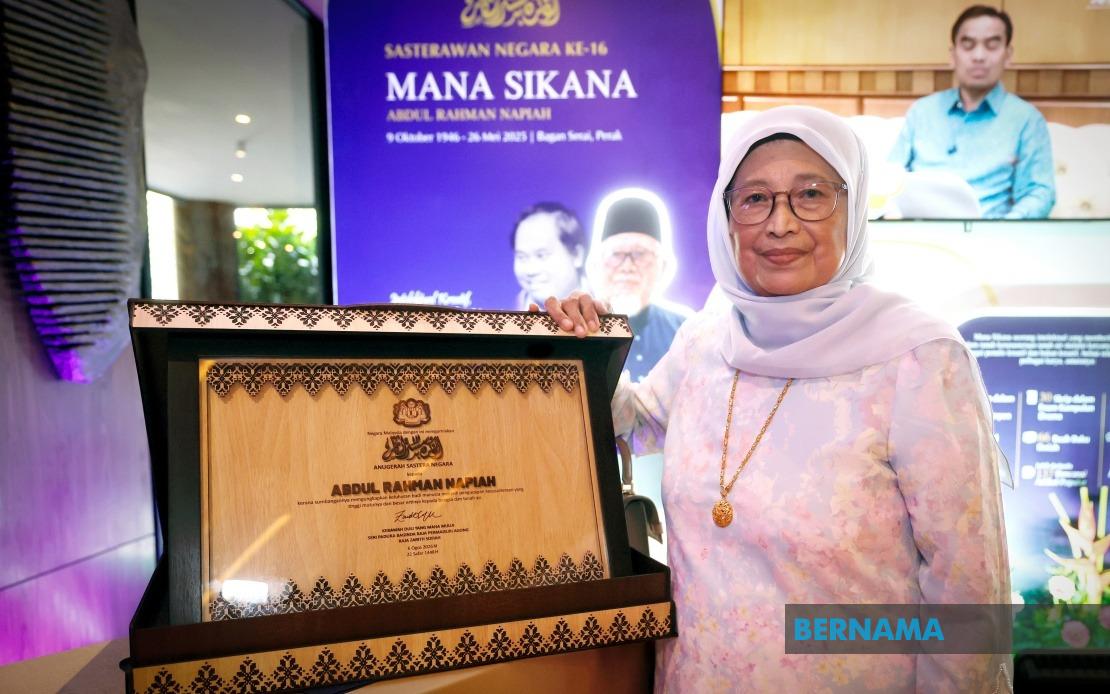
The widow of Malaysia's most celebrated Malay author and academic has accepted the National Laureate award on his behalf, describing the honour as recognition that arrived too late for him to witness personally. Salmah Ali, 82, received the 16th National Laureate distinction for her late husband, Dr Abdul Rahman Napiah—known professionally as Mana Sikana—from Her Majesty Raja Zarith Sofia, Queen of Malaysia, during a ceremony in Kuala Lumpur on August 6. Though pride and happiness filled the occasion, Salmah's words carried unmistakable emotion as she reflected on her husband's inability to receive the accolade he had long anticipated.
Mana Sikana passed away in May at age 80 following heart complications, having spent his final working hours in service to Malaysian letters. On the very day he suffered the health crisis that would prove fatal, he was presenting a research paper to Dewan Bahasa dan Pustaka, Malaysia's premier institution for language and literature. That dedication typified his character throughout a career spanning more than five decades. Salmah recounted that he had been informed of the award possibility before his death, making its conferment bittersweet—a validation of his life's work arriving only in memory.
The Education Minister Fadhlina Sidek attended the presentation ceremony and articulated the official reasoning behind the selection. Her remarks positioned Mana Sikana as a transformative force in the evolution of Malay literature, one whose influence extended across multiple domains. Beyond creative writing itself, he shaped the intellectual foundations of the field through theoretical frameworks, critical analysis, and sustained scholarly discourse. This multidisciplinary approach distinguished him from literary figures whose impact remained confined to a single genre or audience.
Mana Sikana's career trajectory demonstrated unusual breadth for a writer of his calibre. After beginning as a classroom teacher, he systematically pursued advanced qualifications that culminated in a professorship, a trajectory that allowed him to mentor subsequent generations while maintaining his own creative output. His academic appointments spanned Malaysia and beyond, including positions at Universiti Kebangsaan Malaysia, Universiti Pendidikan Sultan Idris, and as a visiting lecturer at Indonesian universities. He also spent formative years in Johor Bahru producing drama for Singaporean broadcasting networks whilst maintaining teaching responsibilities—a schedule that would exhaust most professionals yet somehow enabled continued literary production.
Television and radio represented vital creative outlets for Mana Sikana during an era when Malaysian broadcasting was establishing its cultural identity. Drama production, particularly through these electronic media, allowed him to reach audiences far beyond the readership of literary journals or academic papers. The visibility of his broadcast work throughout Malaysia and Singapore demonstrated that serious literature need not remain confined to elite intellectual circles. This democratic impulse—making sophisticated cultural content accessible through popular media—became increasingly rare as Malaysian literature developed, making his contributions historically significant even beyond their intrinsic artistic merit.
The academic dimension of his work proved equally consequential. Salmah emphasised that even in his final years, approaching his ninth decade, Mana Sikana continued transmitting knowledge to his immediate family circle. Four children and twelve grandchildren benefited from his guidance on the craft and philosophy of literature, suggesting that his influence would persist through familial channels. This pattern of knowledge transmission mirrors traditional approaches to cultural inheritance whilst remaining adaptable to contemporary contexts. Universities across Southeast Asia recognised his standing sufficiently to invite him as a visiting scholar, indicating that his reputation transcended national boundaries.
Mana Sikana was born on October 9, 1946, in Bagan Serai, Perak, establishing him as part of the post-independence generation of Malaysian intellectuals. This generation inherited and reshaped a literary tradition previously dominated by colonial-era concerns, transforming Malay literature into a vehicle for exploring national identity, contemporary social issues, and artistic innovation. His emergence as the sixteenth National Laureate places him among Malaysia's most significant cultural figures—a distinction that reflects institutional recognition of his outsized impact on how successive writers approached their craft.
The National Laureate designation holds particular weight within Malaysian cultural hierarchies, marking the recipient as embodying the highest standards of literary achievement and contribution to national cultural life. The award's presentation by the Queen herself underscores its significance within the honours system. For Salmah, accepting on her husband's behalf meant participating in a ceremony that vindicated decades of sacrifices—the long hours devoted to writing, teaching, and creative production that may have seemed underappreciated during his lifetime. Yet the emotional toll of attending without him present tempered the celebration, a poignancy that resonated through her public remarks.
Malaysian literature and cultural development have benefited immeasurably from figures like Mana Sikana, whose careers spanned the discipline's most formative decades. As the nation navigated post-independence cultural identity formation, literary figures shouldered responsibility for articulating national consciousness through artistic means. Mana Sikana's multiple careers—as creative writer, theorist, broadcaster, and academic—collectively addressed this burden with unusual versatility. The National Laureate award acknowledges not merely past achievement but the ongoing influence of his methodologies and insights on younger writers and scholars still shaping Malaysian literature's trajectory.
For Southeast Asian readers, Mana Sikana's recognition carries broader implications about how the region values and preserves its literary heritage. His work with Indonesian universities and Singaporean broadcasters demonstrated that quality literature requires regional cooperation and cross-border engagement. The formal honour bestowed posthumously also raises questions about whether living writers and artists receive adequate recognition or whether institutional validation typically arrives only after death removes the possibility of the honouree's gratification. Salmah's emotional acceptance, whilst deeply moving, implicitly poses this uncomfortable consideration to Malaysia's cultural institutions and policymakers.

