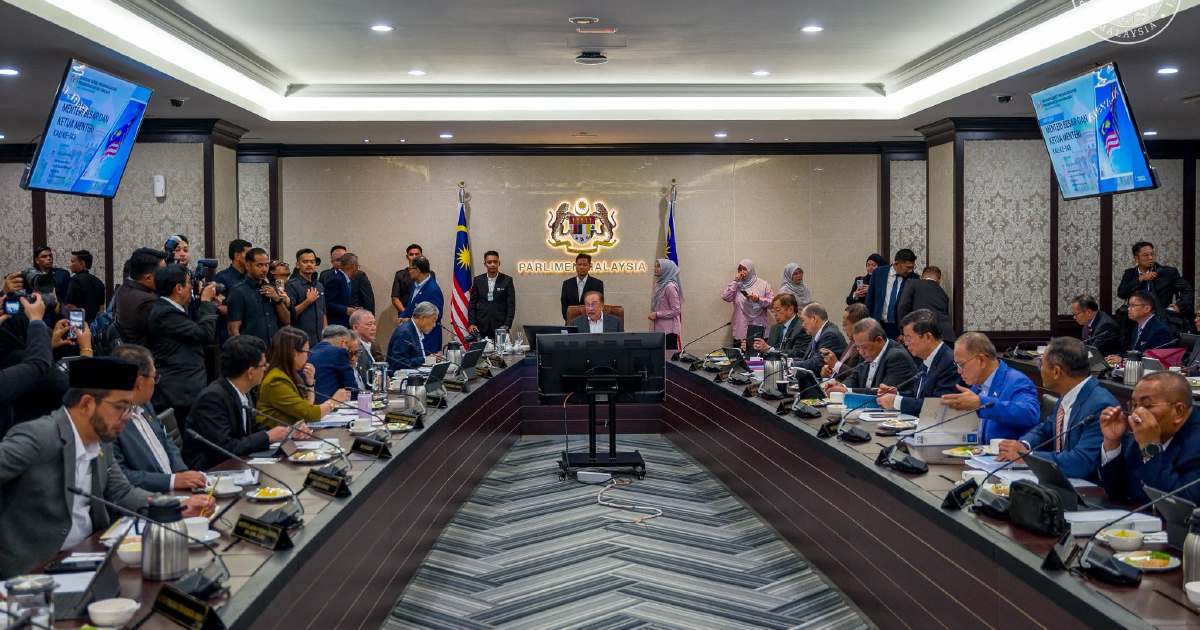
Prime Minister Datuk Seri Anwar Ibrahim brought together the nation's most senior state administrators for the 149th Meeting of Menteris Besar and Chief Ministers at Parliament House in Kuala Lumpur, with economic resilience emerging as the central theme of deliberations. The congregation of state leaders, who exercise considerable influence over regional development and policy implementation, underscored the government's determination to fortify Malaysia's financial position against mounting external headwinds. The timing of the gathering reflects deepening anxieties about how international upheaval—particularly the escalating tensions in the Middle East—could reverberate through Southeast Asian supply chains and investment flows.
The emphasis on economic revitalisation signals recognition among Malaysia's political establishment that the country cannot insulate itself from global volatility. Middle Eastern conflicts carry particular significance for Malaysia, given the region's importance as a source of oil and liquefied natural gas, crucial inputs for energy-dependent economies across Asia-Pacific. Any disruption to energy supplies or sharp price fluctuations would immediately pressure Malaysian manufacturers, utilities, and households. Beyond energy concerns, geopolitical instability in the Middle East typically triggers capital flight from emerging markets as investors retreat to safer havens, potentially constraining credit availability and raising borrowing costs for domestic businesses and the government.
For Malaysian readers, this meeting carries direct implications. State governments hold responsibility for local economic development, infrastructure projects, and attracting foreign investment—all areas where coordinated federal-state action becomes essential during uncertain periods. The session provided an opportunity for Prime Minister Anwar to align state chief executives around shared economic objectives and ensure that development initiatives proceed coherently across the federation. When middle-tier administrators lack clear direction from federal leadership, fragmented approaches can emerge, undermining the overall effectiveness of stimulus measures or recovery programmes.
The gathering also highlights the intricate interplay between Malaysia's domestic economic challenges and international conditions. Prior to the recent Middle Eastern tensions, the nation had already grappled with moderating growth, inflationary pressures, and structural adjustments required for long-term competitiveness. These preexisting vulnerabilities mean that external shocks arrive when the economy possesses limited buffer capacity. State leaders needed to grasp how federal strategy would adapt, whether fiscal stimulus remained forthcoming, and what resources would be directed toward their respective jurisdictions during a period of contraction or slowdown.
The constitutional arrangement in Malaysia, which distributes certain economic powers between federal and state governments, necessitates precisely these coordinating forums. State governments control land policy, local business licensing, and some infrastructure investments—levers that, when pulled in harmony with federal monetary and trade policies, can either amplify or diminish the impact of external shocks. Without alignment, overlapping regulations or conflicting initiatives could handicap private sector confidence. The 149th meeting therefore served not merely as an information-sharing exercise but as a mechanism for cementing a unified response to economic adversity.
Mideast geopolitical upheaval also intersects with Malaysia's sectoral composition in ways that demand careful coordination between state and federal authorities. Several Malaysian states host port facilities, petrochemical complexes, and manufacturing hubs with exposure to regional trade. Johor, for instance, benefits from proximity to Singapore's financial markets and serves as a gateway for trade with neighbouring countries; any disruption in regional commerce directly threatens state revenues and employment. Sarawak and Sabah, meanwhile, have energy and commodity sectors vulnerable to price swings resulting from Middle Eastern tensions. Penang's electronics and precision manufacturing industries depend on stable supply chains that could fracture under geopolitical stress.
The economic revival agenda reflects a pragmatic acceptance that Malaysia must pursue multiple tracks simultaneously. Strengthening domestic demand through targeted spending, encouraging private investment through regulatory clarity, and maintaining macroeconomic stability through prudent monetary management all require coordinated effort. State leaders returning to their jurisdictions after the Kuala Lumpur meeting would carry clearer mandates regarding federal priorities, budgetary allocations, and thematic focuses—whether economic diversification, digital transformation, or sectoral development—that align with overarching national strategy. This coordination prevents the wasteful duplication or contradictory messaging that can emerge when state governments operate independently.
The 149th meeting also implicitly acknowledged that Malaysia's economic path forward cannot be reactive to external crises alone. Structural reforms aimed at productivity improvement, human capital development, and innovation remain essential. Middle Eastern tensions may constrain growth in the near term, but the underlying imperative for Malaysia—a middle-income nation seeking to escape the middle-income trap and compete globally—remains unchanged. State leadership participation in this conversation ensures that development initiatives serving long-term competitiveness proceed even as short-term crisis management occupies policy bandwidth.
From a Southeast Asian perspective, Malaysia's concerted state-level mobilisation around economic revival signals that the region's third-largest economy intends to weather geopolitical turbulence without surrendering growth ambitions. If Malaysia manages to sustain investment and employment through the current period of international instability, it might preserve market share and supply chain relationships that competitors lose through hesitation or mismanagement. Conversely, failure to coordinate effectively across state lines could allow Malaysian economic momentum to dissipate precisely when regional competition remains fierce.

