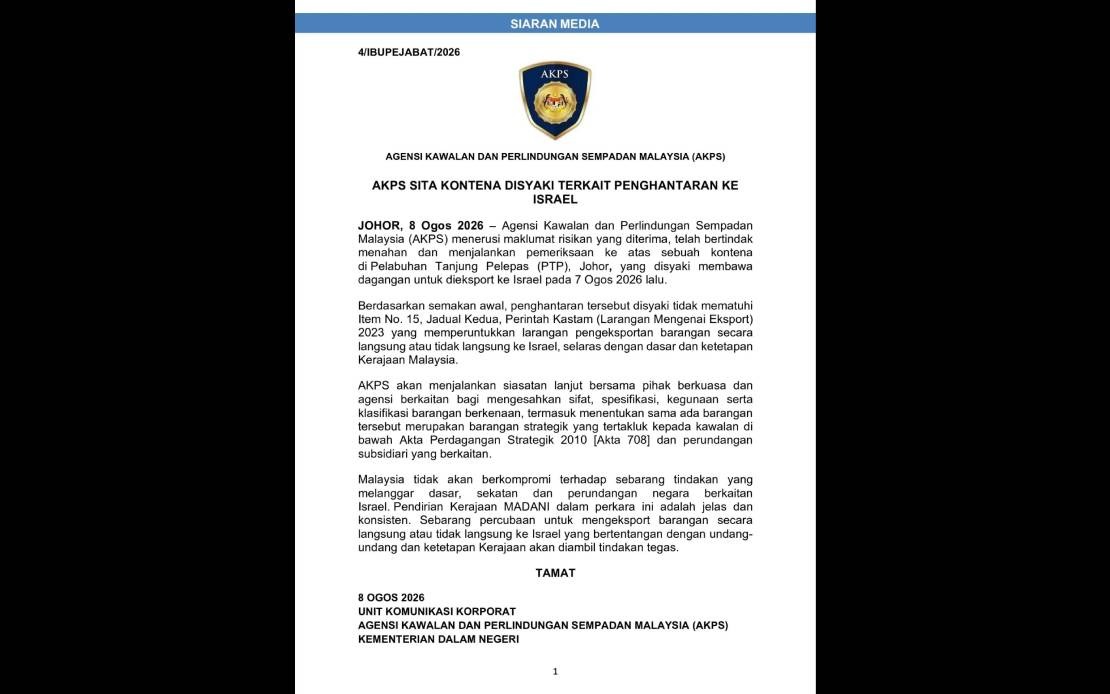
Malaysia's customs authorities have demonstrated the country's resolute commitment to its Palestine solidarity policies by intercepting a suspicious shipment at one of its major ports. Prime Minister Datuk Seri Anwar Ibrahim publicly commended the Malaysian Border Control and Protection Agency (AKPS) for moving swiftly to detain and inspect a container at Port Tanjung Pelepas in Johor, which officials suspected contained goods earmarked for export to Israel. The seizure represents a tangible enforcement action that translates Malaysia's longstanding rhetorical support for Palestinian causes into concrete border management practices.
The interception carries particular significance within the context of Malaysia's evolving trade restrictions targeting Israel. Since December 2023, Malaysia has implemented a comprehensive ban preventing Israeli-flagged vessels and ships transporting cargo to Israel from accessing the country's ports. This measure, framed as part of the nation's broader commitment to international humanitarian principles, aims to prevent Malaysian infrastructure from facilitating commerce that might indirectly support Israeli military or economic activities. The AKPS operation demonstrates that these restrictions extend beyond simple port-access denials to encompass active monitoring and seizure of suspect shipments that attempt to circumvent the prohibition through transshipment routes.
According to AKPS officials, the detained container violated Item No. 15 of the Second Schedule of the Customs (Prohibition of Exports) Order 2023, which explicitly prohibits direct or indirect export of goods to Israel in accordance with Malaysian government policy directives. This legal framework provides the formal justification for the agency's intervention and reflects formal legislation underpinning Malaysia's informal political commitments. The distinction between direct and indirect exports proves crucial here, as it suggests authorities remain vigilant against sophisticated schemes that might route Israeli-destined goods through intermediary jurisdictions or port cities to obscure their final destination.
Prime Minister Anwar's public acknowledgement of the seizure through social media underscores the political resonance of such actions within Malaysia's domestic context. The statement positions the government as actively defending Palestinian interests and preventing the nation from becoming complicit in what he characterizes as Israeli "atrocities" against Palestinians. This framing aligns with the broader narrative that Malaysia's foreign policy stance reflects moral principle rather than mere geopolitical calculation, a messaging strategy that resonates with Malaysia's Muslim-majority population and domestic constituencies invested in Palestine advocacy.
The government's invocation of The Hague Group framework provides an international law dimension to these unilateral restrictions. By linking the AKPS action to this multilateral context, officials suggest that Malaysia's Israel trade embargo operates within a broader pattern of international concern rather than representing isolated Malaysian activism. This positioning potentially shields the government from accusations of pursuing discriminatory trade practices, though Malaysia's approach remains notably more stringent than many nations' responses to Israeli activities.
The enforcement action highlights practical challenges that Malaysian authorities must continuously navigate. Port facilities processing thousands of containers daily require sophisticated intelligence-gathering and inspection capabilities to identify suspect shipments effectively. The AKPS operation indicates at least some capacity to detect and interdict potentially Israel-destined cargo, though the single seizure provides limited insight into either the volume of such attempted shipments or the overall effectiveness of detection mechanisms. Regional competitors and trading partners may monitor these enforcement practices closely, as they could influence maritime traffic patterns and port selection decisions across Southeast Asia.
From a trade perspective, the seizure reflects Malaysia's willingness to impose economic costs on compliance with its Palestine-solidarity policies, distinguishing it from nations that express sympathy for Palestinian causes while maintaining pragmatic commercial relationships with Israel. This positioning carries implications for Malaysia's relationships with trading partners, particularly Western nations and Israel's regional allies, though appears unlikely to generate significant diplomatic incidents given the measured international response to similar actions by other states.
The broader context includes Malaysia's long trajectory of pro-Palestine activism within ASEAN and international forums. Unlike Southeast Asian neighbours that maintain quieter relationships with Israel, Malaysia has consistently leveraged its diplomatic platform to amplify Palestinian grievances and push for stronger international accountability mechanisms. The AKPS seizure constitutes one operational manifestation of this sustained policy orientation, converting abstract political commitments into visible enforcement actions that domestic audiences can recognize and evaluate.
Looking forward, the seizure may establish operational precedents that shape how Malaysia's customs and border agencies approach similar suspect shipments. If the AKPS develops more sophisticated detection capabilities, the frequency of such interceptions could increase, potentially generating additional headlines and reinforcing public perception of governmental commitment. Conversely, if this represents an isolated incident, ongoing smuggling attempts might succeed with greater regularity, undermining the practical effectiveness of the formal export prohibition.
The incident also carries significance for Southeast Asian maritime commerce more broadly. Shipping lines and logistics operators now face explicit confirmation that Malaysian ports enforce Israel-related trade restrictions actively, information that likely influences routing decisions and risk assessments throughout the region. Companies dealing in sensitive commodities must factor Malaysia's enforcement posture into broader supply-chain planning, a consideration that extends the policy's economic reach beyond Malaysia's immediate territorial waters.
Finally, the public nature of Prime Minister Anwar's commendation of the AKPS sends signals about governmental priority-setting. By elevating a single customs seizure to prime ministerial public acknowledgement, the government demonstrates that Palestine-related enforcement ranks among acceptable topics for executive attention and praise. This messaging choice positions solidarity with Palestine as entirely consistent with governing responsibilities rather than representing political theatre disconnected from substantive administration.

