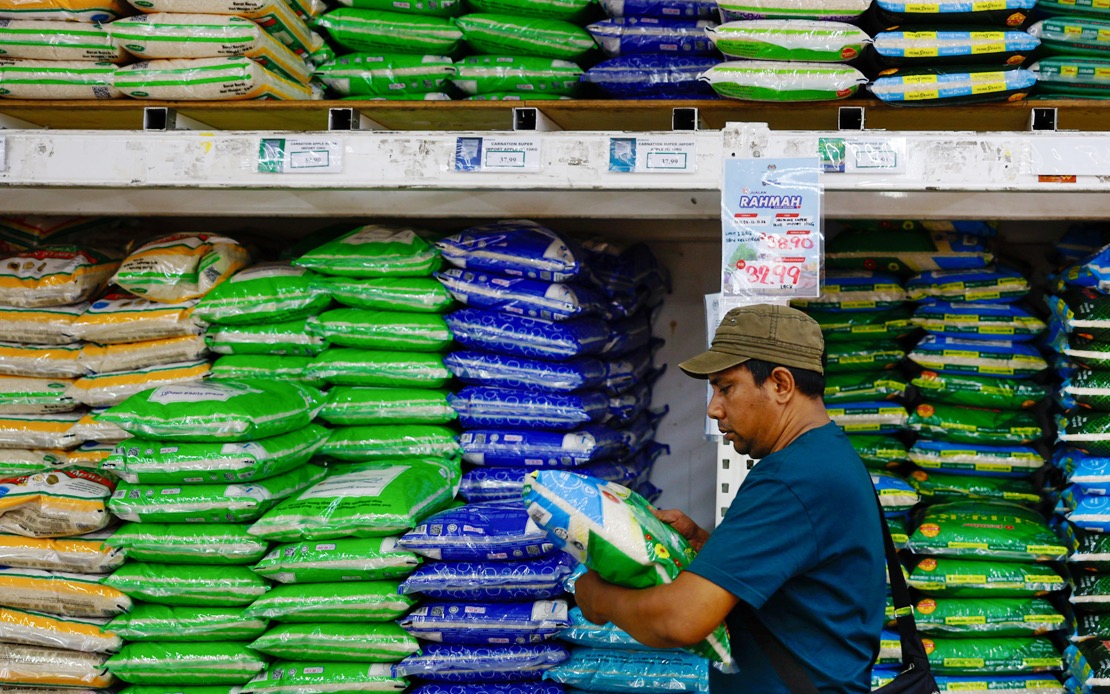
Malaysia's rice supply chain remains insulated from the escalating geopolitical tensions gripping West Asia, with the country holding sufficient reserves to meet domestic consumption for at least the next six months. Deputy Agriculture and Food Security Minister Datuk Chan Foong Hin disclosed to Parliament that total rice stocks amount to 1.237 million tonnes, a strategic buffer designed to shield Malaysian consumers and the economy from international food security shocks. This disclosure, made during a Dewan Negara question-and-answer session, underscores Kuala Lumpur's proactive stance on maintaining food stability even as global supply chains face unprecedented uncertainty.
The reserve comprises two distinct components working in tandem to secure the nation's rice security. A dedicated national buffer stock of 200,000 tonnes is managed directly by Padiberas Nasional Berhad (BERNAS), the state-owned enterprise responsible for coordinating Malaysia's rice sector. Complementing this strategic reserve, commercial stocks held across the supply chain amount to 1.037 million tonnes, creating redundancy and stability throughout distribution networks. This dual-layer approach reflects a deliberate policy structure where government-maintained emergency reserves operate alongside market-driven commercial holdings, creating both security and price stability mechanisms.
The significance of maintaining these reserves extends beyond immediate supply concerns. With prices for staple foods climbing across global markets in response to geopolitical disruptions, Malaysia's government-subsidised white rice pricing becomes increasingly valuable as a price stability anchor. Unlike commodities exposed to currency fluctuations and international market volatility, domestically-controlled rice supplies allow the authorities to maintain predictable prices for ordinary Malaysians regardless of external shocks. This pricing mechanism, supported by direct government subsidy interventions, functions as a crucial social safety net protecting purchasing power across income groups.
Yet Malaysia's current comfort with its rice position masks longer-term strategic vulnerabilities that the government acknowledges must be addressed urgently. The nation's self-sufficiency ratio for rice currently falls below the 80 per cent target slated for achievement by 2030, reflecting a production trajectory that has declined over recent years. This shortfall means Malaysia remains dependent on imports for roughly one-fifth to one-quarter of its rice consumption, a reliance that becomes precarious when international suppliers face disruptions. The Ministry of Agriculture and Food Security recognises that climate-related threats, particularly the El Niño phenomenon with its drought-inducing effects, compound these production challenges and demand comprehensive solutions.
Addressing the production gap requires both innovation in agricultural technology and expansion of cultivated capacity. The ministry is promoting adoption of drought-resistant padi varieties designated as MR 380, MR 381, and MR 382, each engineered to maintain productivity even when water availability becomes constrained. These varieties represent Malaysia's contribution to global agricultural innovation addressing climate vulnerability. Simultaneously, the government is introducing water-efficient cultivation techniques including Alternate Wetting and Drying (AWD) and the System of Rice Intensification (SRI), methodologies that reduce irrigation demands whilst maintaining or improving yields. These approaches recognise that future food security depends not merely on producing more rice, but on producing it sustainably given water scarcity trends affecting the broader Southeast Asian region.
Infrastructural investment forms the backbone of Malaysia's medium-term rice production strategy. The Ministry of Agriculture and Food Security is implementing a five-season rice cultivation project spanning two years across areas administered by the Muda Agricultural Development Authority (MADA), the primary rice-producing region in peninsular Malaysia. This intensive cultivation schedule aims to maximise output from established agricultural zones. Concurrently, irrigation systems serving MADA and other rice-growing regions are undergoing upgrading to improve water distribution efficiency and reduce wastage, critical investments given water stress affecting agricultural production across the region.
Immediate cost pressures on padi farmers demand parallel government intervention to sustain production momentum. The rising expenses for agricultural inputs—particularly fertilisers and mechanised services—threaten farmer profitability and discourage continued investment in rice production. In response, the government is implementing targeted fiscal measures to alleviate these burdens. A temporary exemption from the Sales and Service Tax for agricultural fertilisers, including rock phosphate and magnesium sulphate, extends from January 2026 through December 2027, providing relief to farmers purchasing these essential inputs.
Farmer incentive schemes have also been substantially enhanced to encourage continued participation in rice cultivation. The ploughing incentive for the 2026 planting season has been nearly doubled from RM160 to RM300 per hectare, a significant 87.5 per cent increase that signals government commitment to supporting agricultural livelihoods. This increment carries budgetary implications of approximately RM40 million in additional allocation, yet reaches an estimated 200,000 farmers across the country, indicating broad-based support for the rice sector. Such targeted subsidies represent strategic investment in maintaining a distributed network of producers resilient to external disruptions.
Malaysia's approach to rice security reflects broader Southeast Asian challenges in maintaining food self-sufficiency amid climate volatility and geopolitical instability. As a net food importer, the region faces particular vulnerability to international supply disruptions and price inflation in staple commodities. Malaysia's emphasis on building strategic reserves, investing in climate-resilient agriculture, and supporting farmer incomes provides a potential template for regional food security policy, though implementation challenges remain substantial.
The six-month supply cushion announced by the Deputy Minister offers current reassurance but should not obscure the structural reforms necessary for long-term security. Reaching the 80 per cent self-sufficiency target by 2030 requires sustained commitment to agricultural modernisation, water management, climate-responsive farming, and farmer support—investments whose payoff extends well beyond rice into broader regional stability and economic resilience amid an increasingly volatile global environment.

