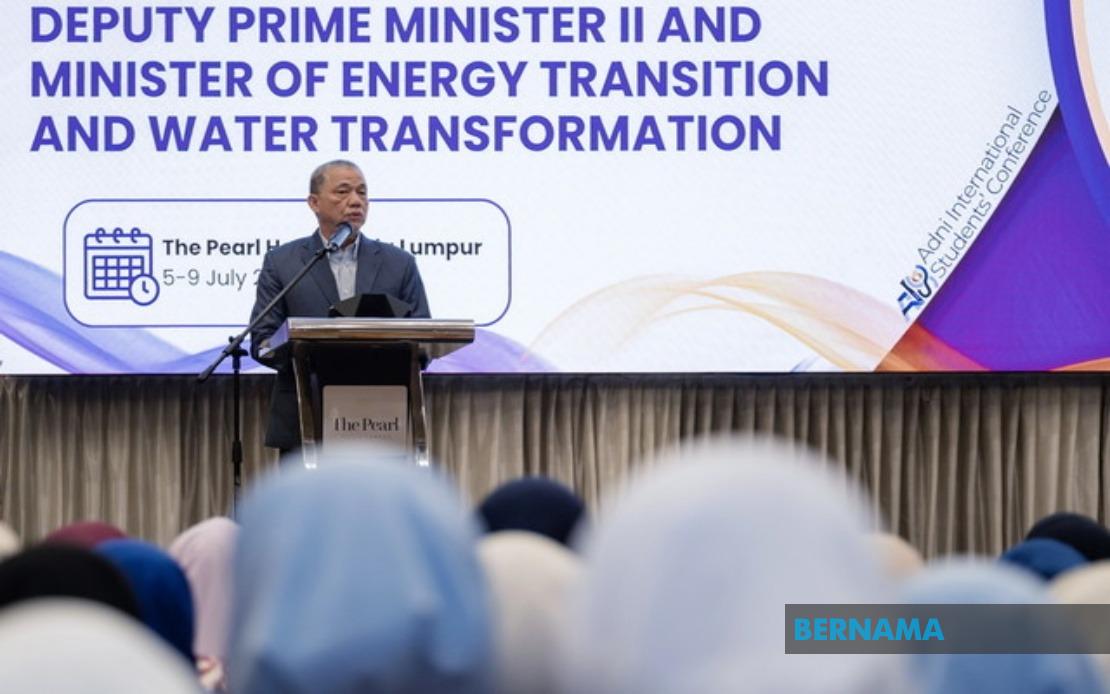
Malaysia's trajectory towards sustained prosperity cannot be built on economic metrics or technological prowess alone, according to Deputy Prime Minister Datuk Seri Fadillah Yusof, who has elevated human capital development as the central pillar of national advancement. Speaking at the opening of the ADNI International Students' Conference (AISC) 2026 in Kuala Lumpur on July 6, Fadillah articulated a vision of nation-building that prioritises the cultivation of individuals equipped with adaptive mindsets and sophisticated communication skills. In an era characterised by rapid globalisation and interconnectedness, he argued, countries must invest deliberately in nurturing citizens capable of navigating complexity and thriving amid uncertainty.
The Deputy Prime Minister's remarks reflect a deliberate recalibration of Malaysia's development narrative, one that acknowledges the limitations of purely economic or technological frameworks. Fadillah contended that emerging threats—from climate catastrophe to pandemic risks, from the acceleration of digitalisation to entrenched social inequalities—transcend borders and sectoral boundaries. Addressing these multifaceted challenges requires orchestrated action spanning governments, universities, commercial enterprises, community organisations and the youth demographic itself. This interdependence demands individuals capable of transcending disciplinary silos and bridging ideological divides through substantive dialogue.
Fadillah positioned the MADANI Government's approach as a deliberate inversion of conventional development orthodoxy, one that places the character and cohesion of the populace at the forefront of policy. He invoked the legacy of Malaysia's third Prime Minister, Tun Hussein Onn, whose philosophical conviction held that national resilience originates from unified citizenship and collective moral fortitude rather than institutional capacity or resource abundance. This historical reference grounds contemporary policy discussions in Malaysia's constitutional and philosophical traditions, suggesting continuity across administrations in valuing social harmony as a foundational prerequisite for advancement.
Central to Fadillah's conception of holistic development is the integration of ethical dimensions alongside technical competencies. He emphasised that genuine progress encompasses educational attainment, physical and mental wellbeing, moral integrity, imaginative capability, environmental stewardship and social harmony. This multidimensional framework departs from narrower metrics that reduce development to GDP growth or labour productivity. Instead, it proposes a more expansive understanding wherein technological sophistication and institutional effectiveness serve human flourishing rather than constituting ends in themselves.
The Deputy Prime Minister drew a philosophical distinction between technological capability and wisdom, cautioning against the assumption that algorithmic intelligence represents a substitute for human judgement rooted in experience and reflection. Similarly, he highlighted the irreplaceable nature of compassion in human relationships and social institutions. These remarks implicitly critique techno-optimism and remind stakeholders that artificial intelligence, despite its escalating capabilities, remains fundamentally a tool devoid of ethical agency or emotional resonance. The cultivation of wisdom and compassion therefore remains an irreducibly human endeavour.
Fadillah underscored the critical importance of shared institutional frameworks in binding diverse societies together. While technological infrastructure undoubtedly facilitates connectivity between devices and platforms, genuine social cohesion emerges from the cultivation of common values, reciprocal esteem and institutional trust. This observation carries particular salience for Malaysia, a multi-ethnic and multi-religious federation where plural identities coexist within a constitutional framework. Building and maintaining social cohesion requires deliberate pedagogical and cultural investments that reinforce mutual understanding across demographic boundaries.
The AISC 2026 conference itself exemplified the cross-cultural engagement Fadillah championed. Convening approximately 150 delegates drawn from Malaysia, Thailand, the Philippines and Indonesia, the gathering embodied a regional approach to addressing shared challenges. The conference's thematic focus—'Thriving Together: Diversity, Education and Wellness in a Digital World'—echoes the Sustainable Development Goals framework established by the United Nations, signalling alignment between national aspiration and international commitments. For Malaysia and its Southeast Asian neighbours, such collaborative platforms facilitate the exchange of pedagogical innovations, research insights and policy lessons relevant to development trajectories.
The Deputy Prime Minister situated the conference within the broader architecture of the UN's Sustainable Development Goals, highlighting how cultivating young leaders attuned to quality education, inclusive institutions and strategic partnerships represents instrumental progress toward these transnational objectives. The SDG framework encompasses environmental sustainability, economic opportunity, health security and institutional integrity—domains requiring coordinated action across national boundaries. Malaysia's participation in nurturing internationally minded youth positions the country as a responsible stakeholder in this global endeavour.
Fadillah's emphasis on intellectual discourse and cross-cultural exchange as essential to developing globally competent individuals with strong values and robust identity reflects an understanding that insularity breeds vulnerability. Young Malaysians equipped with international exposure, exposure to diverse worldviews and experience collaborating across cultural lines emerge better prepared to navigate and shape a multipolar world. The confidence to engage with difference while maintaining cultural particularity represents a sophisticated form of competence essential for contemporary leadership.
The Deputy Prime Minister's remarks implicitly contest assumptions that development proceeds automatically through technological adoption or market liberalisation. Instead, they assert that intentional institutional effort, pedagogical investment and cultural reinforcement remain necessary for translating technical capacity into human flourishing and social progress. This perspective aligns with emerging research in development economics emphasising the critical role of institutional quality, social capital and human agency in determining long-term prosperity trajectories.
For Malaysia's policy landscape, Fadillah's articulation carries implications extending across education, labour market strategy and social integration. Universities and vocational institutions must calibrate curricula not merely toward technical skills but toward cultivation of critical faculties, ethical reasoning and collaborative capability. Similarly, private sector recruitment practices might increasingly weigh adaptability, integrity and cultural competence alongside formal qualifications. At the societal level, investments in cross-cultural forums and intellectual platforms become not merely cultural amenities but strategic infrastructure for human capital development.
The remarks also reflect Malaysia's strategic positioning within Southeast Asia, a region characterised by dynamic growth, demographic youth and rising geopolitical significance. Countries that successfully invest in human capital development—understood broadly as moral, intellectual and adaptive capability—position themselves advantageously in competition for talent and in addressing transnational challenges. Fadillah's emphasis on collaborative problem-solving and cross-border engagement acknowledges that Malaysian prosperity increasingly depends on regional stability and constructive relationships with neighbouring economies.
Ultimately, the Deputy Prime Minister's intervention reframes national development discourse around human dignity, social cohesion and ethical capacity. Rather than treating these dimensions as secondary to economic metrics, his remarks position them as foundational to any sustainable vision of prosperity. For policymakers across Malaysia and Southeast Asia, this articulation offers a compelling counternarrative to purely technocratic or market-driven approaches, suggesting that human capital development remains inseparable from investments in education quality, institutional trust and the values that bind societies together across difference.

