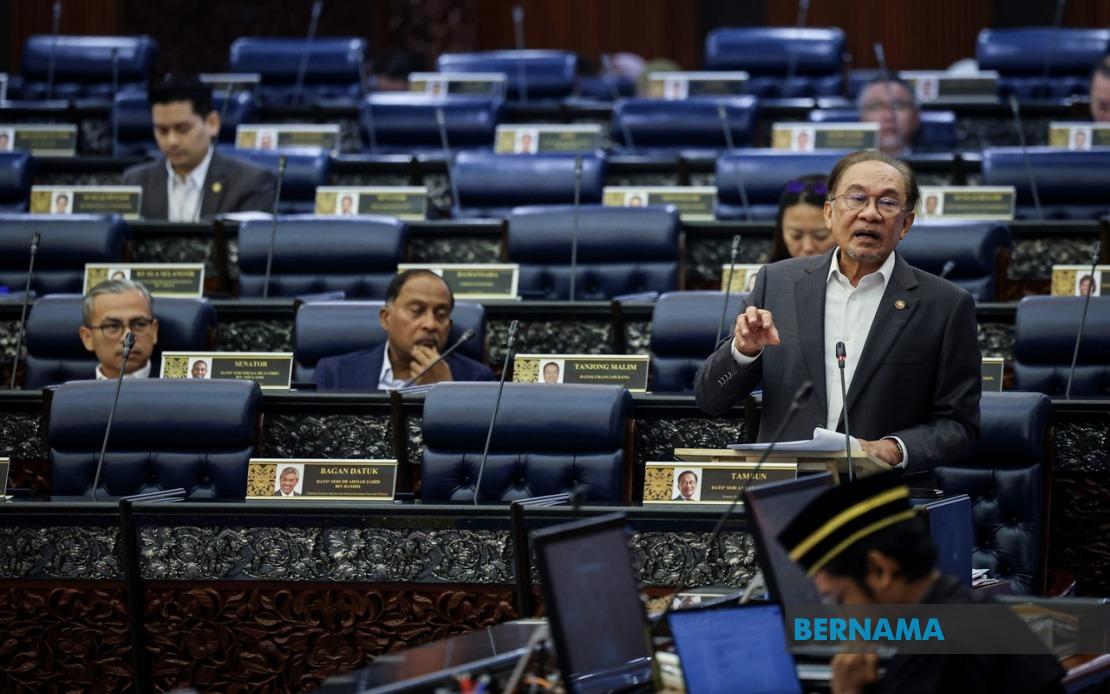
Malaysia's descent in the 2026 World Press Freedom Index to 95th place, down from 88th the previous year, reflects enforcement actions targeting content involving religion, race, and the royal institution rather than an attempt to silence legitimate political criticism, Prime Minister Datuk Seri Anwar Ibrahim told Parliament on July 7. Speaking during Minister's Question Time in the Dewan Rakyat, Anwar acknowledged that international press freedom assessors view such enforcement negatively, but argued that protecting these three sensitive areas remains a constitutional and national priority distinct from suppressing democratic discourse.
The Prime Minister drew attention to two specific cases that he suggested had influenced Malaysia's ranking downward among the international media watchdogs. The first involved Sin Chew Daily, which faced action following the publication of an inaccurate illustration of the Jalur Gemilang, the national flag. The second concerned Sinar Harian's publication of the Inspector-General of Police's biography. Anwar noted that action against established news organisations carries disproportionate weight in global press freedom assessments, immediately flagging a country's rating downward when enforcement occurs against recognisable media players rather than smaller or alternative outlets.
Central to Anwar's defence was a distinction between permissible and impermissible government intervention. He stated unequivocally that the administration takes no action against content that is merely factually inaccurate or politically critical in nature. Rather, intervention occurs when content touches the three protected categories—matters involving religion, race, and the royal institution—or when national security is at stake. This demarcation attempts to preserve space for political debate while honouring constitutional constraints that Malaysia, like several other Commonwealth nations, has placed around discussion of monarchy and communal sensitivities.
Anwar emphasised that the government's approach aligns with positions agreed upon by the Conference of Rulers, which maintains close oversight of reports involving insults to the royal institution and content liable to inflame religious or racial tensions. This framework, rooted in Malaysia's constitutional settlement and interethnic social contract, reflects the complexity faced by democracies with plural societies where certain topics carry heightened social risk. The Prime Minister's framing suggests that Malaysia's international ranking penalty reflects a genuine tension between global press freedom norms, which tend toward maximalist free expression standards, and Malaysia's constitutional architecture, which carves out defined exceptions.
Beyond enforcement action, the government has moved to liberalise the legal framework governing media and online speech. Anwar highlighted amendments to Section 233 of the Communications and Multimedia Act 1998, which now exclude satirical remarks directed at the Prime Minister or other leaders from criminal sanction. This reform signals a shift toward protecting political satire and humour—genres often critical of those in power—while maintaining boundaries around the sensitive categories. The change suggests the administration recognises the distinction between biting political commentary and prohibited speech, and seeks to create legal space for the former even as it guards the latter.
Anwar also directed attention to factors beyond direct government action that influence Malaysia's press freedom ranking. He noted that the Reporters Without Borders assessment, which produces the World Press Freedom Index, considers multiple dimensions: the political environment, legal framework, economic conditions, socio-cultural context, and security situation. This multifactorial approach means that Malaysia's ranking reflects not solely government media policy but also broader conditions including economic pressures on news organisations and the security environment in which journalism operates. Such context matters for regional readers evaluating Malaysia's standing, as it suggests that press freedom cannot be reduced to a single policy lever.
A notable element of Anwar's explanation concerned the removal of online content by social media platforms acting on user complaints rather than government direction. He cited his own experience, noting that posts he made regarding Hamas were removed by platforms despite government disagreement with those removals. This dynamic—where private technology companies rather than state authorities determine what content remains visible—has become increasingly important in assessing effective press freedom in the digital age. Anwar's point underscores that government action represents only one mechanism through which speech can be restricted; algorithmic curation and platform enforcement create additional layers of content governance beyond state control.
The Prime Minister further noted that requests from the Malaysian Communications and Multimedia Commission (MCMC) to social media platforms are not automatically accepted, as final decisions rest with platform operators themselves. This observation highlights a tension in modern media governance: governments can request removals, but multinational technology companies ultimately decide compliance, sometimes leading to outcomes that neither government nor civil society finds satisfactory. For Malaysia and other Southeast Asian nations, this dynamic raises questions about sovereignty and the ability of domestic regulatory bodies to shape the information environment within their borders.
Anwar's parliamentary remarks reflect broader regional and global debates about how to balance competing commitments to press freedom, democratic accountability, and social cohesion. Southeast Asia contains several democracies wrestling with similar tensions—between protecting pluralist societies from communal incitement and defending robust political debate. Malaysia's experience, as articulated by its Prime Minister, suggests that some governments in the region are attempting to thread this needle through legal reform, clearer demarcation of protected versus prohibited speech, and increased transparency about enforcement rationales. Whether such efforts satisfy international assessors or genuinely expand space for journalism remains contested, but Anwar's parliamentary intervention indicates that the government views its ranking decline not as a referendum on authoritarianism but as a cost of maintaining constitutional protections for communal sensitivities.
The debate also illuminates how developing democracies, particularly those with diverse populations, may struggle to climb global press freedom rankings designed around assumptions prevalent in Western liberal democracies. International indices, while valuable benchmarks, sometimes reflect value systems and legal traditions that differ from those embedded in Malaysia's Constitution and social compact. Anwar's explanation suggests a government attempting to operate within its constitutional constraints while recognising international criticism, without ceding ground on what its leadership views as essential protections for national cohesion. For Malaysian readers and policymakers, the challenge lies in determining whether this balance truly preserves democratic space or whether the boundaries around the 3R categories have become tools for suppressing legitimate journalism.

