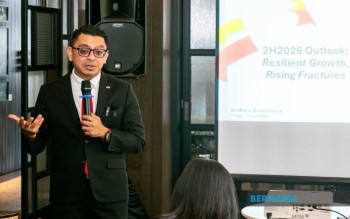
Malaysia's strategic position as a transhipment nexus along one of the world's busiest maritime corridors is generating renewed momentum for its port operators, according to AmBank (M) Bhd chief economist Firdaos Rosli. Speaking during a media briefing on the second-half 2026 economic outlook, Firdaos highlighted how geopolitical instability in West Asia has fundamentally reshaped global shipping patterns, with Malaysia emerging as a primary beneficiary of this involuntary trade rerouting.
The Strait of Melaka, through which approximately one-third of global maritime trade passes, has become an increasingly attractive alternative for shipping companies seeking to circumvent volatile regions. This shift has translated into tangible growth metrics for Malaysia's port infrastructure. Port Klang, the nation's flagship facility, processed 15.14 million twenty-foot equivalent units of container cargo throughout 2025, while the Port of Tanjung Pelepas maintained a robust throughput of 14.03 million TEUs during the same period. These volumes underscore the confidence that international shipping lines and logistics operators place in Malaysia's operational reliability and security.
Momentum has continued into 2026, with both facilities recording year-on-year growth during the first five months of the year. Port Klang expanded its container volumes by five per cent compared to the same period in 2025, while PTP achieved a stronger eight per cent increase. These figures suggest that the supply chain diversification phenomenon is not a temporary phenomenon but rather reflects deeper structural changes in how global commerce flows. Companies are systematically evaluating their logistics networks and appear to be consolidating additional capacity through Malaysian ports as part of broader risk mitigation strategies.
However, Firdaos cautioned that maintaining Malaysia's competitive advantage requires sustained commitment to infrastructure enhancement. The port sector faces pressure from rising operational costs, which have been driven partly by elevated freight rates and broader logistics expense inflation. International shipping companies are simultaneously juggling competing pressures: they require efficient, predictable routes yet confront persistently high transportation costs that erode margins. Malaysian ports must therefore invest strategically in capacity expansion and modernisation to justify their position within global supply chains, particularly as competitors in neighbouring countries strengthen their own maritime infrastructure.
The shipping market dynamics reveal a more complex picture than surface-level political disruptions might suggest. The Baltic Exchange Index, a widely-used barometer of maritime freight rates, surged above 120 per cent year-on-year growth during February and May 2026, before moderating to 64.6 per cent growth by June. Critically, freight rates have not followed their typical pattern of rapid normalisation following temporary geopolitical shocks. Instead, elevated shipping costs have persisted, signalling underlying structural imbalances in global supply and demand for maritime transport capacity.
Firdaos observed that the sustained elevation in shipping costs reflects genuine supply-side constraints rather than temporary disruptions. While West Asian geopolitical tensions are no longer directly disrupting crude oil markets and energy supplies, they continue to influence maritime transportation networks indirectly. Shipping companies maintain expensive detours around certain regions, port congestion persists in alternative hubs, and vessel utilisation patterns remain sub-optimal. These cumulative factors keep transportation costs elevated, which has broader implications for Malaysia's ports: higher shipping costs theoretically encourage greater transhipment and cargo consolidation activities, which favour hub ports like Klang and Tanjung Pelepas.
Simultaneously, Malaysia is pursuing a parallel strategic initiative to establish itself as a regional leader in sustainable maritime fuels. The government has unveiled an ambitious Green Bunkering Regulatory Roadmap targeting the transition toward low-carbon maritime fuel consumption, with a specific goal of achieving forty per cent market penetration for alternative fuels by 2050. This timeframe reflects the long-term nature of energy transition within shipping, where vessel lifecycles extend decades and infrastructure investments require substantial lead time. Port of Tanjung Pelepas has already operationalised bunkering facilities for liquefied natural gas and methanol, positioning itself at the forefront of Malaysia's green maritime agenda.
The convergence of supply chain realignment and environmental imperatives creates distinctive opportunities for Malaysian port operators. International shipping lines increasingly face regulatory pressure to reduce carbon intensity and demonstrate progress toward net-zero commitments. Malaysia's ports, by offering both geopolitical security and emerging green fuel infrastructure, provide compelling value propositions that transcend traditional cost-based competition. Companies seeking to align operations with environmental standards while maintaining supply chain resilience find Malaysian ports particularly attractive. This dual positioning—as a reliable transhipment hub and a green fuel provider—differentiates Malaysia from regional competitors.
The implications extend beyond ports themselves. Container throughput growth at major port facilities typically indicates broader economic health within the region, supporting downstream sectors including manufacturing, logistics, and related services. Malaysia's maritime sector expansion should generate employment opportunities and strengthen ancillary industries supporting port operations. Additionally, developing green bunkering capacity positions Malaysia to capture high-margin fuel sales as the shipping industry transitions toward alternative fuels, creating new revenue streams for both port operators and fuel suppliers.
Looking forward, the success of Malaysia's port sector hinges on executing the infrastructure investments that Firdaos identified as critical. Port authorities must balance near-term cost pressures with long-term capacity investments, requiring careful financial planning and potentially partnerships with international port operators. The window of opportunity created by supply chain rerouting and green energy momentum may not remain open indefinitely. As geopolitical situations stabilise or as alternative routes develop, the incentive for companies to maintain elevated transhipment volumes through Malaysian ports could diminish. Malaysia must therefore solidify its competitive position through tangible improvements in efficiency, sustainability, and operational excellence during this favourable period.

