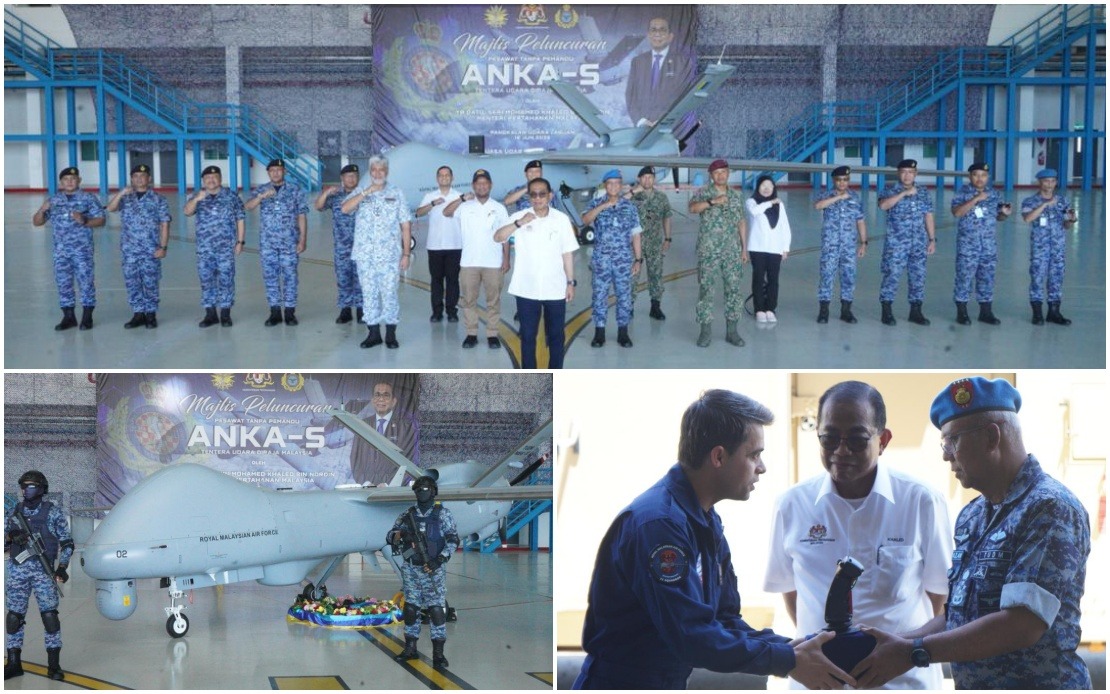
Malaysia has taken a significant step toward modernising its maritime defence infrastructure with the operational deployment of the ANKA-S Unmanned Aircraft System by the Royal Malaysian Air Force. Launched at the RMAF Labuan Air Base, the medium-altitude long-endurance platform represents a technological upgrade that addresses long-standing gaps in the nation's ability to monitor one of the world's busiest and most strategically contested ocean zones. Defence Minister Datuk Seri Mohamed Khaled Nordin underscored the importance of this acquisition, framing it as essential to protecting Malaysia's maritime interests and maintaining situational awareness across the South China Sea.
The three ANKA-S aircraft, procured at a total investment of RM423.8 million including ground control stations and two years of comprehensive personnel training, have been designed specifically to operate in the demanding conditions that characterise Malaysia's maritime environment. Their stationing at Labuan, positioned strategically in the northeastern approaches to Malaysia's maritime zones, will enable continuous monitoring of shipping lanes and territorial boundaries. The platform's capability to remain airborne for more than 24 hours while maintaining operational altitude of up to 30,000 feet fundamentally changes the calculus of maritime surveillance, allowing the RMAF to maintain persistent coverage across vast ocean expanses without relying on continuous manned aircraft rotations.
The introduction of this system addresses a critical vulnerability in Malaysia's defence posture. Previously, maritime surveillance relied heavily on manned fighter aircraft and naval vessels, both of which entail substantial operational costs and cannot maintain the continuous presence necessary for effective monitoring of disputed waters. The ANKA-S enables all-weather operations, allowing the RMAF to maintain surveillance capability regardless of meteorological conditions—a considerable advantage given Southeast Asia's tropical climate patterns. Moreover, the drone's ability to operate in positions difficult to detect provides an intelligence-gathering advantage while minimising diplomatic friction that more visible aerial operations might generate.
Beyond raw endurance and range, the system's sensor suite offers substantial analytical advantages for Malaysian authorities. The platform can accurately identify and classify vessel profiles, enabling rapid distinction between commercial traffic, fishing vessels, and potential intruders. This capability transforms how Malaysia approaches maritime enforcement, shifting from reactive patrols covering entire zones to precision deployments directed at verified intrusion locations. The resulting efficiency gains translate directly into cost savings, as the RMAF can concentrate resources on genuine security concerns rather than conducting unproductive blanket patrols across maritime territories. Defence officials emphasised that this intelligence-driven approach reduces operational expenditure while improving security outcomes.
The deliberate decision to deploy the ANKA-S without weaponry carries substantial geopolitical weight, particularly given regional sensitivities surrounding military capabilities in the South China Sea. By choosing not to equip the aircraft with offensive systems despite their technical capacity to carry weapons, Malaysia has signalled a commitment to defensive rather than aggressive positioning. This posture distinction carries implications for how neighbouring nations and global powers perceive Malaysia's intentions, potentially reducing tensions that might otherwise emerge from the deployment of armed surveillance platforms. The choice reflects broader Malaysian diplomatic strategy that prioritises the protection of sovereignty without provocative displays of military capability.
The government's consideration of a second acquisition phase, involving three additional ANKA-S aircraft under a future development planning cycle, suggests confidence in the platform's operational utility and integration with existing RMAF capabilities. Expansion of the fleet would significantly extend Malaysia's persistent surveillance coverage, enabling simultaneous monitoring of multiple critical maritime zones and providing redundancy for maintenance cycles. The proposal's inclusion in national development planning frameworks indicates that civilian oversight structures are engaged in evaluating the procurement, ensuring that defence acquisitions undergo appropriate budgetary scrutiny and strategic assessment.
For Malaysia, the ANKA-S deployment occurs amid broader regional dynamics that have intensified competition for control and influence over South China Sea resources and shipping routes. China's extensive surveillance and military infrastructure development has raised concerns among Southeast Asian nations about monitoring capabilities disparity. The acquisition of advanced unmanned systems helps Malaysia narrow this gap, providing technological tools comparable to those deployed by major powers. However, the platforms' relatively modest numbers mean Malaysia remains dependent on international partnerships and alliances to achieve comprehensive regional surveillance coverage alongside domestic capabilities.
The presence of senior defence establishment figures at the launch—including the Defence Ministry secretary-general, Chief of Navy, Chief of Air Force, and Joint Forces Commander—reflected the system's strategic importance to Malaysia's integrated defence architecture. This high-level engagement signals that the ANKA-S represents more than a procurement transaction; rather, it constitutes an operationalised component of evolving security strategy. The integration of the platform with existing RMAF assets, command structures, and intelligence networks will require substantial training investments and procedural adjustments, with the included two-year personnel training programme providing foundational capability development.
The Data Exploitation Centre witnessed during the launch event highlights an often-overlooked dimension of modern surveillance operations: the intelligence processing infrastructure required to convert raw sensor data into actionable insights. The volume of information that a 24-hour endurance platform generates daily far exceeds what traditional manned aircraft operations produce, necessitating sophisticated analytical systems and trained personnel capable of interpreting imagery and signals data. Malaysia's investment in such centres reflects recognition that technological capability without analytical capacity merely creates overwhelming information streams rather than operational advantages.
For regional stakeholders, Malaysia's acquisition raises questions about broader Southeast Asian defence modernisation trajectories and the implications for power balance in contested waters. Vietnam and Indonesia have pursued similar unmanned systems acquisitions, suggesting a region-wide recognition that persistent surveillance platforms represent essential components of contemporary maritime security frameworks. The interconnected nature of these regional acquisitions creates potential for enhanced maritime domain awareness through intelligence sharing, though such cooperation remains complicated by competing sovereignty claims and strategic divergences among Southeast Asian nations.
The investment in advanced unmanned systems also reflects Malaysia's broader technological modernisation agenda, encompassing civilian and defence applications. The commercial drone industry's rapid advancement has generated spillover benefits for military programmes, with proven technologies being adapted for defence purposes. This convergence between civilian and military technological development creates opportunities for cost-sharing and capability development that purely military procurement channels might not achieve. Malaysia's willingness to integrate such systems demonstrates openness to leveraging global technological innovation for domestic security purposes.
Looking forward, the ANKA-S deployment represents a first phase in what appears to be longer-term modernisation of Malaysia's maritime surveillance infrastructure. As the initial three aircraft become operationalised and their utility validated through sustained operations, the proposed expansion phase will likely proceed with strong institutional support. The effectiveness of these platforms in identifying unauthorised intrusions, tracking fishing vessel incursions, and maintaining general situational awareness will directly influence future procurement decisions and potentially shape how Malaysia approaches maritime enforcement across its expansive ocean territories.