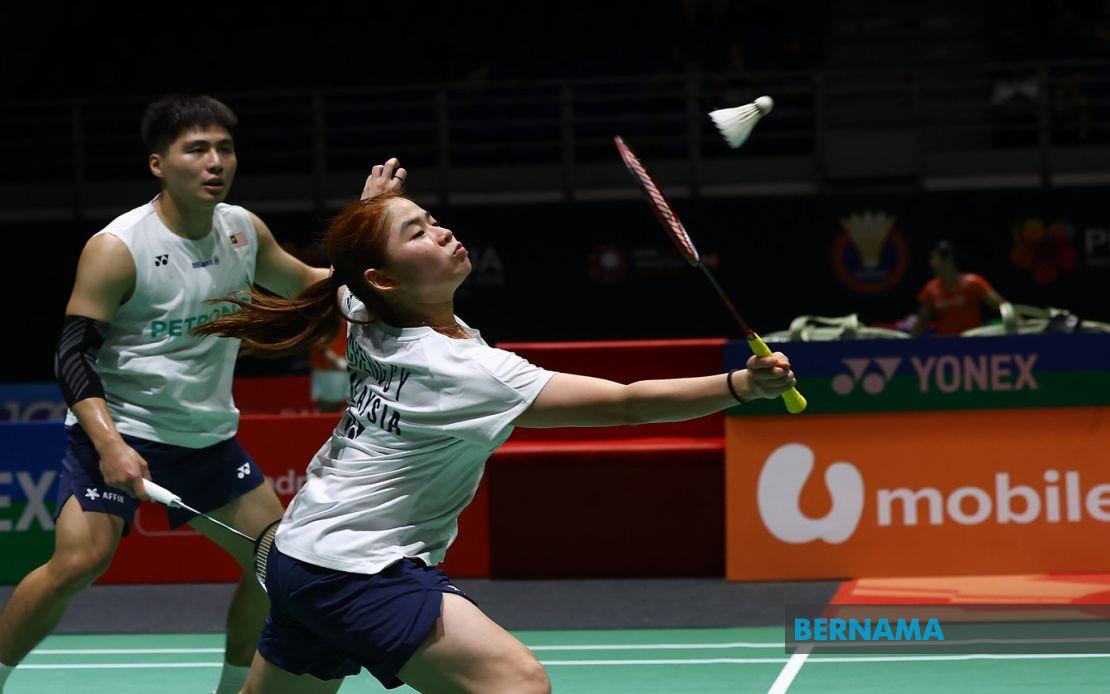
Malaysia's bid to claim medals at the 2026 Japan Open came to an end on July 18 when the nation's remaining badminton contingent exited the tournament in the semi-finals. Two pairs — the mixed doubles combination of Jimmy Wong and Cheng Su Yin, alongside the men's doubles team of Goh Sze Fei and Nur Izzuddin Rumsani — fell short of reaching the championship matches, marking the conclusion of what had been a promising campaign for the Malaysian contingent in Tokyo.
Jimmy Wong and Cheng Su Yin's remarkable run through the tournament came to an end at the hands of Hong Kong's Tang Chun Man and Tse Ying Suet. The Malaysian pair, who had entered the competition as unseeded players and impressed observers with their performances against higher-ranked opposition, fell 17-21, 21-18, 21-15 in a demanding 69-minute contest that tested both their physical endurance and tactical acumen. The match showcased the calibre of Malaysia's emerging mixed doubles talent, even as the experienced Hong Kong pairing proved too formidable in the crucial moments.
Despite the defeat, the performance by Jimmy Wong and Cheng Su Yin reflected considerable credit on Malaysian badminton. Their pathway through the tournament had defied expectations for an unseeded pairing, and their ability to compete meaningfully against some of the world's elite mixed doubles combinations demonstrated that they possess the technical skills and competitive temperament required at the highest levels of international badminton. The pair's semi-final appearance alone represented significant progress for a relatively young partnership.
The men's doubles bracket provided equally disappointing outcomes for Malaysia. Goh Sze Fei and Nur Izzuddin Rumsani encountered South Korea's Kim Won Ho and Seo Seung Jae, a duo ranked first in the world standings. The Malaysian pair mounted a spirited challenge across their 58-minute encounter, refusing to concede without resistance despite the formidable opposition.
The match unfolded in contrasting fashion across its three games. In the opening set, Malaysia struggled to establish rhythm and control, surrendering the frame decisively with a 12-21 scoreline that suggested the South Koreans might dominate the encounter. However, Goh and Nur Izzuddin demonstrated resilience by recalibrating their approach and strategy, producing a dominant 21-11 performance in the second game to level proceedings and set up a decisive final set. The third game proved decisive, with the world number one pair securing a 21-13 victory to advance to the championship.
The history between these two pairings adds context to the semi-final result. Goh Sze Fei and Nur Izzuddin Rumsani have now lost three times in five competitive meetings against Kim Won Ho and Seo Seung Jae, indicating that while the Malaysian duo has occasionally competed evenly with the South Koreans, the weight of experience and ranking typically prevails when the matches matter most. This pattern reflects the broader challenge facing Malaysian badminton in consistently matching the elite performers from regional rivals.
The elimination of both Malaysian pairs marks a sobering conclusion to what had appeared to be a solid campaign for the country's badminton fraternity at this prestigious international tournament. The Japan Open remains one of the most significant badminton competitions on the global calendar, attracting the world's best players and offering substantial prize money and ranking points. For Malaysian players to progress to semi-final stages indicates competitive depth, yet the failure to convert those positions into final appearances suggests gaps remain against the very highest tier of international opposition.
The results offer important lessons for the Malaysian badminton coaching staff and administrative bodies. While both pairs performed creditably and showed glimpses of capability to trouble elite combinations, the consistency required to sustain challenges over multiple games and crucial moments still eludes them. The mixed doubles pair's inability to close out the match despite competitive scorelines, and the men's doubles team's struggle to maintain early momentum, highlight technical and mental areas requiring further development.
For Malaysian badminton moving forward, these performances carry implications for strategic planning. The visibility of Malaysian pairs at this level demonstrates that investments in player development and coaching infrastructure are producing international-standard athletes. However, the gap between reaching semi-finals and contending for titles suggests that bridging from competitive participation to medal-winning performances requires sustained effort and refinement of preparation methodologies. The pathway is clear, but the execution remains the challenge.

