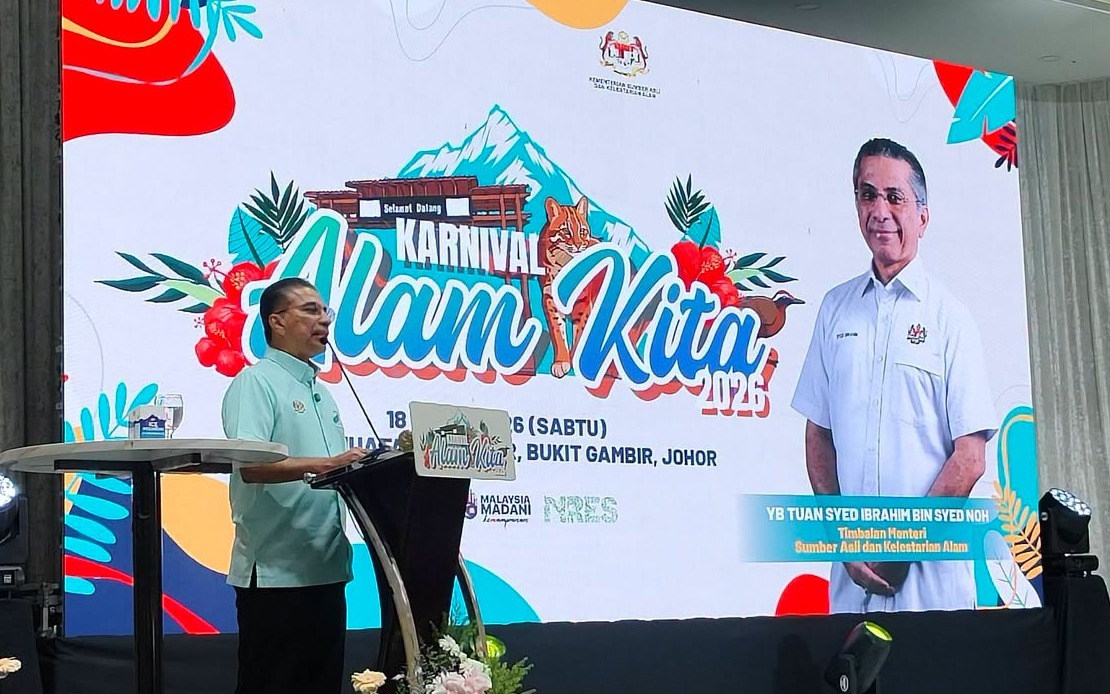
The Karnival Alam Kita (KAK) 2026, a major environmental awareness initiative orchestrated by the Ministry of Natural Resources and Environment (NRES), has expanded its footprint into Johor with an expanded mandate to embed conservation consciousness into household routines and community practices. Launched at the Dewan Muafakat Bukit Gambir in Tangkak, the carnival represents a strategic pivot away from top-down environmental messaging towards participatory, ground-level engagement that allows residents to witness sustainability principles in tangible, implementable form.
Deputy NRES Minister Syed Ibrahim Syed Noh articulated the philosophical underpinning of this year's approach, emphasising that the carnival functions as a mobile knowledge-transfer platform delivering environmental information, technological solutions, practical services, and economic opportunities directly into communities. Rather than confining sustainability discourse to government offices and academic conferences, the initiative recognises that behaviour change emerges most readily when citizens can observe, interact with, and personally experiment with green practices in familiar contexts. This decentralised model reflects growing international consensus that environmental governance succeeds only when it dissolves the perceived distance between policy frameworks and household decision-making.
Central to the NRES vision is the reframing of environmental responsibility as a distributed rather than centralised burden. Syed Ibrahim stressed that sustainability cannot remain the exclusive domain of environmental ministries, but must instead become embedded within family units, educational institutions, workplaces, and neighbourhood associations. This formulation acknowledges a persistent challenge within Malaysia's sustainability agenda: the difficulty in translating broad environmental concepts—rare earth elements, electronic waste streams, climate mitigation targets, and forest conservation—into language and frameworks that resonate with ordinary citizens and persuade them that individual actions carry material consequence.
The gap between environmental awareness and environmental action has historically plagued Malaysia's green initiatives. Citizens may intellectually accept that climate change or biodiversity loss represents a threat, yet struggle to perceive how their purchasing decisions, waste segregation habits, or energy consumption patterns connect to these macro-level phenomena. The KAK 2026 explicitly confronts this perception gap by establishing cognitive bridges between daily life and environmental outcomes. By presenting sustainability not as austere sacrifice but as accessible lifestyle modification generating tangible benefits, the carnival attempts to overcome the psychological distance that typically separates people's stated environmental values from their actual consumption behaviours.
A particularly significant component of the Johor launching involved the inauguration of the Young Environmental Ambassador Programme, a structured training initiative targeting secondary school students. This youth-focused dimension recognises that environmental consciousness formed during adolescence tends to demonstrate greater persistence into adulthood than attitudes adopted later in life. By cultivating peer-to-peer environmental messaging through trained young ambassadors, the NRES leverages both generational dynamics and social influence mechanisms to amplify the reach of sustainability education. These young leaders, equipped with training in environmental science and community engagement, become multipliers capable of extending the carnival's impact beyond formal events into schools, families, and social networks.
Paralleling the educational thrust, the NRES orchestrated a waste collection initiative termed KUDAH, executed by the Lestari Squad in partnership with Bateriku (M) Sdn Bhd. This operation moved beyond symbolic gestures to demonstrate measurable environmental impact: collection efforts yielded 37 kilogrammes of waste, including 17.3 kilogrammes of plastic bottles, translating to an estimated reduction of 43.2 kilogrammes of carbon dioxide equivalent. To contextualise this impact for participants, organisers calculated the equivalent of removing a petrol vehicle's emissions over approximately 100 kilometres—a localised metric that renders abstract carbon reductions concrete and relatable.
The carnival's emphasis on electronic waste and used cooking oil recycling campaigns reflects Malaysia's particular environmental vulnerabilities. As a rapidly industrialising economy with growing consumer electronics consumption, Malaysia faces mounting e-waste challenges. Simultaneously, the commercial cooking sector generates substantial used cooking oil streams that, if improperly managed, contaminate waterways and soil. By integrating these practical recycling opportunities into a broader sustainability carnival framework, the NRES positions waste management not as burdensome civic obligation but as accessible participation in a national environmental transition.
The involvement of diverse stakeholders—government bodies, non-governmental organisations, and private sector partners—underscores the recognition that environmental sustainability transcends traditional sectoral boundaries. The carnival model creates spaces where citizens encounter comprehensive information ecosystems addressing environmental challenges from multiple perspectives. Biodiversity exhibitions complement recycling campaigns; green product vendors coexist with technology demonstrations. This diversity communicates implicitly that sustainability encompasses multiple domains and permits varied forms of participation based on individual interests and circumstances.
For Malaysia's regional positioning, initiatives like KAK 2026 carry significance beyond domestic environmental outcomes. Southeast Asia increasingly confronts scrutiny from international partners regarding environmental governance capacity and climate action commitment. A nation that successfully translates sustainability policy into widespread community practice potentially establishes competitive advantage in accessing global green finance mechanisms and maintaining favourable trade relationships with environmentally conscious markets. Johor's selection as an expansion site reflects deliberate strategic calculation: as Malaysia's southern industrial and manufacturing hub, Johor's environmental practices carry outsized influence on the nation's overall sustainability profile.
The carnival's approach also reflects tactical sophistication regarding behaviour modification. Rather than emphasising restriction or sacrifice, messaging highlights opportunities and benefits—economic opportunities through green products, health benefits from reduced air and water pollution, cost savings through energy efficiency. This positive framing acknowledges that sustainability messaging rooted primarily in sacrifice or catastrophe often triggers psychological resistance. By contrast, framing environmental action as enabling desirable outcomes—cleaner communities, healthier families, economic participation in growing green sectors—increases receptiveness and participation likelihood.
Looking forward, the success of KAK 2026 will depend substantially on sustaining momentum beyond carnival periods. One-off events, however well-executed, rarely generate lasting behavioural change absent reinforcement mechanisms. The Young Environmental Ambassador Programme potentially provides such reinforcement by establishing ongoing community touchpoints. Schools serve as natural venues for continuous sustainability messaging, and ambassador-led initiatives can maintain awareness between carnival iterations. Whether the NRES commits sufficient resources to supporting these young leaders through training continuation and project facilitation will substantially influence the initiative's long-term environmental impact.
Malaysia's commitment to achieving net zero carbon emissions by 2050 requires transformations across energy systems, transportation infrastructure, industrial processes, and consumption patterns. Initiatives like KAK 2026 address what might be termed the cultural precondition for such transformations: building widespread recognition that sustainability represents not external imposition but achievable lifestyle enhancement. By bringing environmental practices, technologies, and opportunities directly to communities, the carnival acknowledges a fundamental political reality: durable environmental change emerges only when significant population segments internalise sustainability as consistent with their interests and values rather than constraining them.

