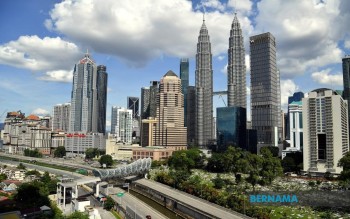
Malaysia's economy expanded at 6.0 per cent in the second quarter of 2026, marking its strongest performance in over a decade outside pandemic years as the government's intervention measures shielded households and businesses from mounting global pressures. Prime Minister Datuk Seri Anwar Ibrahim attributed the outperformance to deliberate policy responses targeting small and medium enterprises, coupled with strategic subsidies and cash assistance programmes designed to sustain consumer spending during a period of significant international turbulence.
The second-quarter result exceeded expectations from both the Department of Statistics Malaysia and international analysts, who had forecast growth of 5.8 per cent, cementing Malaysia's position as an outlier among emerging economies navigating a treacherous global environment. This marks the third consecutive quarter of stronger-than-anticipated expansion, reflecting both structural economic resilience and the effectiveness of coordinated government interventions introduced under the MADANI Economy framework.
The government's response to disruptions stemming from the West Asia conflict illustrates a deliberate strategy to insulate the domestic economy from shocks beyond Malaysia's control. Alongside emergency financing facilities for SMEs facing supply chain complications and input cost pressures, authorities have deployed targeted fuel subsidies and direct cash transfers—including Sumbangan Tunai Rahmah and Sumbangan Asas Rahmah—to bolster purchasing power among lower-income households. These measures represent an attempt to maintain the consumption engine that typically drives Malaysian growth even when external conditions deteriorate.
Inflation management has emerged as a critical success factor in Malaysia's economic performance relative to regional peers. Despite global commodity price increases and widespread supply chain disruptions pushing inflation higher across developed and developing economies, Malaysia has maintained price growth at a contained 1.9 per cent in the second quarter. This relatively benign inflation trajectory reflects both commodity market dynamics favourable to net energy importers and the stabilising effect of targeted subsidies, providing households with tangible relief from rising living costs that might otherwise dampen consumption.
The prime minister's statement acknowledges, however, that aggregate economic performance obscures uneven distribution of benefits across Malaysian society. While headline indicators demonstrate robust expansion, real pressures persist for segments of the population struggling with elevated costs of living, particularly in food and essential services. Certain employment sectors face structural headwinds, with workers experiencing reduced demand or shifting income patterns. This candid recognition distinguishes the government's framing from purely celebratory narratives, instead presenting growth as a foundation upon which targeted support mechanisms must build.
The composition of second-quarter growth reveals an economy bolstered simultaneously by robust domestic demand and a surprisingly resilient external sector. This dual-engine dynamic proves particularly valuable given the uncertainty surrounding global trade flows and the risks posed by persistent geopolitical tensions. Domestic consumption remains supported by employment stability and government transfers, while Malaysia's manufacturing and services sectors continue attracting investment and generating export revenues despite regional complications.
The first-half 2026 growth rate of 5.7 per cent positions the economy comfortably within the government's full-year forecast corridor of 4.0 to 5.0 per cent, suggesting that even accounting for potential deceleration in subsequent quarters, Malaysia should achieve mid-range expectations. This cushion proves psychologically important for policymakers and investors, offering confidence that current trajectory remains sustainable even if external shocks intensify or domestic consumption moderates from current levels.
Geopolitical uncertainty continues to pose measurable risks to Malaysia's economic trajectory, particularly regarding further disruptions to supply chains, elevated input costs, and potential escalation in the West Asia region. Food price volatility remains a particular concern given Malaysia's reliance on imports for substantial portions of its food requirements. Employment pressures in sectors like tourism and export-oriented manufacturing could accelerate if global demand contracts, potentially reversing the consumption gains that have buoyed household spending.
The MADANI Government's emphasis on protecting purchasing power and supporting affected workers and businesses signals recognition that growth without inclusive benefit-sharing risks undermining social cohesion and political legitimacy. Beyond immediate crisis response, the framework appears designed to embed structural support for vulnerable populations, suggesting the government views current challenges as opportunities to reshape social safety nets rather than temporary expedients requiring dismantling once circumstances normalise.
For Malaysian investors and businesses, the strong second-quarter result validates confidence in the domestic economy's fundamentals while highlighting the importance of policy stability and government support mechanisms. The outperformance relative to regional peers and global forecasts suggests Malaysia's policy architecture—combining macroeconomic discipline with targeted interventions—offers advantages in navigating turbulent periods. As the economy moves through the remainder of 2026, sustaining this trajectory will require maintaining the balance between supporting vulnerable households and preserving fiscal sustainability, a challenge that will test policymakers' ability to prioritise effectively amid competing demands.

