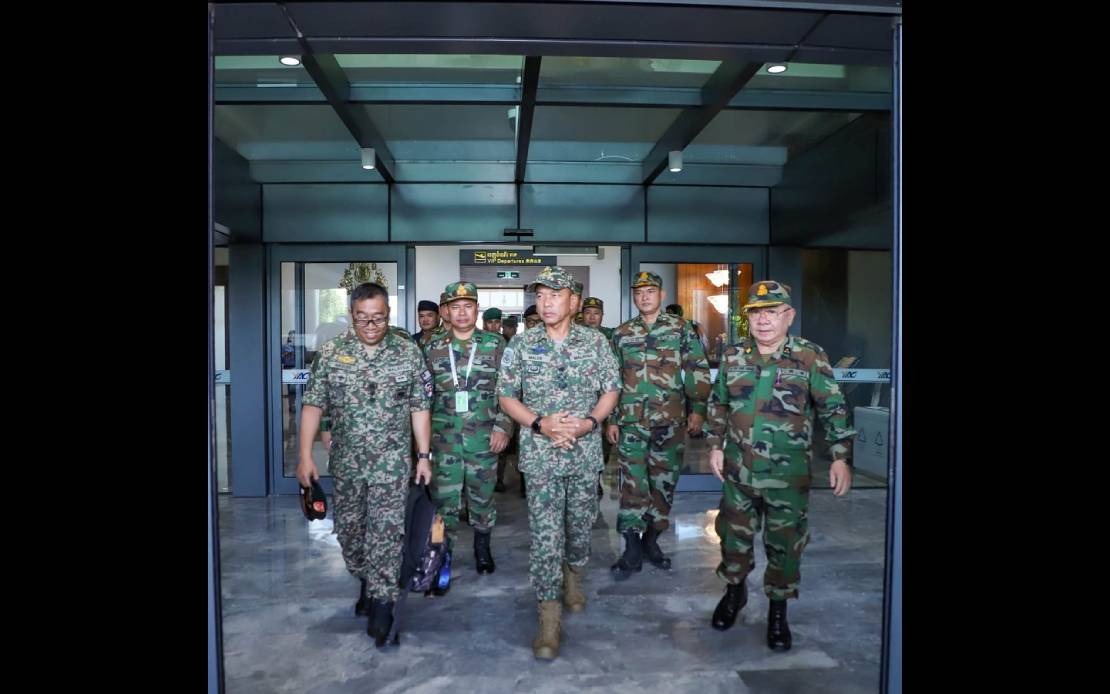
Malaysia's Chief of Defence Force Gen Tan Sri Malek Razak Sulaiman travelled to Cambodia's northwestern Banteay Meanchey province this week to conduct a direct evaluation of security conditions in a border region of strategic importance to Southeast Asia. The visit, undertaken at the invitation of General Vong Pisen, Commander-in-Chief of the Royal Cambodian Armed Forces, runs through July 11 and represents a tangible commitment by Malaysia to remain actively engaged with cross-border security challenges affecting its ASEAN neighbours.
During his time in the province, the Malaysian military leader received comprehensive briefings from the ASEAN Observer Team stationed there, which provided him with current assessments of the security environment in Cambodia's northwestern territory. The AOT furnished Malek Razak with detailed information about the prevailing conditions in the region, enabling him to form a grounded understanding of the challenges and opportunities present in the area. This hands-on approach reflects a deliberate Malaysian strategy to gather intelligence and situational awareness directly from ground-level sources rather than relying solely on diplomatic channels or written reports.
The timing and location of this visit carries particular significance within the broader context of ASEAN's security architecture. Malaysia's decision to inspect the Cambodia-Thailand frontier zone demonstrates Kuala Lumpur's recognition that border stability between member states directly affects the entire regional bloc's cohesion and economic viability. The visit signals that Malaysia takes seriously its responsibilities as an ASEAN member to remain vigilant about and engaged with disputes that could destabilise the region, even when Malaysia itself is not a party to the underlying territorial disagreement.
The ASEAN Observer Team, which was established in response to military confrontations erupting in July 2025 between Cambodia and Thailand over contested border areas, represents an important multilateral mechanism for conflict prevention and monitoring. The AOT's presence and work constitute a concrete example of ASEAN's capacity to mobilise collective mechanisms to address member-state disputes before they escalate into wider regional instability. By visiting the AOT and receiving its assessments, Malek Razak positions Malaysia within this broader peacekeeping architecture, enhancing the mission's legitimacy and demonstrating broad-based member commitment to the ceasefire monitoring process.
Currently, the AOT operates under the stewardship of the Philippines, which holds the chairmanship of ASEAN for the current term. This leadership arrangement underscores how security matters involving ASEAN member states require coordinated engagement across the bloc. The Philippines' role in directing the observer mission creates a forum through which all member states, including Malaysia, can contribute expertise and maintain visibility into the situation. Malaysia's active participation in this framework—through high-level visits and direct engagement with the observation mission—strengthens the collaborative security posture that underpins regional stability.
For Malaysia specifically, engagement with ASEAN security mechanisms carries practical implications for maritime and terrestrial border management. As a nation with extensive maritime claims in the South China Sea and terrestrial borders with Thailand and several other neighbours, Malaysia has a vested interest in ensuring that dispute resolution mechanisms function effectively. The Cambodia-Thailand border situation serves as a test case for ASEAN's ability to manage interstate conflicts through multilateral dialogue rather than military escalation. Success in this instance bolsters confidence in mechanisms that Malaysia itself might one day require if its own border disputes intensify.
The broader geopolitical context amplifies the importance of Malek Razak's visit. The region faces mounting pressures from great power competition, with major external actors seeking to expand influence in Southeast Asia. By demonstrating Malaysia's active involvement in managing intra-ASEAN disputes, Kuala Lumpur reinforces the principle that ASEAN members prefer to resolve their differences through regional mechanisms rather than inviting external powers into these disputes. This approach protects ASEAN's strategic autonomy and prevents border conflicts from becoming vehicles for foreign interference.
Cambodia, as the host nation for this visit, also benefits from Malaysia's direct engagement with its security situation. The arrival of a high-ranking Malaysian military official validates Cambodia's efforts to address the border situation through institutional channels and demonstrates that Cambodia's challenges concern the wider ASEAN membership. Such validation can strengthen the political resolve of Cambodian leadership to pursue negotiated solutions with Thailand rather than permitting the dispute to fester or escalate unpredictably.
Looking forward, Malaysia's engagement pattern with the ASEAN Observer Team and the Cambodia-Thailand border situation will likely influence how other member states approach similar disputes. If Malaysia's involvement produces positive outcomes—such as enhanced stability, improved intelligence-sharing, or diplomatic breakthroughs—other capitals will view similar direct engagement as a worthwhile investment. Conversely, if the situation deteriorates despite such involvement, it may prompt reconsideration of how ASEAN structures its conflict management mechanisms. Either outcome will have ripple effects across Southeast Asian security architecture.
Malek Razak's four-day visit thus represents far more than a routine military-to-military engagement. It embodies Malaysia's philosophy of proactive regional stewardship, its commitment to ASEAN institutional mechanisms, and its preference for collaborative approaches to security challenges that affect the bloc's stability. For Malaysian policymakers and defence strategists, the insights gathered during this visit will inform future approaches to regional security cooperation and contribute to ongoing discussions about how ASEAN can strengthen its capacity to prevent and manage interstate conflicts in an increasingly complex and contested regional environment.

