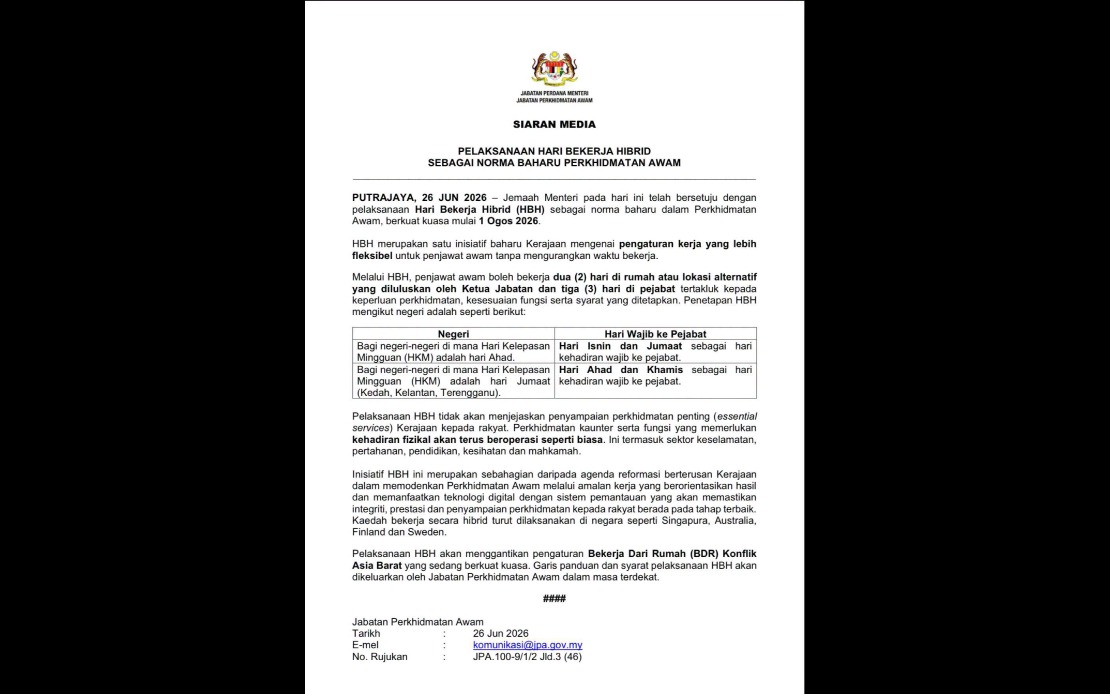
Malaysia's Cabinet has formally endorsed a new Hybrid Work Day (HBH) arrangement that will reshape how the nation's public service operates, with the framework taking effect on August 1. The Public Service Department (PSD) announced the decision on June 26, signalling a significant departure from the pandemic-era Work From Home (WFH) model that has governed remote arrangements for the past few years. This transition represents the government's attempt to balance workforce flexibility with the institutional need for in-office presence and operational continuity.
Under the new hybrid structure, civil servants across Malaysia will be granted the flexibility to work remotely two days per week from their homes or at an alternative location designated by their respective Head of Department. The remaining three working days will be spent at their office premises. However, this arrangement remains conditional on multiple factors, including the nature of public service delivery requirements in each sector, the functional suitability of individual positions, and any special conditions stipulated by departmental leadership. This nuanced approach acknowledges that different government agencies have vastly different operational needs and cannot adopt a one-size-fits-all remote work policy.
The government has explicitly prioritised the continuation of essential public services during the transition to HBH. Services requiring physical counter presence, such as those in security, defence, education, healthcare, and the judicial system, will maintain their normal operational patterns without disruption. This safeguard reflects official concerns that hybrid arrangements, if poorly managed, could create bottlenecks in critical government functions and undermine public confidence in service delivery. The PSD has taken pains to reassure stakeholders that the restructuring is designed to enhance work practices rather than compromise public sector responsiveness.
Regional variations in the implementation reflect Malaysia's federal structure and the different weekend practices observed across states. For the majority of states where Sunday serves as the Weekly Rest Day (HKM), the government has designated Monday and Friday as mandatory office attendance days. This ensures that most of the working week has consistent in-office presence, particularly at the beginning and end of each week. Conversely, in the three states of Kedah, Kelantan, and Terengganu, where Friday is observed as the weekly holiday, Sunday and Thursday have been set as compulsory office days. This differentiation demonstrates administrative sensitivity to local practices while maintaining the core principle of structured hybrid work.
The adoption of hybrid work arrangements sits within a broader modernisation agenda for Malaysia's public service sector. Officials have framed HBH not merely as a concession to workforce preferences but as part of a comprehensive reform strategy focused on results-based work practices and enhanced digital technology integration. By shifting emphasis from physical presence to measurable outcomes, the government hopes to align the civil service with contemporary management philosophies and improve overall efficiency. This ideological reframing suggests that the move towards hybrid work is intended to signal a new era of progressive public sector management.
International precedent has informed Malaysia's decision-making process on this matter. The PSD highlighted that hybrid work arrangements have already been successfully implemented in developed economies including Singapore, Australia, Finland, and Sweden. These references serve multiple purposes: they lend credibility to the Malaysian initiative by associating it with governance models in economically advanced nations, they suggest that such arrangements are compatible with high standards of public service, and they implicitly position Malaysia as joining a global trend towards flexible work arrangements. However, the applicability of these models to the Malaysian context, with its distinct governance structure and service delivery landscape, remains an important consideration.
To ensure that the transition does not compromise institutional integrity or workforce accountability, the PSD has committed to establishing a comprehensive monitoring mechanism. This system will be tasked with tracking employee performance, measuring service delivery standards, and maintaining ethical compliance across the civil service. The emphasis on monitoring reflects government awareness that hybrid arrangements introduce complexities in workforce supervision and performance evaluation. Without robust oversight mechanisms, hybrid work could potentially become a liability rather than an efficiency gain, particularly in sectors where public accountability is paramount.
The announcement arrives at a moment when Malaysia's labour market is undergoing significant transformation, with private sector companies increasingly adopting flexible work policies to attract and retain talent. By moving towards hybrid arrangements for civil servants, the government positions itself as a competitive employer capable of modernising its workplace culture. This carries particular significance for mid-career professionals and younger government employees who may otherwise gravitate towards private sector opportunities offering greater flexibility. The HBH framework thus functions as both a modernisation initiative and a subtle tool for civil service retention.
Implementation of the new framework will occur in phases, with the PSD promising detailed guidelines and specific operational conditions to be released at a later date. This phased approach suggests that the government recognises the complexity of rolling out such a significant policy change across numerous agencies with differing operational requirements. The delay in releasing comprehensive guidelines, while potentially frustrating to departments eager for clarity, allows space for departmental consultation and problem-solving before the August 1 deadline. Agencies will need to calibrate their specific HBH policies to align with both the national framework and their particular operational contexts.
The HBH initiative carries implications beyond Malaysia's borders. As a regional economic leader, Malaysia's adoption of progressive workplace policies may influence labour practices across Southeast Asia, particularly among government organisations seeking to modernise their operations. The framework demonstrates how a developing nation can adopt contemporary work arrangements while maintaining strict accountability standards and public service delivery commitments. For Malaysia specifically, the transition represents a test case for whether the civil service can successfully manage workforce flexibility without sacrificing the bureaucratic discipline that has historically characterised the public sector.

