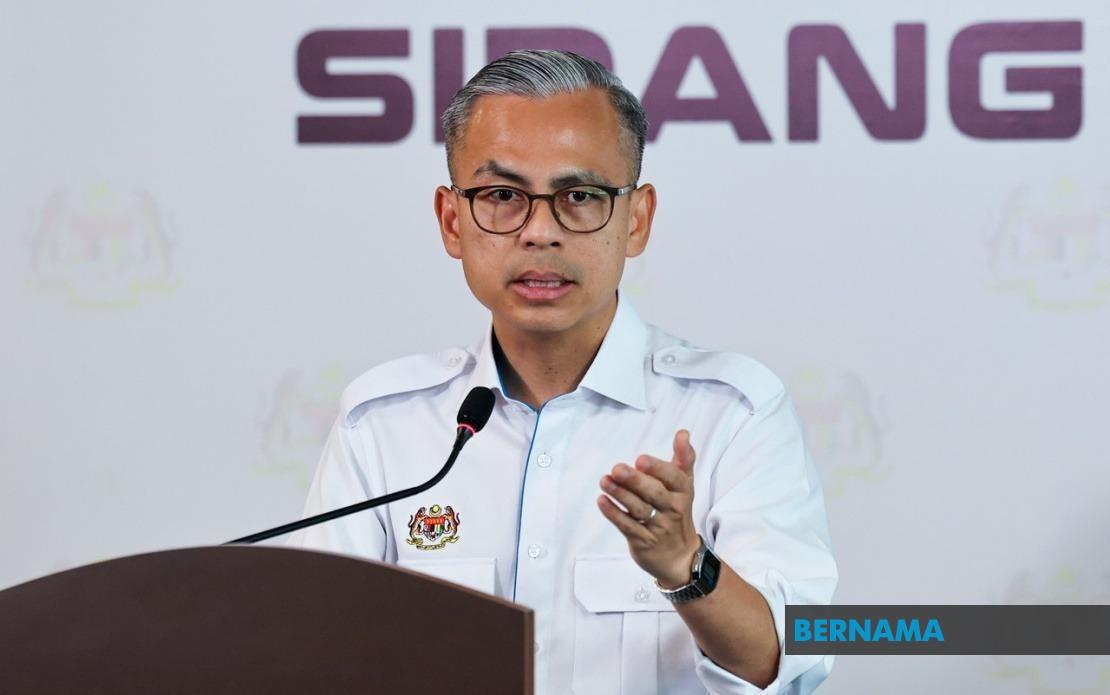
Preparations for Malaysia's 2026 National Day and Malaysia Day celebrations at Dataran Putrajaya have reached an advanced stage, with organisers confident that nearly all operational aspects will be finalised following tomorrow's comprehensive dress rehearsal. Communications Minister Datuk Seri Fahmi Fadzil, who chairs the main committee overseeing the festivities, confirmed the significant progress made during today's rehearsal inspection, noting that only minor adjustments remain to perfect the execution of what promises to be a landmark national celebration.
The refinements now underway centre primarily on logistics and spatial choreography rather than substantive structural concerns. Fahmi highlighted that coordinators have identified spacing irregularities between parade contingent formations, where certain groups trail noticeably far behind their predecessors, disrupting the visual cohesion and disciplined flow expected of such high-profile state ceremonies. Tightening these intervals and synchronising movement patterns across all participating units will enhance the overall aesthetic and symbolic impact of the procession, reflecting the unity and order that organisers aim to project on Malaysia's national stage.
Today's rehearsal proceeded smoothly, buoyed by cooperative weather and the enthusiastic participation of all involved parties. Security personnel, students from three participating states, and military units demonstrated the commitment necessary for executing such logistically complex events. The visible morale and energy among participants suggested that despite the scale of coordination required, the human element of the celebration remains fully engaged and motivated to deliver a memorable spectacle for national and international audiences.
Several novel elements will distinguish the 2026 edition from previous National Day parades, elevating its distinctiveness and relevance to contemporary Malaysia. The Johor Military Force will make its inaugural appearance in the parade formation, marking an expansion of ceremonial military representation. More symbolically significant is the participation of the Ibrahim-class maritime vessel, a naval asset personally designed by His Majesty Sultan Ibrahim, King of Malaysia, which will feature prominently among the procession's attractions. These additions underscore how the celebrations blend traditional pageantry with innovation and reflect the patronage of the nation's highest office.
A centrepiece of this year's human graphics performance involves an elevated multi-level structure supporting 1,500 student performers, whose coordinated movements create large-scale visual patterns visible from elevated vantage points. Concerns have arisen regarding both the structure's stability and its geometric alignment, yet Fahmi provided detailed reassurance addressing these technical matters. Putrajaya Corporation has conducted thorough safety assessments confirming that the observable slight movement of the platform falls entirely within engineering tolerance parameters designed to accommodate the rhythmic choreography of the student formations without compromising structural integrity.
The structure's minor asymmetrical positioning, which has drawn attention among observers, stems from practical geometric constraints rather than construction deficiency. The parade route and adjacent PPj administrative buildings operate on different architectural axes, creating an inherent misalignment that cannot be easily rectified without major infrastructure modification. Additionally, organisers reduced the number of student participants from the originally planned 2,000 to 1,500, a decision that naturally altered the spatial relationship between performers and the platform's dimensions. This structural accommodation now requires careful positioning to maintain both safety and visual balance.
Fahmi acknowledged the positioning concerns and indicated that while current arrangements meet all safety and functional requirements, future iterations of the National Day parade will incorporate technical refinements to address any residual negative perceptions. This forward-looking approach suggests that organisers view the 2026 celebration not merely as a one-time event but as part of an evolving tradition that can incorporate lessons learned and continuous improvement across consecutive editions. Such institutional learning reflects growing sophistication in how major national ceremonies are planned and executed.
The confidence expressed regarding near-completion of all preparations carries particular significance for Malaysia's international image. National Day celebrations represent moments when countries showcase their organisational capacity, national cohesion, and cultural identity to both domestic audiences and the wider world. For a nation navigating complex multicultural society and regional geopolitical dynamics, executing a flawlessly coordinated pageant demonstrates administrative competence and national unity that resonates beyond ceremonial symbolism.
Looking ahead to tomorrow's final full-scale rehearsal, organisers will focus on validating operational procedures, confirming timing across all contingent movements, and identifying any last-minute adjustments required before the actual celebration date. The dress rehearsal serves as the critical test run where problems can be rectified without impact to the real event, and where all participating agencies can validate their coordination and response protocols. Should this final rehearsal confirm the near-complete status reported today, it will position Malaysia to deliver a celebration that reflects both traditional pageantry and contemporary standards of precision and excellence expected of the nation's premier national observance.

