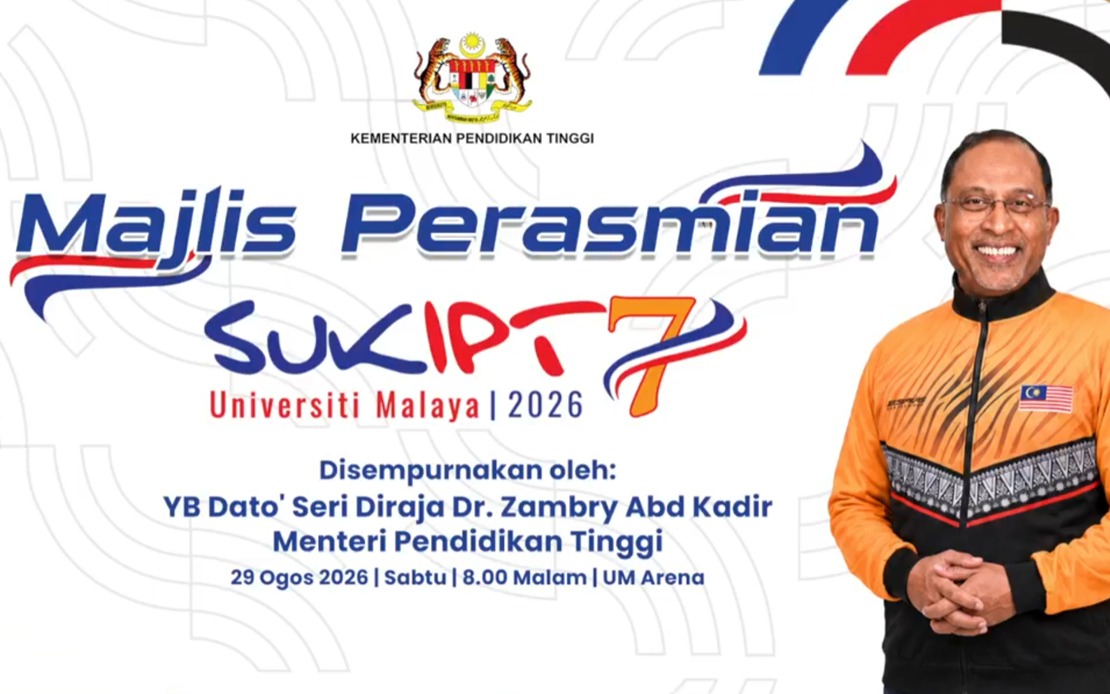
Malaysia's higher education institutions are proving themselves as genuine incubators for international sporting talent, according to Higher Education Minister Datuk Seri Dr Zambry Abdul Kadir, who pointed to a string of recent victories as evidence that university sports can forge a pipeline for national athletic excellence. Speaking at the opening ceremony of the Higher Education Institution Games (SUKIPT) 2026 at Universiti Malaya (UM) Arena in Kuala Lumpur, Zambry underscored the strategic importance of channelling university students toward competitive sport, not merely as an extracurricular pursuit but as a deliberate pathway to international success.
The minister's remarks come at a significant moment for Malaysian university athletics. Recent performances at the Glasgow 2026 Commonwealth Games have validated this vision, with IPT athletes capturing medals across disciplines and establishing themselves as legitimate contenders on the global stage. Zambry emphasized that these achievements represent more than isolated victories; they exemplify the potential within the country's student population and signal that Malaysian competitors can compete credibly against the world's best. His framing of university sports as a mechanism for national pride reflects a growing recognition that talent development must begin in tertiary institutions, where athletes can balance rigorous training with academic pursuit.
Among the standout performers Zambry highlighted were Muhammad Erry Hidayat from Universiti Putra Malaysia (UPM) and Muhammad Aniq Kasdan from Universiti Teknologi MARA (UiTM), both of whom claimed gold medals in weightlifting at the Commonwealth Games—Hidayat in the men's 79-kilogramme category and Kasdan in the men's 60kg division. These victories demonstrate that Malaysian university athletes possess the technical skill and mental fortitude required to succeed in strength sports, traditionally dominated by specialists from larger sporting nations. The weightlifting medals are particularly significant as they reflect years of coaching investment and athlete dedication within the university system.
Judo, meanwhile, has become another arena for Malaysian university sport to make its mark. Amir Daniel Abdul Majid from Universiti Sains Malaysia (USM) etched his name into the history books by securing gold in judo at the Commonwealth Games, becoming the first Malaysian athlete to win a Commonwealth gold medal in the sport. This breakthrough is especially noteworthy because judo has historically been a secondary priority in Malaysia's sporting hierarchy, dominated by athletes from larger nations. Majid's victory suggests that with proper coaching structures and institutional support within universities, Malaysian competitors can establish excellence in disciplines previously considered peripheral to national sport. Additionally, Amirul Daniel Abdul Rahim from Universiti Malaya (UM) contributed a bronze medal in lawn bowls, further diversifying the medal haul across multiple sports and proving that university excellence transcends athletics and weightlifting alone.
The domestic arena has similarly witnessed impressive record-breaking performances. Omar Osman from Politeknik Sultan Ibrahim has shown his prowess in the 400 metres, while Muhammad Fadwah from UiTM and Danish Iftikhar Muhammad Rosli from Universiti Pendidikan Sultan Idris (UPSI) have shattered Malaysia Games (SUKMA) records in the 200 metres and 4x100 metres relay. These domestic breakthroughs are significant because they establish new benchmarks that future athletes must aspire to reach, creating a competitive environment within university sport that elevates overall standards. Record-breaking performances also generate momentum and media attention, inspiring younger students to view elite sport as an achievable pathway rather than an exclusive pursuit.
The SUKIPT 2026 competition itself reflects the scale and ambition now embedded within Malaysia's university sports infrastructure. Running from August 28 through September 6 at Universiti Malaya, the seventh edition of the games assembles 64 contingents across 20 public universities, 42 private higher education institutions, one polytechnic, and one community college, fielding 8,244 athletes and officials competing in 30 sports. This breadth of participation—spanning public and private sectors, polytechnics, and community colleges—demonstrates that university-level sport development is no longer confined to elite institutions but has become a nationwide phenomenon.
The tournament's financial incentive structure reveals institutional commitment to excellence. Organisers have allocated RM3,000 cash prizes for individual Sportsman and Sportswoman of the Games awards, RM7,000 for Best Male and Female Team honours, and a substantial RM20,000 for athletes who break national records during competition. These rewards serve dual purposes: they acknowledge athletic achievement immediately and encourage competitors to pursue excellence even at the university level, recognizing that record-breaking performances carry tangible value. The 227 gold medals available across the competition emphasize that SUKIPT remains fundamentally about excellence and achievement, not mere participation.
The thematic focus on 'Creating a Legacy of Champions' carries deeper implications for Malaysian sports policy. By framing university competition as a mechanism for establishing lasting legacies, organisers signal that success at SUKIPT should not be temporary or episodic but rather foundational to athletes' longer-term careers. This philosophy aligns with best practices internationally, where university systems in countries like Australia, Canada, and the United States function as genuine talent pipelines feeding national teams and Olympic delegations. For Malaysia, embracing this model could significantly elevate the nation's competitive standing across multiple sports.
Zambry's emphasis on universities daring to challenge records and elevate Malaysia's international standing reflects an important strategic pivot in how the nation conceptualizes sports development. Rather than treating university competition as separate from elite sport, the minister positioned it as directly contributory to national excellence. This integration is crucial because it justifies continued investment in university sports infrastructure—facilities, coaching, scholarships—as genuine returns to national competitive capacity rather than discretionary educational spending.
The success narratives emerging from Malaysian universities also challenge regional perceptions about the nation's sporting capabilities. Neighbouring countries have long dominated disciplines like weightlifting and martial arts, and Malaysian breakthroughs in these areas suggest shifting competitive dynamics within Southeast Asia. As university-level athletes continue achieving Commonwealth and potentially Olympic success, Malaysian sport stands to gain elevated status and profile within regional sporting organisations, influencing how nation-state competition is structured and perceived across Asia.
Looking forward, Zambry's vision implies that university sport investment should not fluctuate based on immediate results but rather be sustained as foundational infrastructure. The Glasgow 2026 Commonwealth Games performances, combined with domestic record-breaking, demonstrate that this patient investment yields returns. For Malaysian policymakers, educators, and sporting bodies, the message is clear: universities are not merely educational institutions but can legitimately function as elite talent development centres, provided they receive appropriate resources, strategic guidance, and institutional commitment.
The broader significance extends beyond medals and records. By showcasing Malaysian university athletes on international stages, institutions build pride within the education sector itself and attract student-athletes who might otherwise pursue sport outside formal education channels. This creates a virtuous cycle where university excellence attracts talent, which generates success, which inspires future cohorts. For a nation seeking to establish itself as a serious sporting force regionally and globally, investing in university sport represents not a diversion from national sporting objectives but rather their most promising avenue of realisation.

