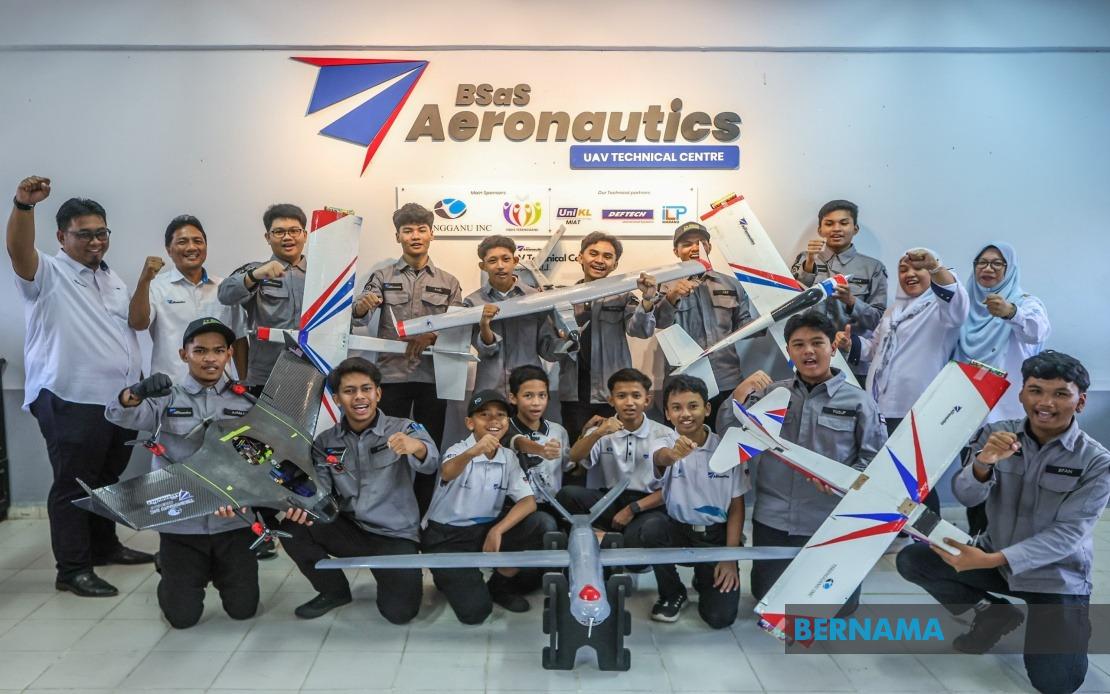
An initiative at SMK Bukit Sawa in Marang is proving that hands-on aerospace education can flourish in Malaysian schools. The TI-BSAS UAV In School programme has enabled 35 students to design and build their own unmanned aerial vehicles using industrial-grade techniques and materials, marking a significant step forward in vocational technology training at the secondary level. The project, which commenced in 2023 and continues to expand, represents a growing recognition that practical engineering skills must be developed earlier in students' educational journeys to build local capacity in advanced manufacturing sectors.
Badrul Hisyam Zakaria, an English teacher who has spearheaded the initiative, has collaborated with two fellow educators to guide students through the full aircraft development cycle. Each completed UAV represents an investment of between RM6,000 and RM10,000 and incorporates full aircraft specifications alongside Global Positioning System (GPS) technology for autonomous target tracking. Rather than importing pre-assembled kits, the school has adopted genuine engineering methodology, allowing students to understand not just how UAVs operate but the underlying principles of aeronautical design and systems integration. This pedagogical approach transforms what could be a rote learning experience into authentic problem-solving that mirrors actual industry practice.
The programme's trajectory reflects deliberate scaling and technological advancement. Current UAV models employ GPS-based targeting systems that function according to predetermined flight parameters. However, development teams are now progressing toward more sophisticated platforms equipped with artificial intelligence capabilities that can visually identify and track targets without preprogrammed coordinates. This evolution demonstrates that the school is not simply replicating existing designs but actively participating in technological innovation, albeit at an educational scale. The shift toward AI-enabled systems positions participating students at the frontier of contemporary UAV development rather than confined to legacy technologies.
The real measure of the programme's success extends beyond the vehicles themselves. SMK Bukit Sawa captured the championship in the UAV Avionics Integration Challenge for secondary schools at the MyAERO Challenge 2026 at MAEPS, Serdang, Selangor, in June this year, validating the quality and sophistication of student work against competitors from across Malaysia. More significantly, the programme has already demonstrated its capacity to influence career trajectories. Two former participants are currently enrolled in aircraft engineering programmes at Universiti Kuala Lumpur, while three others have gained admission to matriculation-level science streams, suggesting a genuine pipeline effect from secondary education toward tertiary aerospace studies.
Badrul Hisyam has articulated an ambitious long-term vision for the initiative, framing it as a multi-year commitment to talent development rather than a discrete project with defined endpoints. The school intends to track participating students as they progress through their academic and professional journeys, monitoring which participants eventually establish careers within the aviation sector. With systematic development over three to four years, the coordinator anticipates that the first cohort will yield qualified aircraft engineers who have gained foundational knowledge and practical experience while still in secondary school. This longitudinal approach acknowledges that building advanced technical expertise requires sustained engagement and institutional continuity.
The programme's broader objectives extend beyond individual student advancement to address national industrial capacity. Malaysia currently relies substantially on imported aerospace technology and foreign expertise for UAV development and deployment. By cultivating local expertise from the secondary education level upward, the TI-BSAS initiative seeks to establish the human capital foundation necessary for Malaysia to develop indigenous UAV technologies and reduce technological dependence on foreign suppliers. This objective aligns with national aspirations toward greater technological self-sufficiency and the development of knowledge-intensive industries that generate high-value employment.
Terengganu Incorporated, the state-owned investment company, has provided the financial backbone essential for the programme's viability. Since 2023, the organisation has channelled RM75,000 through its corporate social responsibility allocation to support aeronautics and UAV development at SMK Bukit Sawa. The initial commitment of RM45,000 established the foundational infrastructure and materials, while a subsequent RM30,000 injection in 2026 has enabled ongoing operational expenses and technological advancement. Datuk Burhanuddin Hilmi Mohamed, Terengganu Inc's president and group chief executive officer, emphasised that this investment specifically targets students from lower-income households, with the B40 economic cohort representing a priority beneficiary group.
The emphasis on providing early technology exposure to economically disadvantaged students addresses a critical gap in Malaysia's education system. Students from B40 households typically have limited access to advanced equipment, specialised mentorship, and industry connections that wealthier peers take for granted. By implementing such programmes in public secondary schools serving diverse socioeconomic populations, Terengganu Inc and the school are actively working to level educational disparities. This approach recognises that technical talent is distributed across all income levels, but opportunity structures are not, and targeted interventions can unlock capabilities that might otherwise remain dormant.
The collaboration structure reflects sophisticated understanding of educational programme sustainability. The Terengganu State Education Department provides institutional support and curriculum integration, ensuring that the initiative operates within the formal education system rather than as an isolated extracurricular activity. Multiple corporate partners, anchored by Terengganu Inc's significant financial commitment, distribute financial and technical responsibilities. Teachers at the school have received sufficient support and guidance to serve as credible educators rather than external consultants who would be dependent on external expertise. This distributed model increases the probability that the programme can continue and evolve even if specific corporate partners eventually reduce their engagement.
The project demonstrates how secondary schools can become sites of genuine technological innovation rather than purely transmitters of established knowledge. Students are not learning about UAV development through textbooks or simulations but through direct participation in design, construction, testing, and refinement cycles. They encounter real constraints—budgetary limitations, material properties, technical tolerances, and integration challenges—that force genuine problem-solving rather than predetermined exercises with known solutions. This experiential dimension develops practical competencies alongside theoretical understanding, creating graduates better equipped for tertiary studies and professional careers in engineering disciplines.
The broader implications for Malaysian education policy are substantial. The success at SMK Bukit Sawa suggests that secondary students are capable of engaging with sophisticated technological challenges when provided with adequate resources, expert guidance, and institutional support. This finding contradicts assumptions that hands-on advanced technical education should be deferred until tertiary level. Earlier exposure to authentic engineering work may improve retention in STEM subjects, clarify career aspirations before subject selection bifurcations occur, and develop problem-solving dispositions that transfer across disciplines. As Malaysia seeks to develop knowledge-intensive industries and compete globally in advanced sectors, secondary-level technical engagement of this calibre may prove increasingly important.
Looking forward, the TI-BSAS initiative establishes a model potentially replicable across other states and institutions. The programme's framework—combining public school infrastructure, state-level corporate investment, teacher development, and genuine industry collaboration—offers a template for similar ventures. If other states adopt comparable approaches targeting different technical fields aligned with regional economic assets, Malaysia could develop a distributed network of secondary school innovation hubs serving both educational and economic development objectives. The students currently building UAVs at SMK Bukit Sawa may represent the beginning of a broader transformation in how Malaysia prepares young people for technological careers.

