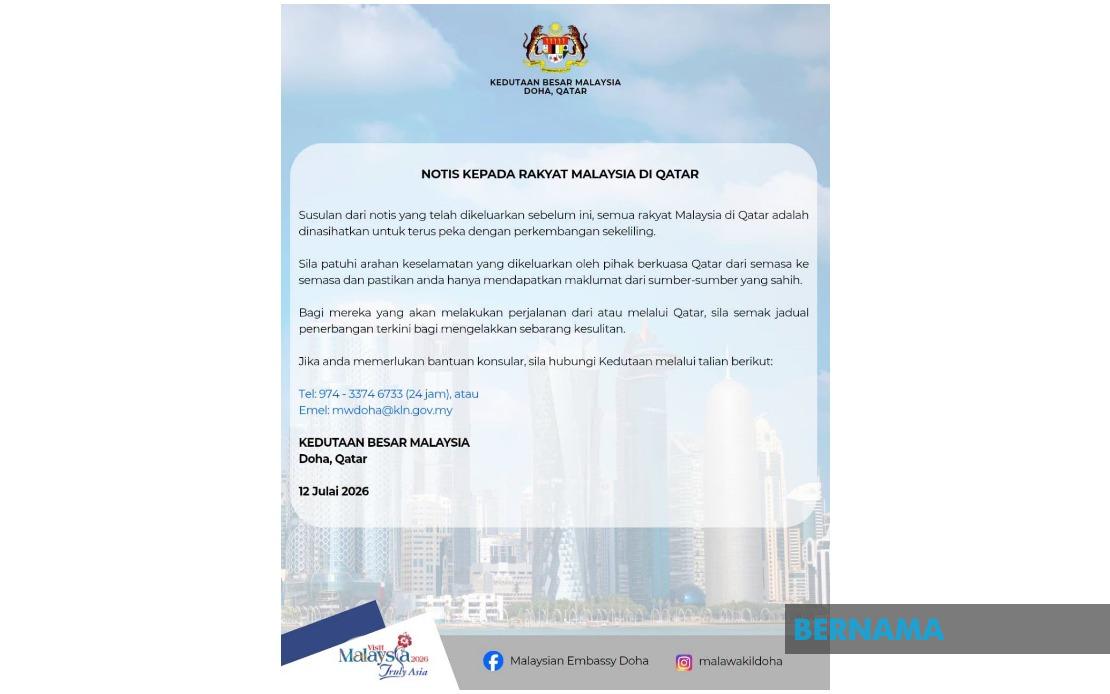
Malaysia's diplomatic mission in Doha has issued fresh security guidance to its nationals in Qatar as military hostilities between the United States and Iran intensify in the Persian Gulf region. The Malaysian Embassy released the advisory through its official social media channels, urging Malaysians to maintain heightened awareness of their surroundings and adhere strictly to any protective measures announced by Qatari authorities. Citizens have also been cautioned to rely exclusively on official and credible sources for information regarding the security situation, underscoring concerns about misinformation during periods of regional instability.
The embassy's alert comes in response to significant military developments that have dramatically raised tensions in one of the world's most strategically vital waterways. On Sunday, American military forces conducted their third major round of strikes targeting Iranian positions within the span of a single week, escalating a cycle of tit-for-tat attacks. The strikes were launched after Iranian military vessels opened fire on a commercial ship navigating through the Strait of Hormuz, a narrow passageway through which approximately one-third of the world's maritime oil trade transits annually.
Iranian authorities have responded with an even more provocative action: the Islamic Revolutionary Guard Corps announced an immediate and indefinite closure of the Strait of Hormuz to all maritime traffic. The announcement stipulated that no vessels would be permitted passage until United States military interventions in the region cease entirely. This blockade represents a dramatic escalation from previous warnings and threatens to disrupt global shipping and energy markets significantly. The closure directly contravenes the terms of a peace agreement signed just weeks earlier between Tehran and Washington.
The resurgence of hostilities is particularly striking given that in June, both nations had reached what appeared to be a major breakthrough. Brokered by Pakistan, the two governments had negotiated a comprehensive memorandum of understanding that was intended to terminate the broader conflict that erupted in late February. The agreement established several key provisions, including an immediate cessation of military operations across all theaters, a commitment by the United States to lift its naval blockade imposed on Iran, and a mutual pledge to restore normal shipping through the Strait of Hormuz.
Despite the existence of this formal accord, the current week's military exchanges demonstrate the fragility of the arrangement and the deep mutual mistrust that continues to characterize relations between Washington and Tehran. The two nations have clashed specifically over the movement of commercial vessels through the strategic waterway, with each side accusing the other of violating the agreement's terms. The situation reflects broader regional anxieties about maritime security and freedom of navigation in waters increasingly contested by multiple military powers.
For Malaysian travelers and residents in Qatar, the implications are substantial. Doha hosts a significant expatriate population, and the country serves as a major hub for international business, with its modern facilities and strategic location attracting companies and professionals from across the region and beyond. Any prolonged security disruption could affect both daily life and business operations. The embassy has therefore advised those planning to travel through or from Qatar to monitor airline schedules closely, as the regional instability may trigger flight cancellations or rerouting.
The timing of the Malaysian Embassy's advisory reflects the diplomatic community's broader concern about the situation. Unlike some smaller nations, Malaysia maintains a substantial diplomatic presence in the Gulf region and takes seriously its obligation to protect and assist its nationals abroad. The 24-hour emergency hotline established by the embassy at +974-3374 6733 represents an important lifeline for any Malaysian requiring immediate consular assistance, whether due to security incidents, medical emergencies, or other critical needs.
The broader context of Malaysia's relationship with Gulf nations adds further significance to this advisory. Malaysia has cultivated increasingly important economic and political ties with countries across the Persian Gulf, including Qatar, and any major regional conflict threatens to disrupt these carefully developed relationships. Trade flows, investment commitments, and diplomatic initiatives could all be jeopardized if the military situation deteriorates further.
The situation also carries implications for Southeast Asian shipping and energy security more broadly. Many ASEAN nations depend on stable transit through the Strait of Hormuz for their oil imports and maritime commerce. Any prolonged closure or military confrontation in this waterway would have cascading effects throughout the region's economies. Malaysia, as one of ASEAN's leading economies and a major maritime trader, would be particularly vulnerable to supply chain disruptions and energy price volatility resulting from further escalation.
What remains uncertain is whether the Pakistan-brokered agreement can survive this latest round of military escalation. The rapid deterioration from diplomatic accord to active hostilities suggests that fundamental disagreements over implementation and verification mechanisms remain unresolved. Both nations appear to be testing each other's resolve and establishing bargaining positions for potential renegotiation. For Malaysians in the region, the embassy's advice to maintain vigilance and follow local directives represents a prudent acknowledgment that the situation could evolve unpredictably in coming days.

