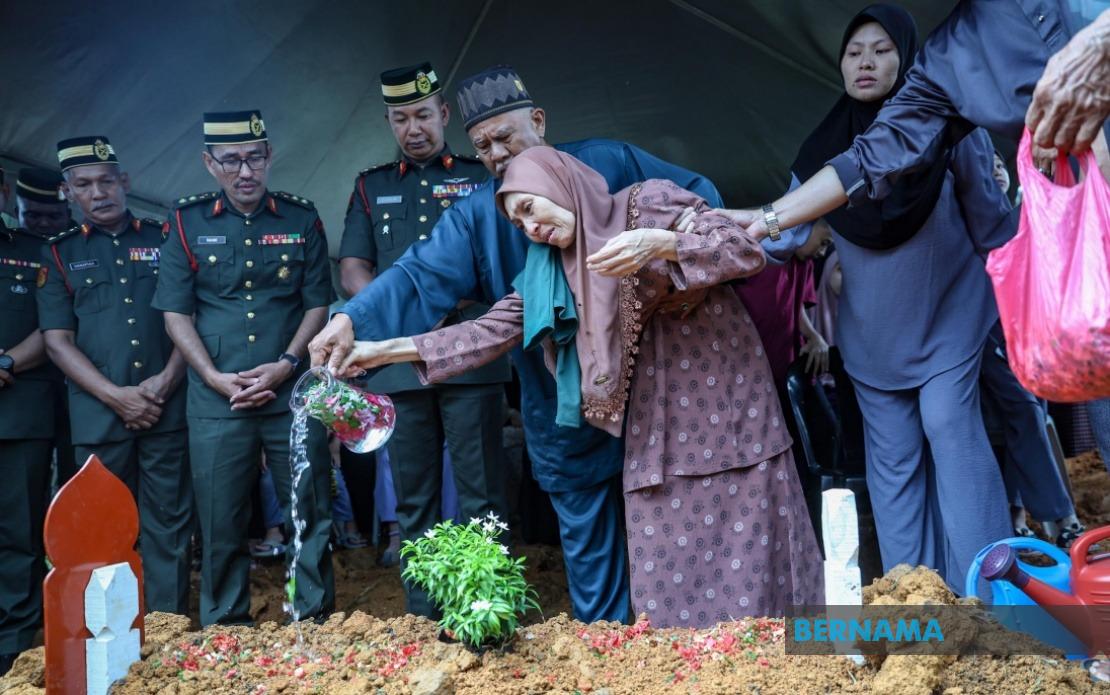
The Malaysian Army paid solemn military tribute on June 17 as Private Siti Khadijah Sungip, a 24-year-old soldier with the First Squadron of the Royal Engineer Regiment, was laid to rest at Taman Sri Lambak Muslim Cemetery in Kluang. Her burial at 1.15 pm marked the final chapter of a tragedy that unfolded during routine training at Hobart Camp near Gurun in Kedah, claiming two military lives within moments of each other.
The funeral drew a considerable gathering of mourners spanning the full spectrum of Siti Khadijah's world—grieving family members, close relatives, military comrades, and fellow friends who had come to pay their respects to the fallen soldier. The cemetery atmosphere, typically a place of quiet reflection, took on a particularly heavy tone as the uniformed personnel stood alongside civilians, united in their sorrow over the loss of a young life cut short in service to the nation.
A ceremonial highlight came when Brigadier General Datuk Zulhelmy Masdar, Commander of the 7th Brigade based at Mahkota Camp, formally presented the Malaysian flag to Siti Khadijah's father, Sungip Jais, 65, in recognition of his daughter's sacrifice. This symbolic gesture, steeped in military tradition, acknowledged not only her death but her commitment to her country during active duty. For the grieving father, the flag would serve as both a memorial and a national acknowledgement of her service.
The journey to the cemetery had begun much earlier that morning. After completing post-mortem procedures at Sultanah Bahiyah Hospital in Alor Setar around 2.30 am, the deceased's remains were escorted back to Kluang. Her body arrived at the family residence in Taman Sri Lambak at 12.10 pm, accompanied by First Field Troop Leader Lieutenant Muhammad Lutfil Hadi Osman and four members of the First Squadron of the Royal Engineer Regiment from Sangro Camp in Taiping, Perak. From there, the cortège proceeded to Darul Iman Mosque for the final Islamic funeral prayer, which was conducted by Major Mohd Azlan Shah Abdul Razak from the TDM Field Engineering Institute.
The incident that claimed Siti Khadijah's life occurred at 10.57 am on June 16 during routine grenade-throwing training exercises at the target range within Hobart Camp. In what authorities characterized as an explosion during training, both Siti Khadijah and Corporal Norazmi Abu Bakar of the Sixth Battalion of the Royal Malay Regiment suffered catastrophic injuries. Despite emergency medical intervention en route to Sultan Abdul Halim Hospital in Sungai Petani, neither soldier survived the journey, both succumbing to the severity of their wounds before reaching medical facilities.
The dual tragedy raises critical questions about training protocols at military installations across Malaysia and the region. Hobart Camp, situated in Gurun, Kedah, serves as a vital training facility for the Malaysian Army, hosting personnel from various regiments and branches including the Royal Engineer Regiment and Royal Malay Regiment. While grenade training is a standard and essential component of military preparation, incidents such as this underscore the inherent risks soldiers face even during what should be controlled, supervised exercises.
For the Royal Engineer Regiment specifically, this represents a significant loss. The First Squadron, based at Sangro Camp in Taiping, Perak, would have known Siti Khadijah as a dedicated colleague. Her role within the regiment and her presence during training operations indicate an active, engaged soldier committed to her professional development and unit responsibilities. The presence of her unit's personnel at the funeral, and their formal escort of her remains, reflected the bonds that form within military formations.
The incident also highlights broader concerns about military safety standards and accident investigation procedures. The Malaysian Army's prompt communication regarding the incident—identifying both victims and their respective units, describing the nature of the training exercise, and acknowledging the circumstances—suggests an institutional commitment to transparency. However, the underlying investigation into what caused the explosion during what should have been a controlled training scenario remains a matter of significant concern for military leadership and defence policy makers.
Siti Khadijah's death carries particular resonance given that she represented a growing cohort of female soldiers in the Malaysian Armed Forces. Her service with the Royal Engineer Regiment indicated her willingness to take on roles traditionally male-dominated within military hierarchies. Her loss represents not merely a personal tragedy for her family but also a broader national loss of trained, capable personnel and a reminder of the real dangers that uniformed service entails.
The military's formal funeral honours, including the flag presentation ceremony and the attendance of senior officers, affirmed that Siti Khadijah's death would be recognized not as a mere training accident to be quickly forgotten but as a loss worthy of national acknowledgement. For her father Sungip Jais, the Malaysian flag presented by Brigadier General Datuk Zulhelmy Masdar would carry profound meaning—a tangible reminder that his daughter's sacrifice had been witnessed and honoured by her nation and the institution she served.