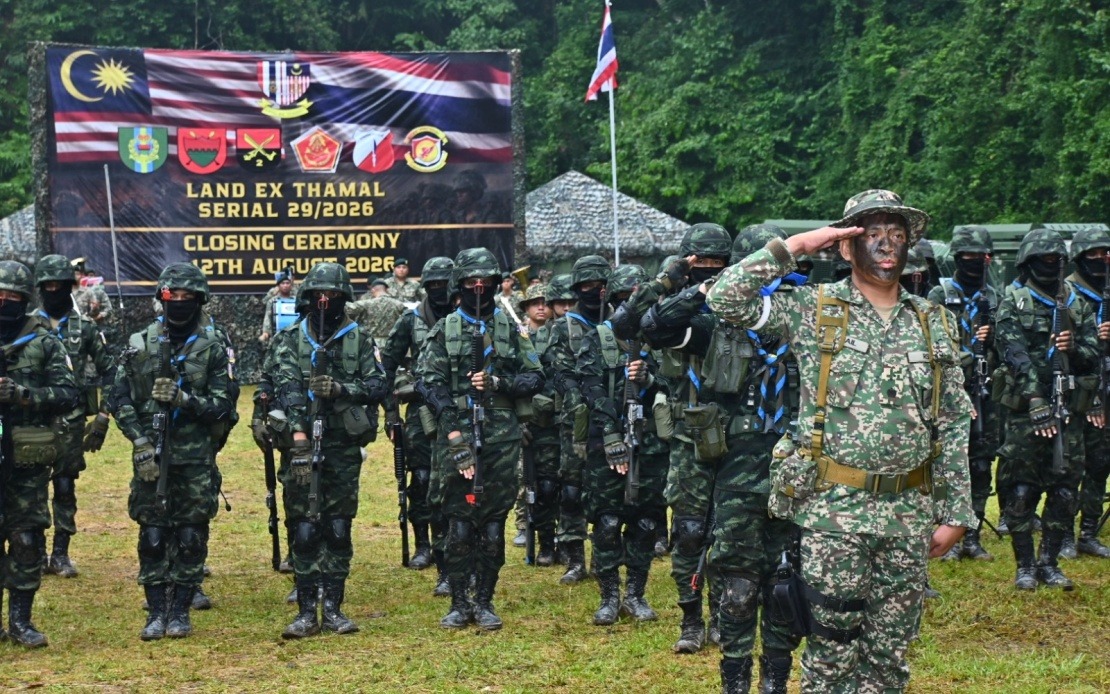
A combined contingent of 252 military personnel from Malaysia and Thailand gathered in Gerik on August 5 to participate in Exercise LAND THAMAL Series 29/2026, a structured training programme designed to refine tactical proficiency and deepen operational coordination between the two neighbouring nations. The exercise brought together 197 officers and personnel from the Malaysian Army (TDM) and 55 from the Royal Thai Army (RTA), representing a significant commitment by both defence establishments to advance their shared capabilities in an increasingly complex regional security environment.
The three-week deployment, organised under the auspices of the 2nd Malaysian Infantry Division headquarters, unfolds across three distinct operational phases. The Cross Training Exercise (CTX) segment introduces personnel to foundational concepts, while the Field Training Exercise (FTX) immerses troops in realistic combat scenarios. The third component, Combined Military Civil Action (CMCA), extends the scope beyond conventional soldiering to encompass civilian engagement and humanitarian dimensions of military operations.
Field training scenarios expose participants to a comprehensive spectrum of tactical challenges that modern soldiers must master. Combat procedures, river and obstacle crossing techniques, rapid base construction, reconnaissance patrols, ambush tactics, and direct assault operations on fortified positions constitute the practical curriculum. By rotating Thai and Malaysian personnel through these demanding situations, the exercise cultivates muscle memory and institutional knowledge that transcends language barriers and doctrinal differences. Personnel learn not merely to execute their own procedures but to anticipate and adapt to the operational approaches favoured by their partners.
The inaugural ceremony on August 5 at the Gerik Airstrip underscored the political significance both nations attach to this collaboration. Brigadier General Datuk Mohd Zaini Hashim, commanding the 30th Malaysian Infantry Brigade, and Senior Colonel Taweeporn Kanatong, his counterpart in the 5th Thai Infantry Brigade, jointly presided over the opening, a symbolic gesture reflecting equal partnership and shared investment in the exercise's objectives.
Taweeporn's remarks during the ceremony articulated Thailand's strategic rationale for such engagements. Beyond the immediate military dimension, LAND THAMAL functions as a confidence-building mechanism between defence establishments. The exercise architecture acknowledges that contemporary security threats encompassing natural disasters, transnational crime, insurgency, and maritime disputes demand the kind of integrated response that only well-rehearsed bilateral cooperation can deliver. When Thai and Malaysian commanders understand each other's decision-making processes and communication protocols, they can respond more swiftly and coherently to crises that respect no borders.
Interoperability—the capacity of different military systems to function seamlessly together—represents one of the exercise's paramount objectives. Malaysian and Thai armies operate under distinct command structures, employ different equipment, and inherit separate institutional traditions. LAND THAMAL provides controlled space to work through these differences methodically. When a disaster strikes the border region, or when cross-border trafficking operations require coordinated response, forces that have trained together benefit from established trust networks and shared understanding of tactical possibilities.
The inclusion of the Jiwa Murni Programme as part of CMCA operations signals that modern defence cooperation extends into civil society. Military personnel from both nations jointly conducted community activities at Sekolah Menengah Kebangsaan Sultan Idris Shah II in Gerik, demonstrating to local communities that security cooperation improves their lives tangibly. This dimension proves particularly important in border regions, where populations sometimes harbour suspicions about military activities. Soldiers engaging in educational support and infrastructure improvements reinforce positive perceptions of bilateral defence relationships.
Malaysia and Thailand's regular conduct of LAND THAMAL reflects a maturation in Southeast Asian security thinking. Rather than viewing defence exclusively through national lenses, both countries recognise that transnational challenges—from maritime piracy to pandemics to environmental degradation—demand collaborative frameworks. This series, having reached its 29th iteration by 2026, demonstrates institutional staying power beyond the fluctuations of political leadership. Defence establishments have encoded the exercise into their long-term planning, suggesting durability independent of temporary diplomatic variations.
For Malaysia specifically, these exercises with Thailand serve multiple strategic functions. They maintain military readiness and provide realistic training opportunities that domestic exercises cannot fully replicate. They reinforce Malaysia's position within regional security architecture at a moment when great power competition complicates Southeast Asian geopolitics. When Malaysian forces train with Thai counterparts, they implicitly reaffirm the centrality of bilateral relationships and ASEAN frameworks as alternatives to exclusive security alignments with distant powers.
The regional security context lending urgency to such cooperation encompasses several dimensions. Maritime challenges in the Andaman Sea and shared concerns about irregular migration patterns create practical reasons for coordination. Transnational criminal networks operating across the Thai-Malaysian border necessitate intelligence sharing and joint enforcement operations. Environmental degradation and climate-induced displacement create humanitarian coordination challenges. LAND THAMAL's comprehensive approach to training acknowledges this multifaceted threat environment.
Beyond immediate tactical gains, the exercise contributes to what defence scholars term 'strategic trust'—the accumulated confidence that comes from repeated positive interactions, transparency in military activities, and demonstrated willingness to prioritise bilateral relationship stability. Each iteration of LAND THAMAL adds institutional memory and personal relationships among commanders who may continue collaborating across decades of their careers. These networks prove invaluable when crises demand rapid decision-making between governments.
The 2026 exercise occurs within a broader Southeast Asian context where military modernisation is accelerating and regional tensions occasionally flare. By maintaining robust bilateral training relationships, Malaysia and Thailand hedge against worst-case scenarios while signalling commitment to peaceful resolution of disputes. The exercise implicitly demonstrates that security can be achieved through cooperation rather than confrontation, an message particularly important for smaller regional powers navigating great power competition.
Moving forward, both military establishments have publicly committed to sustaining LAND THAMAL as a cornerstone institution in their bilateral defence relationship. This commitment extends beyond 2026, with regular scheduling ensuring that institutional capacity building continues uninterrupted. As regional security challenges evolve and new threats emerge, the flexibility embedded within the exercise's three-phase structure allows for adaptation while maintaining the core objective of deepening operational coordination and mutual understanding between two neighbouring democracies committed to regional stability.

