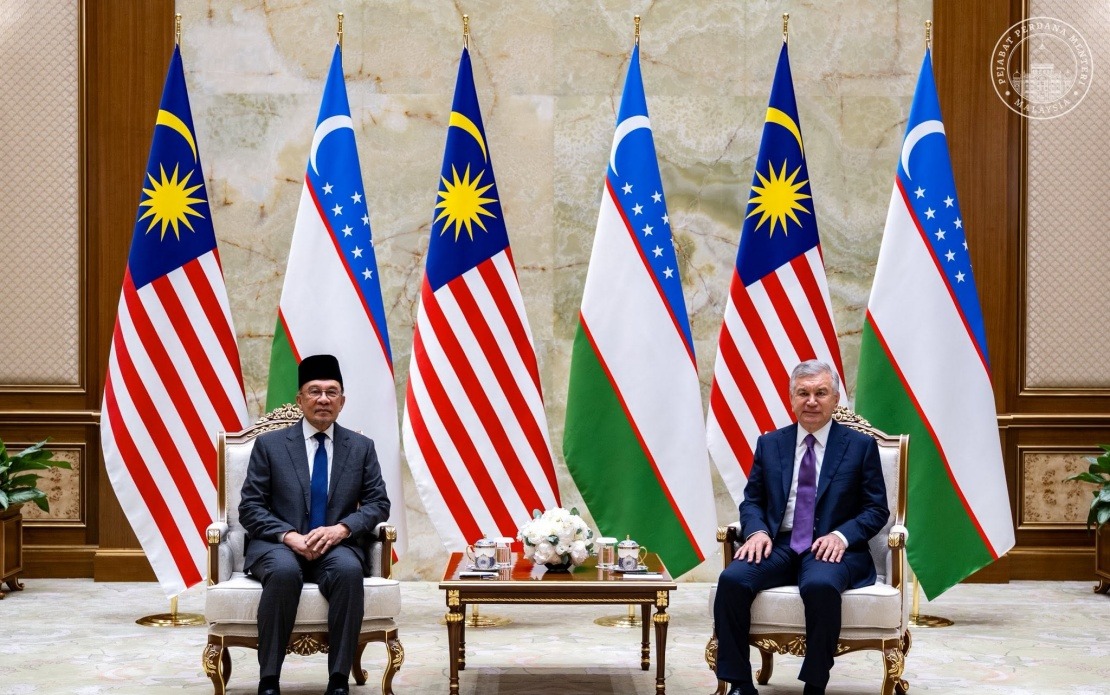
Prime Minister Datuk Seri Anwar Ibrahim has signalled Malaysia's intention to broaden its strategic engagement with Uzbekistan, identifying multiple sectors where the two nations can unlock mutual economic and developmental gains. The Malaysian leader identified energy, trade, investment, education, the halal industry and tourism as priority areas for expanded cooperation during his discussion with Uzbekistan President Shavkat Mirziyoyev in Tashkent on June 17, whilst en route to the ASEAN-Russia Commemorative Summit in Kazan, Russia.
Although the meeting was necessarily brief, given Anwar's transit stopover, it served as a valuable opportunity for both leaders to take stock of bilateral relations and chart a path forward for deeper engagement. The timing of the encounter underscores Malaysia's broader diplomatic strategy of strengthening ties with key players across Asia and beyond, particularly as geopolitical alignments continue to shift. For Uzbekistan, a nation strategically positioned at the crossroads of Central Asia, the dialogue reflects its growing emphasis on building relationships with regional heavyweight Malaysia and the wider ASEAN community.
The energy sector emerged as a particularly significant focus in the bilateral discussion. Both nations recognised substantial scope for cooperation in the gas and petroleum industries, sectors where Uzbekistan possesses considerable reserves and expertise. Such partnerships could prove instrumental not only in driving economic expansion for both countries but also in reinforcing energy security across the wider region—a concern that has gained urgency in recent global circumstances. The collaborative framework envisioned could facilitate technology transfer, investment flows and resource development initiatives that benefit both economies whilst contributing to sustainable energy solutions.
Beyond commercial considerations, Anwar emphasised the deeper cultural and civilisational dimensions of Malaysia-Uzbekistan relations. He underscored the significance of preserving and promoting the rich heritage of Islamic scholarship and civilisation, highlighting the intellectual traditions that have historically enriched human knowledge and advancement. This framing reflects Malaysia's positioning as a bridge between the Islamic world and the broader Asian community, whilst acknowledging Uzbekistan's own substantial contributions to Islamic learning and cultural preservation. The dialogue on these matters suggests both nations view their partnership as extending beyond transactional economics to encompass shared values and civilisational aspirations.
Trade and investment constituted another pillar of the discussion, with both leaders recognising untapped potential in their commercial relationship. Enhanced bilateral trade mechanisms, foreign direct investment corridors and business-to-business linkages could foster deeper economic interdependence and create employment opportunities in both nations. The education sector, similarly, offers promising avenues for cooperation through student exchanges, academic partnerships and capacity-building initiatives that would elevate human capital in both countries.
Malaysia's thriving halal industry represents a distinctive area of comparative advantage that holds particular relevance for Uzbekistan, a Muslim-majority nation with its own expanding halal market. Cooperation in halal certification, food production standards, cosmetics and pharmaceuticals could position both countries as regional leaders in the global halal economy, which continues to expand rapidly. Tourism cooperation, meanwhile, could unlock new visitor flows between the nations, allowing Malaysian travellers to experience Central Asian heritage whilst promoting Malaysia's diverse attractions to Uzbek tourists.
Anwar's acknowledgement of Uzbekistan's commitment to strengthening relations with ASEAN countries reflects the bloc's strategic interest in deepening engagement with Central Asia. As ASEAN continues to articulate an inclusive and pluralistic vision for regional architecture, partnerships with nations like Uzbekistan become increasingly valuable. Uzbekistan's growing role and influence within Central Asia, coupled with its demonstrated openness to ASEAN engagement, creates natural alignment with Malaysia's foreign policy objectives.
The Prime Minister's framing of bilateral cooperation as serving broader goals beyond economics—specifically the elevation of human dignity, empowerment of knowledge and promotion of equitable development—indicates Malaysia's commitment to substantive partnership rather than superficial diplomatic courtesy. This approach resonates with global development narratives emphasising inclusive growth and human-centred progress, positioning the Malaysia-Uzbekistan relationship as contributing to these wider aspirations.
Geopolitically, the timing of Anwar's engagement with President Mirziyoyev carries added significance. Malaysia's diplomatic outreach to Central Asia, evidenced through such high-level interactions, reflects its ambition to expand its strategic footprint and influence beyond Southeast Asia. For a nation seeking greater voice in regional and global affairs, cultivating robust relationships with diverse partners across Asia strengthens Malaysia's diplomatic leverage and reinforces its credentials as a serious stakeholder in pan-Asian affairs.
The practical realisation of these ambitious cooperation frameworks will depend on follow-up mechanisms, institutional arrangements and consistent high-level engagement. Both nations would benefit from establishing joint working groups, regular bilateral consultations and coordinating mechanisms to transform rhetorical commitments into concrete projects. Sectoral engagement, particularly in energy where technical expertise and capital requirements are substantial, will require detailed negotiations and mutually beneficial contractual arrangements.
Looking ahead, the Malaysia-Uzbekistan partnership presents opportunities for both nations to achieve complementary development objectives whilst contributing to broader regional stability and prosperity. As Central Asia reasserts its significance in global affairs, Malaysia's proactive engagement with the region positions it advantageously to benefit from emerging opportunities. Conversely, Uzbekistan gains access to Malaysia's extensive Southeast Asian networks and its position as a gateway to major Asian economies, creating mutually reinforcing advantages that should encourage both nations to invest seriously in translating bilateral intentions into tangible outcomes.