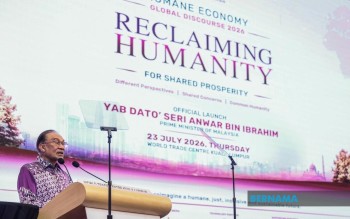
Prime Minister Datuk Seri Anwar Ibrahim has signalled the government's readiness to begin developing Malaysia's 2027 budget, with preparations set to commence in August and parliamentary tabling scheduled for early October. Speaking at the Humane Economy Global Discourse (HEGD) 2026 in Kuala Lumpur, Anwar, who doubles as Finance Minister, outlined the philosophical direction that will underpin the upcoming fiscal blueprint, positioning it as a tool for broader societal benefit rather than mere economic expansion.
The timing of this announcement reflects the government's desire to maintain momentum in its budgetary planning cycle while allowing sufficient time for inter-ministerial consultations and stakeholder engagement before the parliamentary session begins. By initiating formulation in August, the administration is providing itself roughly two months to synthesise departmental spending proposals, revenue projections, and policy priorities before formal presentation to lawmakers. This timeline also enables the ministry to incorporate feedback from business groups, civil society organisations, and other stakeholders who have increasingly demanded voice in Malaysia's fiscal direction.
Crucially, Anwar reframed the purpose of economic policy beyond conventional metrics of growth and productivity. Rather than celebrating higher gross domestic product figures or increased consumption alone, he emphasised that prosperity must manifest in ways directly affecting household welfare—stronger wages, meaningful employment, accessible housing, and quality healthcare. This rhetorical shift reflects a global conversation about "inclusive growth" gaining traction among policymakers confronting rising inequality, cost-of-living pressures, and voter frustration with wealth concentration. For Malaysian readers, this signals potential structural changes in how Budget 2027 allocates resources and measures success.
The prime minister's framing of economic activity as a "means, not an end in itself" represents significant philosophical positioning ahead of budget season. He explicitly questioned whether growth expands or narrows opportunity, whether it fortifies or weakens family structures and communities, and whether it treats citizens as development partners or production inputs. Such language suggests the forthcoming budget may prioritise investments in social infrastructure, wage policies, and community resilience over productivity-focused spending that has dominated recent fiscal cycles. This could translate into enhanced allocations for affordable housing programmes, healthcare expansion, and education reform—areas where Malaysia faces persistent challenges despite respectable economic growth.
Awareness of sustainability concerns also featured prominently in Anwar's remarks, indicating Budget 2027 will grapple with environmental and intergenerational equity dimensions. He cautioned against burdening future generations with environmental degradation, fiscal deficits, or social dislocation—a concern particularly relevant as Malaysia navigates energy transition pressures and climate vulnerability. Southeast Asian economies increasingly face pressure from developed nations and investors to demonstrate environmental responsibility, making this emphasis strategically important for Malaysia's regional positioning and investment attractiveness.
The budget's integration with broader government strategies represents another noteworthy dimension. Anwar linked the fiscal framework to semiconductor industry development, energy transition initiatives, and digital transformation programmes, suggesting Budget 2027 will seek coherence across multiple policy domains rather than treating expenditure as compartmentalised. For Malaysia, this holistic approach reflects recognition that technological capability, clean energy adoption, and fiscal sustainability are mutually reinforcing rather than competing objectives. Semiconductor manufacturing, a cornerstone of Malaysia's economic diversification strategy, will likely receive supportive fiscal measures aligned with broader industrialisation goals.
Innovation's role within the budget framework warrants particular attention for Malaysian observers. Anwar specified that innovation should "expand human capabilities rather than deepen exclusion," signalling caution about technological adoption that concentrates benefits among educated elites while displacing lower-skilled workers. Given Malaysia's service-sector workforce and manufacturing base, this principle could influence decisions about automation incentives, skills development funding, and social safety nets for disrupted workers. It suggests potential fiscal support for vocational training, digital literacy programmes, and entrepreneurship schemes targeting communities vulnerable to technological displacement.
The emphasis on social mobility within Budget 2027's framework addresses a persistent Malaysian concern about intergenerational opportunity. While the nation achieved upper-middle-income status, economic mobility has stalled, with children's earnings closely correlated with parental income. Budget allocations to quality education, affordable healthcare, and affordable housing directly influence mobility prospects, making these areas potentially high-priority within the fiscal blueprint. Enhanced spending on rural infrastructure, tertiary education access, and skills training could represent tangible expressions of the prime minister's emphasis on genuine social mobility.
Regionally, Malaysia's budgetary approach influences Southeast Asian policy conversations about inclusive development. As a developed economy confronting inequality challenges, Malaysian fiscal choices carry demonstration effects for neighbouring states navigating similar tensions between growth imperatives and distributional concerns. Thailand, Indonesia, and the Philippines monitor Malaysian policy experiments in social spending and inclusive growth frameworks as they design their own responses to middle-class expectations and inequality pressures.
The substantial lead time before October tabling provides opportunity for public consultation and parliamentary scrutiny, distinguishing Malaysia's process from more rushed budget cycles elsewhere. Opposition parties and civil society organisations will have roughly two months to prepare substantive critiques and alternative proposals, potentially elevating quality of parliamentary debate beyond year-end grandstanding. This procedural openness, while domestically significant, also influences perceptions of Malaysian democratic governance among international observers and investors evaluating stability and institutional quality.
Implementation challenges will ultimately determine whether Budget 2027's philosophical aspirations translate into material improvements. Anwar's emphasis on tangible welfare enhancements requires not merely budget allocations but effective programme delivery, anti-corruption oversight, and maintenance of macroeconomic stability. Fiscal space constraints, particularly given government debt levels and revenue limitations, will force difficult trade-offs between stated priorities. The months ahead will reveal whether the administration can operationalise inclusive growth rhetoric through concrete budgetary choices or whether conventional spending patterns persist beneath reformist language.

