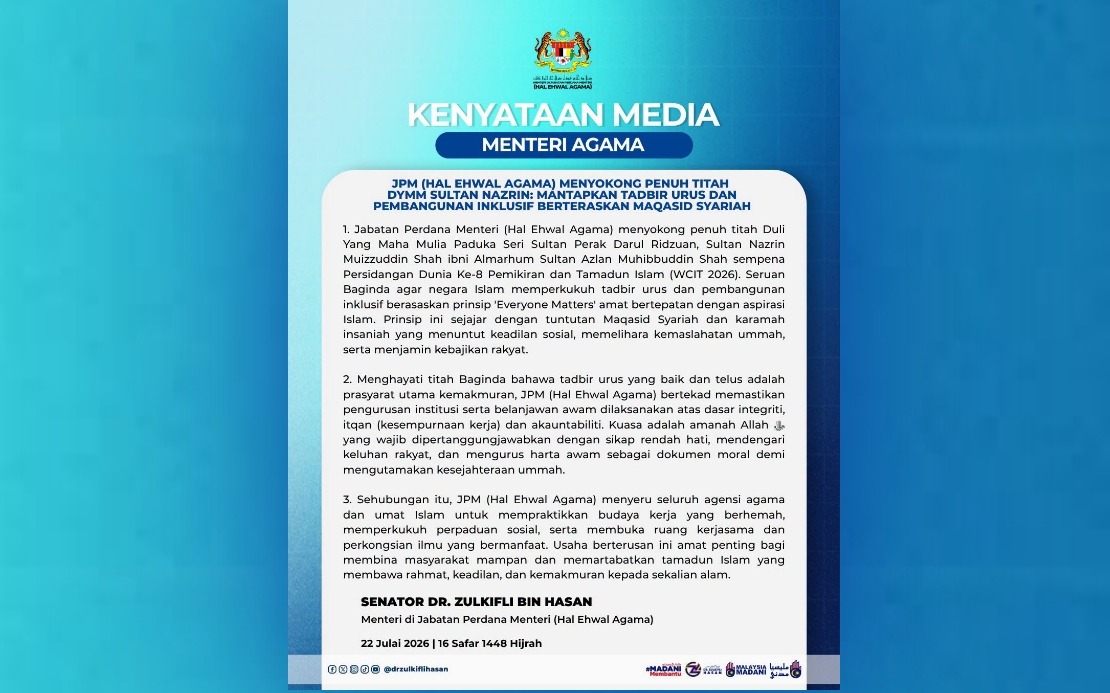
Malaysia's religious affairs administration is pivoting towards a governance model that prioritises inclusivity and public welfare, drawing inspiration from Sultan Nazrin Shah's recent call for Muslim-majority nations to embrace stronger institutional frameworks. Speaking on July 22, Minister in the Prime Minister's Department (Religious Affairs) Dr Zulkifli Hasan announced that the Religious Affairs Ministry would consolidate its approach to overseeing religious institutions through three core pillars: integrity, accountability, and demonstrable commitment to public well-being. The strategic realignment reflects how Malaysian policymakers are responding to the Perak Sultan's international advocacy at the 8th World Conference on Islamic Thought and Civilisation, where he articulated a vision of governance that transcends sectarian boundaries.
Sultan Nazrin's foundational concept—"Everyone Matters"—carries profound implications for how Malaysia's religious bureaucracy engages with citizens and shapes policy implementation. During his address at the global conference, the Sultan emphasised that effective public service extends beyond religious communities to encompass all residents, regardless of ethnic origin, faith tradition, or political affiliation. This framing redefines national unity not merely as symbolic coexistence but as a structural principle embedded in institutional practice. For a diverse Southeast Asian nation like Malaysia, where religious administration intersects with questions of minority rights and social cohesion, this perspective offers a legitimising framework for reforming how religious departments interact with non-Muslim populations and secular governance structures.
Dr Zulkifli underscored that Sultan Nazrin's governance philosophy aligns seamlessly with established Islamic jurisprudential frameworks, particularly Maqasid Syariah—the overarching objectives of Islamic law. He highlighted that the "Everyone Matters" principle complements karamah insaniah, the Islamic concept of universal human dignity that forbids discrimination and mandates equitable treatment. By anchoring the ministry's operational reforms to these theological foundations, the government essentially legitimises inclusive governance as authentically Islamic rather than as a concession to external pressure. This rhetorical manoeuvre has significance beyond Malaysia, potentially influencing how other Muslim-majority nations in Southeast Asia and the broader Islamic world justify modernising their institutional frameworks.
The Sultan's assertion that genuine development cannot proceed in isolation carries particular weight for Malaysia's regional positioning. He articulated that regardless of a nation's internal resources, economic prosperity and social advancement depend fundamentally on openness to international commerce, cross-border investment flows, knowledge transfer mechanisms, and technological advancement. This perspective challenges insular approaches to policymaking and implicitly critiques any tendency towards parochialism within religious governance. For Malaysia, a nation deeply embedded in global supply chains and reliant on foreign direct investment, the messaging reinforces why religious institutions must adapt to facilitate rather than obstruct economic integration and pluralistic engagement.
Dr Zulkifli's commitment to embedding itqan—the Islamic principle of excellence and meticulous execution—into administrative culture represents an attempt to elevate professional standards within Malaysia's religious bureaucracy. The minister framed administrative authority as a sacred trust from Allah, requiring leaders to exercise power with humility whilst actively soliciting grievances from constituents. This conception challenges hierarchical, top-down governance models and instead promotes responsive institutions that listen before legislating. The practical implications extend to religious departments across Malaysia's states and federal levels, potentially catalysing reforms in how zakat distribution, Islamic education, and fatwa issuance processes incorporate citizen feedback and accountability mechanisms.
The emphasis on managing public funds as a moral responsibility targets a persistent concern within Malaysian governance: ensuring that state resources allocated to religious administration genuinely prioritise ummah welfare rather than becoming conduits for patronage or political favour. By invoking the principle that public finances represent a trust requiring transparent stewardship, the minister establishes a normative expectation that religious departments should adopt budgetary practices comparable to other government agencies, with clear performance metrics and public reporting. This potentially opens space for greater scrutiny of religious institutional spending—an area historically shielded from robust oversight in some jurisdictions.
The call for religious agencies and Muslim civil society to cultivate courteous workplace cultures addresses workplace dynamics that influence institutional effectiveness. By emphasising collegiality, knowledge-sharing, and respectful collaboration, the ministry signals that professional excellence requires not merely technical competence but also interpersonal conduct reflecting Islamic ethical values. This framing proves particularly significant for Malaysia's diverse public service, where religious affairs personnel interact with non-Muslim colleagues across multiple government agencies. The emphasis on courtesy and social unity creates space for intra-faith cooperation and inter-faith institutional engagement without requiring compromise on religious principles.
Sultan Nazrin's invocation of humble leadership that listens to citizens before formulating laws distinguishes between consulted and genuine participatory governance. For Malaysia's religious administration, this implies potential reforms in how fatwas are developed, religious policies formulated, and community standards determined. Currently, Islamic legal interpretation in Malaysia remains concentrated among clerical elites and religious scholars with formal credentials. An operationalised version of Sultan Nazrin's principle might involve expanding consultation mechanisms to include broader Muslim constituencies, civil society representatives, and affected community members—though such expansion would likely face resistance from entrenched religious establishments.
The timing of this ministerial articulation warrants consideration. Coming as Malaysia navigates complex questions about religious freedom, minority protections, and the appropriate scope of Islamic law's application, the public endorsement of inclusive governance principles from both the Sultan and the Religious Affairs Ministry suggests an elite consensus around moderating more confrontational approaches. This represents a potential stabilising force within Malaysian politics, where religious polarisation has periodically intensified communal tensions. However, translating principles into institutional practice requires overcoming bureaucratic inertia, vested interests, and competing ideological commitments within Malaysia's sprawling religious apparatus.
For Southeast Asia more broadly, Malaysia's positioning of inclusive religious governance as both Islamic and pragmatically necessary offers a template that other regional Muslim-majority nations might reference. Indonesia, Brunei, and Thailand all wrestle with balancing Islamic governance frameworks with multicommunal realities. Malaysia's effort to locate inclusive development within Islamic jurisprudence rather than portraying it as external imposition could inform how neighbouring countries approach similar challenges. The "Everyone Matters" principle, if genuinely embedded in institutional practice rather than remaining rhetorical flourish, might exemplify how religious governance can strengthen rather than diminish national cohesion.

