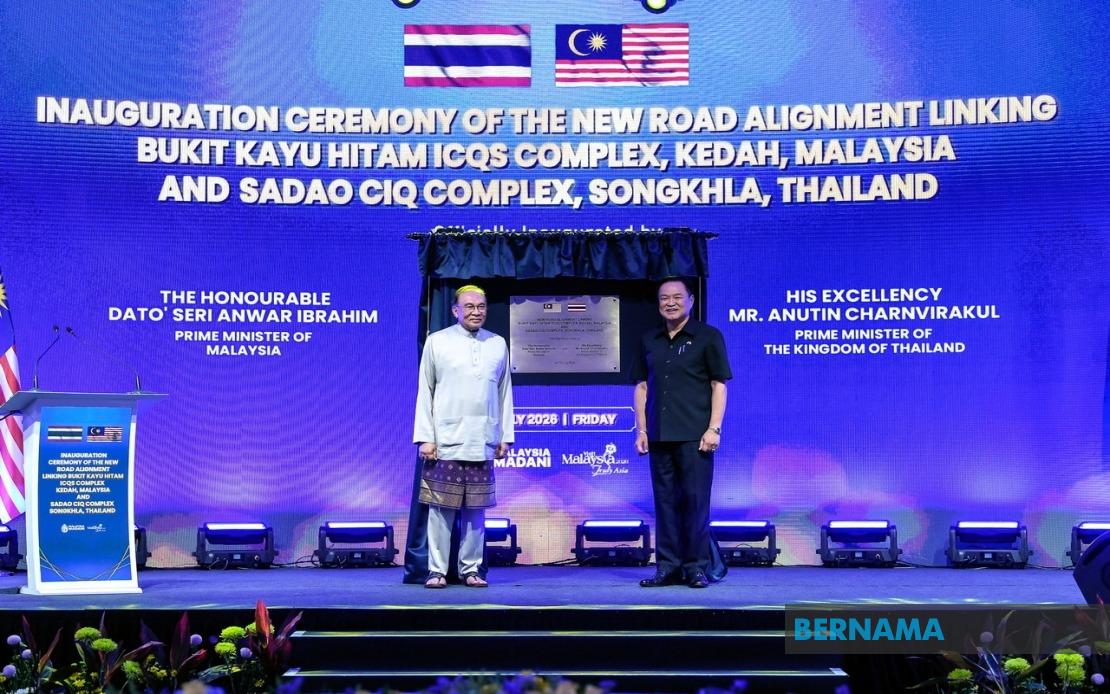
Prime Minister Datuk Seri Anwar Ibrahim has declared the official launch of a new road alignment linking Malaysia's Bukit Kayu Hitam Immigration, Customs, Quarantine and Security (ICQS) Complex in Kedah with Thailand's Sadao Customs, Immigration and Quarantine (CIQ) Complex a watershed moment for bilateral relations. Speaking alongside his Thai counterpart Prime Minister Anutin Charnvirakul at the border ceremony, Anwar positioned the infrastructure project as far more than mere connectivity—it represents a deliberate strategy to unlock economic potential in regions that have historically lagged behind their respective capitals.
The road alignment initiative reflects a broader philosophical shift in how Kuala Lumpur and Bangkok approach cross-border development. Rather than treating the boundary as a constraint, both governments now view it as a natural nexus for shared prosperity. This reframing carries particular significance for Malaysia's northern corridor, where Perlis, Kedah, Kelantan, Perak and Penang stand to benefit substantially from enhanced trade flows. The leadership of both nations has committed to transforming these border communities from peripheral outposts into vibrant commercial hubs, with the infrastructure serving as the connective tissue enabling that transformation.
Central to this vision is the establishment of a special economic border zone spanning northern Malaysia and southern Thailand. Anwar acknowledged during the ceremony that such an undertaking cannot be rushed or achieved through conventional diplomatic channels alone. The zone concept represents an experimental framework within which tariff structures, regulatory harmonisation, and investment incentives might differ from standard practice, creating a controlled environment where cross-border commerce can flourish. This approach mirrors successful models elsewhere in Southeast Asia, where border economic zones have catalysed regional integration while respecting national sovereignty.
The bilateral trade ambition underpinning this initiative is concrete: Malaysia and Thailand aim to achieve USD30 billion in annual trade by 2027. Current volumes fall short of this target, suggesting that both governments perceive infrastructure and regulatory bottlenecks as significant impediments to growth. The new road alignment removes one such physical barrier, but Anwar's emphasis on expediting customs, immigration, fisheries and trade issue resolution indicates recognition that infrastructure alone is insufficient. Digital systems integration, mutual recognition of certifications, and streamlined clearance procedures must accompany improved roads to fully unlock bilateral commerce.
For Malaysian businesses, particularly those in manufacturing, agriculture and logistics based in the northern states, the improved border connectivity offers tangible commercial opportunities. Thai businesses similarly gain more efficient access to Malaysian markets and ASEAN distribution networks. Small and medium enterprises operating in border towns have historically shouldered disproportionate transaction costs due to clearance delays and bureaucratic friction. The combined infrastructure and regulatory reforms promised by both governments could materially improve their competitiveness.
Another dimension of the initiative involves acknowledging the aspirations of border communities themselves. Anwar's appreciation for Anutin's willingness to visit the border area underscores an important principle: major policy decisions should reflect the lived experiences and economic needs of peripheral populations, not merely the preferences of centralised bureaucracies. Communities in Bukit Kayu Hitam, Sadao and surrounding areas have long endured the complications of their geographic positioning without fully sharing in its commercial benefits. A functioning special economic zone could reverse that equation.
The resolution of long-standing bilateral disputes demonstrates political capital expenditure by both prime ministers. Anwar noted that issues requiring years or decades of negotiation have been addressed expeditiously, suggesting personalised commitment from the highest level. Such high-level engagement is essential because border zone development inevitably involves contentious issues—fisheries rights, labour movement, environmental standards—where bureaucratic consensus proves elusive. Prime ministerial involvement signals that compromise and mutual benefit take precedence over zero-sum positioning.
Regionally, this Malaysia-Thailand initiative carries implications beyond the immediate bilateral relationship. It occurs amid broader Southeast Asian efforts to deepen economic integration through mechanisms like the ASEAN Economic Community. A functioning border economic zone demonstrates that sub-regional cooperation can complement rather than undermine multilateral frameworks. Success here might encourage similar initiatives along other ASEAN borders, creating a network of integrated economic micro-regions that strengthen the entire bloc's internal coherence.
The timing of Anutin's two-day official visit and the prominence given to this infrastructure project suggest that both governments view Malaysia-Thailand relations as entering a new phase. Infrastructure announcements serve multiple audiences simultaneously: they signal to businesses that policy stability is forthcoming, to communities that their concerns are being addressed, and to international observers that Southeast Asia's major economies remain committed to deepening integration despite current geopolitical complexities. For Malaysian investors and traders in the northern states, this represents a significant policy signal warranting strategic adjustment.
Implementation will test the sincerity of both governments' commitments. The road itself will be constructed relatively straightforwardly, but the institutional architecture required for a functioning special economic zone—customs bonded areas, special processing zones, streamlined labour regulations, coordinated investment incentives—demands sustained bureaucratic cooperation and occasional political compromises. Both nations must resist parochial pressures from constituencies fearing job losses or market disruption in protected sectors. Success requires not merely infrastructure investment but institutional innovation.

