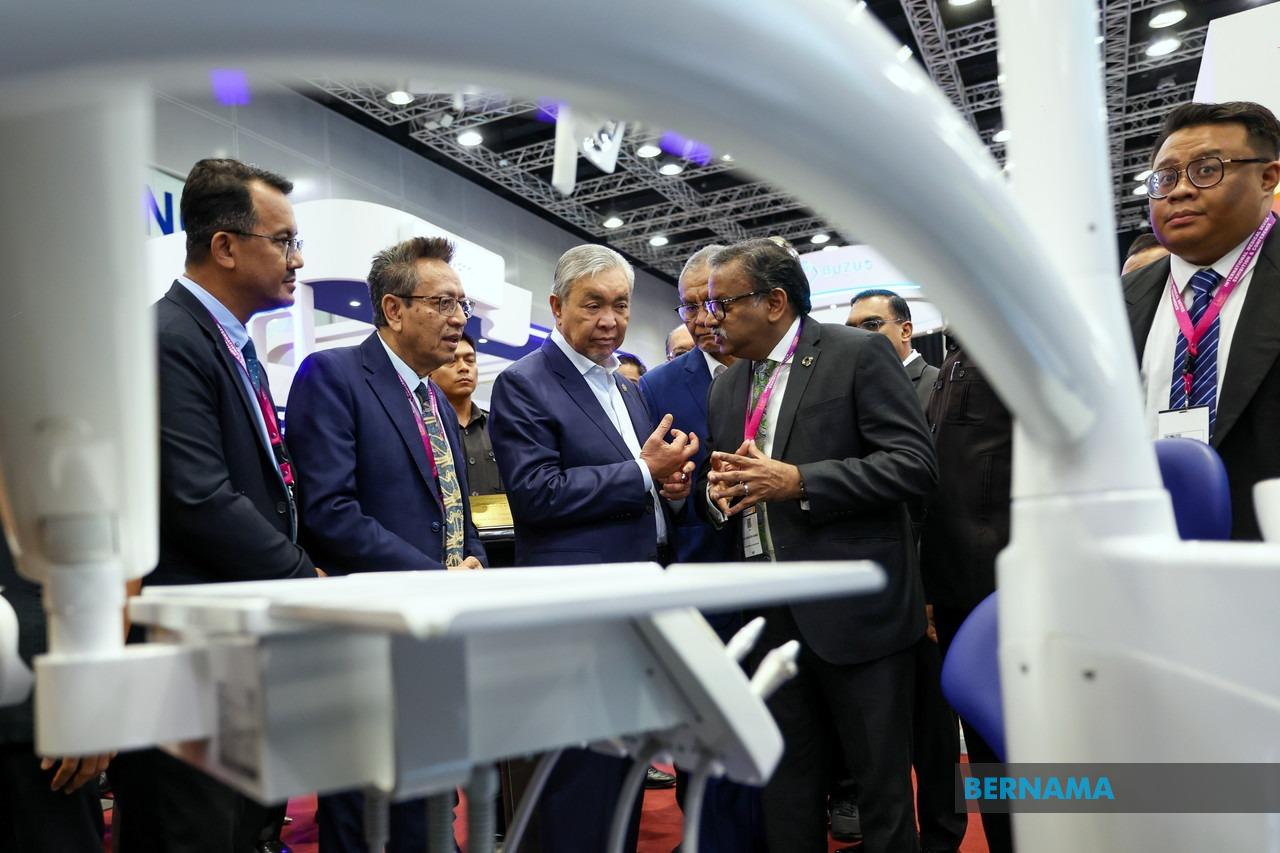
Malaysia's medical technology sector is set for aggressive expansion, with Deputy Prime Minister Datuk Seri Dr Ahmad Zahid Hamidi calling for exports to surge past RM50 billion within the next four years. Speaking at the closing of the International Medical Device Exhibition and Conference (IMDEC) 2026, Ahmad Zahid outlined a transformation roadmap designed to position the country as a serious regional player in one of the world's fastest-growing industries. The target represents a 45 per cent increase from the RM34.54 billion recorded in the previous year, signalling Malaysia's determination to capitalise on existing strengths whilst addressing critical gaps in capability and talent development.
The ambition extends beyond raw export volume. Ahmad Zahid emphasised that future growth must increasingly derive from sophisticated, high-value medical devices rather than low-margin mass-produced goods. Malaysia already possesses significant manufacturing infrastructure, established international market access, and accumulated global credibility built over decades of consistent supply. However, the nation risks plateauing as a merely competent contract manufacturer unless it successfully transitions into innovation-driven production. This shift mirrors broader aspirations across Southeast Asia to move beyond simple assembly operations towards genuine technological leadership.
The strategic framework Ahmad Zahid presented encompasses three interconnected objectives that together paint a picture of ambition tempered by pragmatism. Beyond the export target, the government aims to nurture at least ten homegrown Malaysian MedTech champions capable of holding their own against established regional and global competitors. These champions would represent a qualitative leap—companies that do not merely assemble components but develop proprietary technology, hold valuable intellectual property portfolios, and maintain independent research capabilities. Currently, Malaysia hosts numerous international manufacturers but comparatively few locally-originated firms with such sophisticated profiles.
The third pillar addresses a structural weakness often overlooked in manufacturing-focused economic strategies: job quality. Ahmad Zahid highlighted that only 33.1 per cent of positions in the medical device sector during 2025 fell into managerial, technical, or supervisory categories. By 2030, the government intends for at least half of new jobs created through MedTech investments to occupy these higher-value tiers. This objective reflects a recognition that true industrial upgrading must create sustained prosperity for workers, not merely generate employment statistics. High-skill positions retain talent within Malaysia and support the consumer spending that powers broader economic development.
The human capital dimension underpins the entire strategy. Ahmad Zahid, who chairs the National Technical and Vocational Education and Training Council, stressed that capability development cannot follow investment; it must precede it. Too often, foreign companies arrive in Malaysia seeking a ready-made workforce with skills perfectly matching their immediate needs, creating bottlenecks and wage pressures. Instead, Ahmad Zahid proposed a collaborative model where prospective investors engage with Malaysian vocational and educational institutions during the planning stage, helping shape training curricula, identifying emerging skill requirements, and establishing apprenticeship pathways. This approach builds institutional relationships and ensures educational systems remain aligned with industry evolution.
Context matters here for Southeast Asian readers. The medical device sector globally is valued at more than USD572 billion and projected to exceed USD1 trillion by 2034, offering enormous expansion opportunity. Regional competitors including Thailand, Vietnam, and Singapore are simultaneously pursuing similar upgrading strategies, creating competitive pressure on Malaysia to execute effectively. Thailand has leveraged its existing medical tourism infrastructure and government support to develop domestic medical device manufacturing. Vietnam attracts investment through lower labour costs. Singapore commands premium positions in high-end diagnostics and precision manufacturing. Malaysia must therefore differentiate through a combination of cost competitiveness, technical sophistication, and institutional reliability.
Recent investment momentum suggests the strategy may gain traction. In 2025 alone, RM4 billion in new medical device investments received approval across 46 projects, generating approximately 3,400 employment opportunities. These figures indicate sustained confidence from both multinational corporations and emerging local players. However, raw investment numbers require scrutiny—the quality of jobs created, the technological content of production, and the degree to which intellectual property remains in Malaysia all matter more than headline figures. Ahmad Zahid's emphasis on these qualitative dimensions suggests policymakers understand that volume can mask stagnation.
The IMDEC 2026 conference itself embodied the interconnectedness of this strategy. Gathering over 160 exhibitors and more than 50 regional and international speakers across three days, the event functioned as both showcase and networking nexus. Discussions spanning regulation, innovation, and healthcare transformation provided platforms for Malaysian firms to benchmark themselves against global peers, for investors to assess opportunities, and for policymakers to gather intelligence on emerging trends. Such convening capacity, when leveraged strategically, can accelerate capability transfer and partnership formation.
Implementing these ambitions requires institutional coordination across multiple government agencies and private-sector participation. The medical device sector intersects with vocational education policy, foreign investment incentives, intellectual property protection, healthcare procurement, and pharmaceutical regulation. Misalignment across these domains can undermine even well-intentioned targets. Malaysia's success in electronics manufacturing and palm oil processing demonstrates capacity for coordinated industrial policy, yet the MedTech sector presents distinct challenges—technology evolves rapidly, regulatory standards vary internationally, and knowledge-intensive production demands continuous workforce upgrading. Sustaining the political will and financial commitment necessary to achieve Ahmad Zahid's 2030 targets will test institutional capability.
Looking forward, the trajectory matters as much as the destination. If Malaysia successfully increases MedTech exports to RM50 billion by 2030, the achievement would signal that the nation can move beyond commodity manufacturing into higher-value sectors. Conversely, if growth stalls or remains concentrated in low-skill assembly, the sector risks becoming another example of Malaysia's recurring pattern—initial dynamism followed by competitive displacement. The three-pronged strategy Ahmad Zahid articulated addresses precisely these vulnerabilities, suggesting that policymakers recognise both opportunity and risk. Whether execution matches aspiration will determine whether Malaysia emerges as a genuine regional MedTech innovator or remains a peripheral manufacturer dependent on multinational goodwill.

