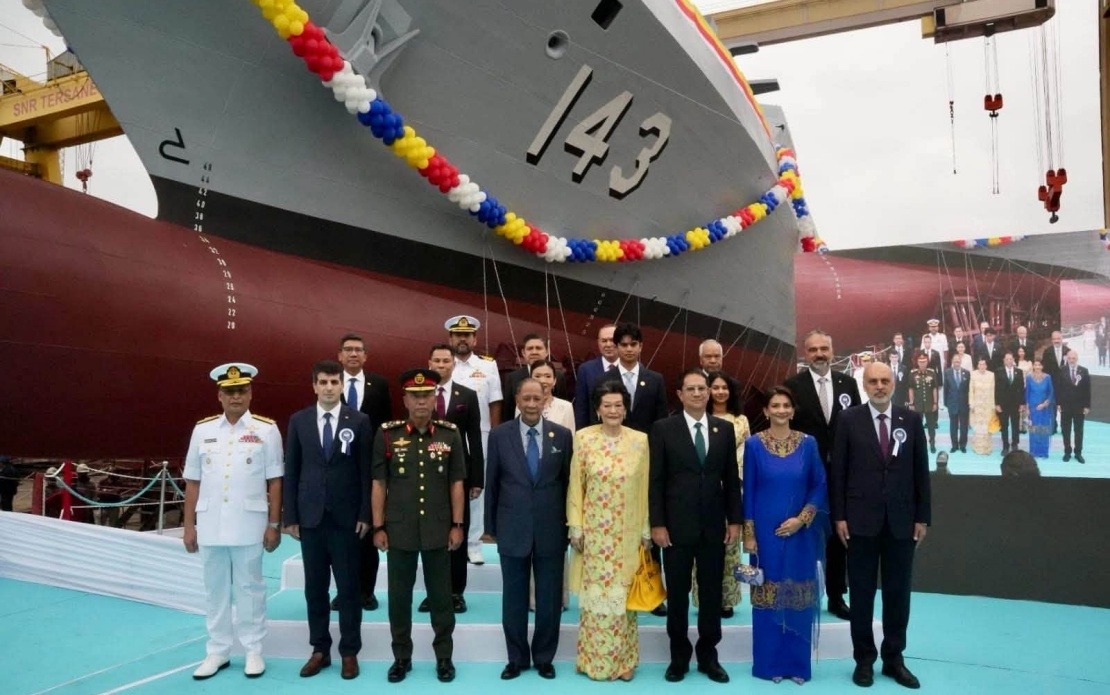
Malaysia's Defence Minister Datuk Seri Mohamed Khaled Nordin has underscored the critical importance of equipping the Royal Malaysian Navy with cutting-edge vessels and systems as the country confronts an increasingly sophisticated maritime security landscape. His remarks came during the official naming and launching ceremony of the third Littoral Mission Ship Batch 2 (LMSB2) vessel, a milestone that represents both a significant capability boost for the RMN and a testament to Malaysia's evolving defence procurement strategy in Southeast Asia.
The newly launched vessel, named Tunku Osman Jewa in honour of the late General Tan Sri Tunku Osman Tunku Mohammad Jewa, an esteemed figure who previously served as Chief of Armed Forces, carries profound symbolic weight beyond its operational significance. The naming ceremony underscores Malaysia's tradition of honouring national defence heroes whilst simultaneously modernizing its military infrastructure. The presence of dignitaries including the Sultan of Kedah Al Aminul Karim Sultan Sallehuddin Sultan Badlishah and Sultanah Maliha Tengku Ariff lent state-level importance to the event, reflecting the government's commitment to naval modernization as a cornerstone of national security policy.
The completion of all three LMSB2 vessels represents a watershed moment for the RMN's transformation agenda. These ships are not merely additions to the fleet but integral components of the 15-to-5 Transformation Plan, an ambitious programme designed to streamline and substantially upgrade Malaysia's naval capabilities over the coming years. By consolidating operational assets whilst enhancing their individual performance specifications, this plan addresses the persistent challenge faced by maritime nations in the region: maintaining effective territorial oversight across vast ocean expanses with limited resources.
What distinguishes this procurement initiative is its unprecedented nature as the first Government-to-Government defence collaboration between Malaysia and Türkiye focused on warship construction. This partnership carries implications that extend beyond the immediate acquisition of three vessels. It signals Malaysia's willingness to diversify its defence partnerships beyond traditional Western suppliers and to leverage technological expertise from emerging defence industries. For regional observers, the Malaysia-Türkiye cooperation model may establish a precedent for other Southeast Asian nations seeking to develop defence relationships that offer both cost efficiency and technological advancement without sacrificing sovereignty considerations.
The delivery timeline for these vessels, with all three expected to enter RMN service by the end of 2027, aligns strategically with Malaysia's medium-term maritime security objectives. The Littoral Mission Ships are specifically designed for operations in shallow and confined waters, making them ideally suited for Southeast Asia's complex maritime environment characterised by archipelagic geography, narrow straits, and contested waters. Unlike larger ocean-going platforms, these vessels excel in coastal patrol, anti-piracy operations, and maritime law enforcement—missions that dominate naval operations throughout the region.
The acquisition programme reflects Malaysia's recognition that maritime security threats have fundamentally transformed in nature and complexity. Beyond traditional inter-state naval competition, contemporary challenges encompass piracy in the Strait of Malacca, transnational smuggling networks, illegal fishing operations, and maritime territorial disputes. The RMN's modernization directly addresses these multifaceted challenges by providing versatile platforms capable of sustained operations across Malaysia's extensive maritime zones. This operational flexibility proves particularly valuable given Malaysia's responsibilities as a custodian of critical regional sea lanes through which trillions of dollars in international commerce transit annually.
Defence Minister Mohamed Khaled's emphasis on government commitment to ensuring the RMN possesses adequate capabilities reflects broader strategic calculations within Malaysia's defence establishment. The minister's statement carries implicit acknowledgment that regional maritime competition is intensifying, with neighbouring powers progressively enhancing their naval capabilities. Malaysia's investment in these modern warships demonstrates determination to maintain credible deterrence and operational effectiveness in contested waters, a position essential for protecting the country's exclusive economic zone claims and maritime economic interests.
From a broader Southeast Asian perspective, Malaysia's defence procurement trajectory carries significance for regional stability dynamics. The country's pursuit of modern naval capabilities, undertaken through transparent government-to-government channels rather than through opaque or contentious acquisitions, contributes to a more predictable regional security environment. Unlike some military modernization efforts that generate suspicion among regional neighbours, Malaysia's measured approach to capability enhancement emphasizes coast guard and territorial defence functions rather than power projection, thereby moderating perceptions of threat among regional states.
The three-ship LMSB2 programme also reflects practical lessons learned from previous RMN operational experiences. These vessels incorporate design features and technological systems refined through consultations with naval officers who understand Malaysia's specific operational requirements. The Littoral Mission Ships represent a middle ground between smaller coastal patrol craft and larger frigates, offering enhanced endurance, improved sensor suites, and greater offensive capability compared to earlier generation vessels whilst maintaining the shallow-draft characteristics essential for operations in Malaysian waters.
Implementing this modernization programme within Malaysia's budgetary constraints required strategic prioritization and careful programme management. The government's decision to structure the LMSB2 acquisition as a phased procurement rather than attempting to acquire entire fleet replacements simultaneously demonstrates fiscal prudence whilst maintaining momentum toward capability enhancement. This measured approach allows the Defence Ministry to absorb technological developments, manage workforce training requirements, and maintain operational continuity as new vessels progressively enter service.
Looking forward, the successful delivery of these three vessels will provide the RMN with contemporary capabilities essential for addressing 21st-century maritime challenges. Beyond the immediate platform improvements, the LMSB2 programme generates downstream benefits including technological transfer, local industry engagement, and enhanced naval personnel training opportunities. These secondary effects contribute to building domestic defence industrial capacity and naval expertise, objectives that align with Malaysia's long-term national security strategy.

