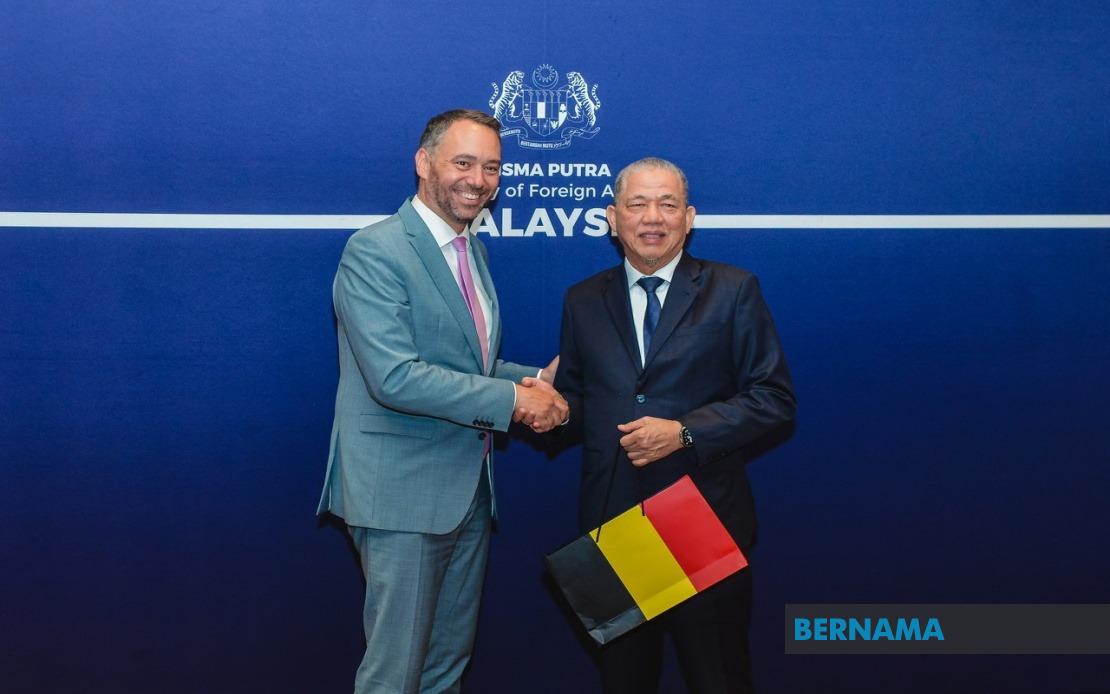
Malaysia has given Belgium formal assurance that maritime access through the South China Sea will remain unrestricted, underscoring the region's commitment to maintaining freedom of navigation despite mounting international concerns over potential shipping disruptions. Deputy Prime Minister Datuk Seri Fadillah Yusof conveyed this guarantee during discussions with Belgium's Deputy Prime Minister and Minister of Foreign Affairs, European Affairs, and Development Cooperation, Maxime Prévot, who arrived in Malaysia on Thursday for a two-day working visit.
Fadillah's reassurance directly addressed Belgium's anxiety about possible interruptions to global maritime commerce similar to those experienced in the Strait of Hormuz, where geopolitical tensions have repeatedly threatened critical shipping routes. The Belgian delegation sought Malaysia's assessment of regional security dynamics and their potential impact on international trade flows. By offering this explicit commitment, Malaysia positioned itself and ASEAN as guarantors of stability in one of the world's most economically vital waterways, through which trillions of dollars in global trade passes annually.
The principle of open access and freedom of navigation remains foundational to ASEAN's regional framework, Fadillah emphasized, stressing that member states are firmly opposed to any form of maritime blockade. This stance reflects the bloc's broader strategic positioning as a neutral arbiter in great power competition, a posture increasingly important as major powers vie for influence across Southeast Asia. Malaysia's explicit disavowal of blockade scenarios carries particular weight given its geographic position straddling critical chokepoints and its role as a key ASEAN voice on security matters.
Beyond security concerns, the two countries identified multiple avenues for deepening economic and institutional cooperation. Belgium indicated a strong desire to expand bilateral trade relationships and signaled willingness to reassess its current travel advisory for Sabah, potentially removing restrictions that have hindered tourism and business flows between the two nations. Such diplomatic gestures often serve as catalysts for broader commercial engagement and reflect Belgium's interest in strengthening ties with Malaysia as a gateway to Southeast Asian markets.
The halal ecosystem emerged as an unexpected but significant area of potential collaboration, with Belgium proposing that Malaysia's established halal certification standards and practices be examined as a model for adoption across the European Union. This represents a notable diplomatic achievement for Malaysia, validating its position as a global leader in Islamic commerce and standards-setting. As the halal market continues expanding worldwide, Malaysia's expertise in certification, compliance, and logistics has become an increasingly valuable commodity in international commerce.
Energy transition and sustainable technologies formed another pillar of the bilateral agenda, with both nations discussing opportunities for Belgian companies to bring advanced materials expertise and green innovation to the Malaysian market. This alignment reflects broader global trends toward decarbonization and the economic opportunities accompanying the shift to renewable energy. Fadillah, who also holds the portfolio of Minister of Energy Transition and Water Transformation, positioned Malaysia as receptive to foreign investment in these sectors, potentially attracting Belgian capital and technical partnerships.
The Belgian delegation's interest in Malaysia also reflects broader European strategic reassessment of Southeast Asian engagement. Belgium, as a hub for EU institutions and decision-making, carries outsized influence in shaping European policy toward the Indo-Pacific region. High-level visits such as Prévot's inaugural trip since taking office in February 2025 signal the EU's determination to strengthen institutional relationships with key ASEAN economies and underscore the region's geopolitical importance to Western policymakers.
Fadillah's emphasis on ASEAN's collective commitment to peace and neutrality represents a careful calibration of Malaysia's diplomatic message. As regional tensions rise—whether from great power competition, maritime disputes, or economic coercion—ASEAN nations have consistently sought to avoid alignment with any single bloc while maintaining their own sovereignty. By framing the South China Sea guarantee as an ASEAN-wide principle rather than a Malaysia-specific policy, Fadillah reinforced the bloc's presumed unity on regional security architecture.
The luncheon also included Foreign Ministry Secretary-General Tan Sri Amran Mohamed Zin and Belgium's Ambassador to Malaysia Peter Van Acker, reflecting the significance Malaysia attached to the bilateral engagement. Such high-level attendance underscores efforts to translate diplomatic courtesy into concrete institutional relationships that can sustain cooperation across multiple domains and successive administrations.
For Malaysian policymakers, the Belgium visit exemplifies the balancing act required in contemporary Southeast Asian diplomacy. Malaysia must simultaneously reassure traditional partners in Europe and the West about regional stability, maintain careful neutrality amid great power tensions, and pursue economic partnerships that serve national development objectives. The breadth of discussion topics—from maritime security to halal standards to energy innovation—reflects the multifaceted nature of modern bilateral relations and the necessity for Southeast Asian nations to engage globally across numerous technical and political domains while preserving their autonomy.
Looking forward, Malaysia's commitment to keeping the South China Sea open carries implications extending well beyond bilateral Malaysia-Belgium relations. As global supply chains become increasingly contested and regional actors face mounting pressure to take sides in strategic competitions, Malaysia's reaffirmation of open navigation principles provides reassurance to trading partners worldwide that Southeast Asia will not become a battleground for competing visions of regional order. This positioning remains central to Malaysia's national interests as a trading nation and a pivot between great powers.

