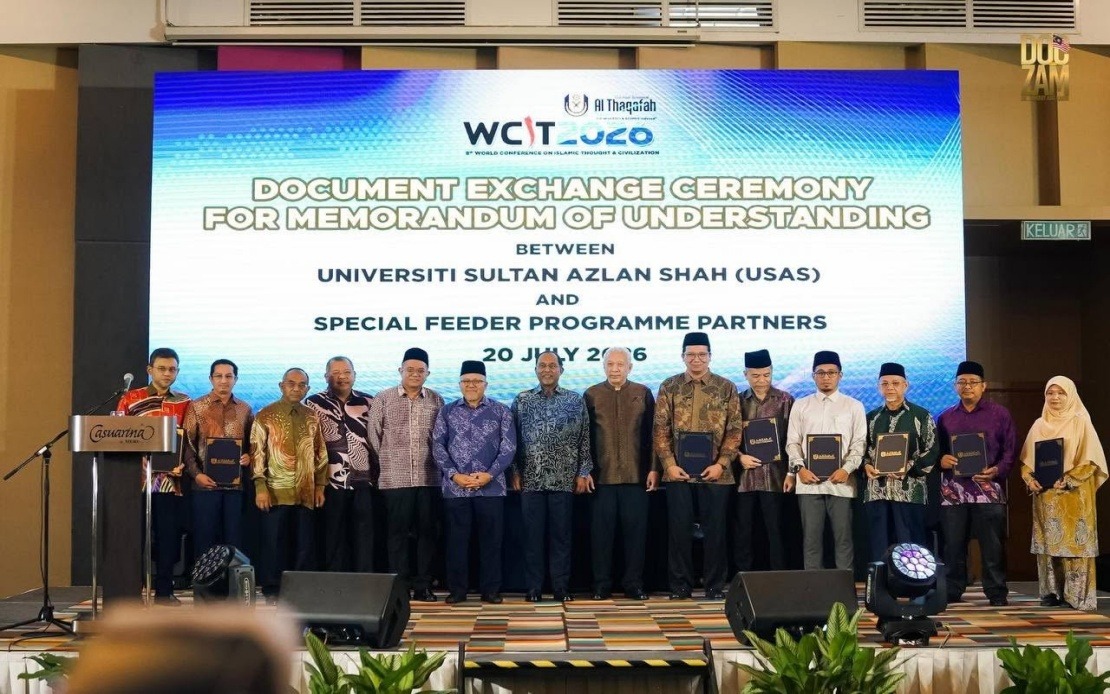
Malaysia is staking its claim as a pivotal hub for scholarly exchange and intellectual advancement in the Islamic world, with the Higher Education Minister articulating an ambitious vision that extends far beyond traditional academic boundaries. Datuk Seri Dr Zambry Abdul Kadir has underscored the country's determination to function as a mediating force in global knowledge conversations, while simultaneously strengthening its position as a destination for world-class higher education. This strategic positioning comes as the nation prepares to host the 8th World Conference on Islamic Thought and Civilisation, an event designed to convene leading voices from across the Muslim world and beyond to confront pressing contemporary challenges through rigorous intellectual engagement.
The conference, scheduled to commence in Kuala Lumpur, represents more than a mere academic gathering. According to the minister, WCIT2026 embodies Malaysia's deeper commitment to creating frameworks through which diverse intellectual traditions can converge, exchange ideas, and forge collaborative networks that transcend geographical and political boundaries. The gathering signals an intentional effort to reclaim the Islamic world's historical role as a generator of knowledge and innovation, moving beyond nostalgic remembrance of past civilisational achievements toward constructing tangible solutions for contemporary crises affecting both Muslim communities and humanity at large.
The inaugural reception for the conference, held at Universiti Sultan Azlan Shah in Ipoh, drew an impressive assembly of over 180 international delegates, academic researchers, and thought leaders from multiple countries. This gathering demonstrated significant appetite among global scholars to participate in Malaysia-hosted forums addressing Islamic intellectual development. The minister's attendance and active engagement at the event underscored the federal government's direct investment in positioning higher education as a strategic national priority, moving it beyond the administrative purview of a single ministry into the realm of significant foreign policy and soft power initiatives.
Databry's remarks at the Ipoh dinner event articulated a pointed critique of contemporary Islamic societies that remain primarily oriented toward historical reflection rather than future-oriented innovation and development. He contended that the Islamic ummah requires far more than scholarly nostalgia or ceremonial reverence for bygone golden ages. Instead, he outlined a compelling framework emphasizing that sustainable advancement must be anchored in systematic knowledge generation, rigorous scientific research, technological innovation, leadership grounded in ethical principles, and the establishment of globally competitive educational institutions capable of attracting and retaining top talent.
Central to the minister's philosophical position is an argument that knowledge itself transcends the narrow confines of national interest or civilisational ownership. He articulated the principle that education must remain insulated from the corrupting influences of partisan political agendas, interstate conflict, and instrumental technological considerations. This perspective carries particular resonance in Southeast Asia, where Malaysia's own trajectory as a multiethnic, multireligious society has frequently depended upon an ability to position education as a unifying force capable of bridging communal divides rather than exacerbating them. The minister's emphasis on knowledge as shared human heritage rather than proprietary intellectual capital reflects a cosmopolitan outlook increasingly rare in contemporary global discourse.
The minister employed historical examples to illustrate the catastrophic consequences of allowing intellectual and educational infrastructure to become collateral damage in conflict. References to the destruction of Baghdad's libraries during the Mongol invasions, the fall of Granada during the Spanish Reconquista, the devastation wrought upon Sarajevo during the Yugoslav Wars, and the ongoing destruction in Palestine served as stark reminders that the loss of universities and knowledge repositories represents not merely material destruction but the erasure of civilisational futures. These historical parallels carry weight for Malaysian policymakers acutely aware that maintaining stable, flourishing educational ecosystems is foundational to national prosperity and regional stability.
For Malaysia specifically, hosting WCIT2026 and positioning itself as a mediating presence in global Islamic intellectual discourse offers substantial strategic advantages. The country has cultivated a reputation for pragmatic engagement with complex religious and philosophical questions while maintaining domestic social cohesion. Malaysian universities increasingly attract international students and faculty, generating economic returns through educational exports while simultaneously enhancing the nation's soft power influence. By deliberately hosting major international conferences on Islamic thought, Malaysia reinforces its brand as a moderate, intellectually rigorous, and inclusive centre for scholarly activity.
The three-day conference structure suggests intensive programming aimed at moving beyond abstract discussion toward the generation of concrete proposals and actionable resolutions. The minister expressed explicit optimism that the gathering would produce substantive intellectual outputs capable of advancing the Islamic world's collective response to global challenges. This outcome-oriented framing distinguishes the conference from purely ceremonial events, positioning it instead as a working forum where scholars might collaboratively develop frameworks applicable to real-world problems affecting Muslim-majority regions and diaspora communities worldwide.
From a Southeast Asian perspective, Malaysia's leadership in facilitating such dialogue carries implications extending beyond Islamic intellectual circles. The region has experienced rising polarization around religious and identity questions, with educational institutions occasionally becoming flashpoints for communal tension rather than bridges for understanding. By demonstrating that major international conferences on Islamic thought can be hosted in a stable, pluralistic context, Malaysia potentially models an alternative approach to religious intellectual engagement. The conference implicitly argues that serious, rigorous scholarship on Islamic civilisation and contemporary challenges need not occur in isolation from other knowledge traditions or in contexts marked by sectarian division.
The minister's emphasis on integrity-driven leadership and research excellence also reflects growing recognition that intellectual advancement cannot be divorced from ethical considerations. This principle has particular relevance for Malaysian higher education institutions navigating questions around academic freedom, research integrity, and institutional autonomy in contexts where governmental and commercial interests frequently intersect. By articulating publicly that knowledge must remain insulated from narrow political manipulation, the minister provides normative grounding for institutional leaders seeking to defend scholarly independence.
Looking forward, the success of WCIT2026 will be measured not merely in attendance figures or rhetorical flourishes but in the tangible networks established, collaborative research projects initiated, and substantive proposals advanced. The conference provides an opportunity to demonstrate that Malaysia can convene diverse international talent around shared intellectual challenges, generating insights and solutions with genuine applicability to pressing issues in education, governance, technology ethics, and social development.
The Higher Education Minister's vision articulates an understanding that knowledge production and scholarly excellence represent crucial components of contemporary national power and regional influence. Malaysia's commitment to bridging intellectual dialogue and positioning itself as a centre for higher education excellence reflects a sophisticated appreciation that in an increasingly knowledge-intensive global economy, the capacity to attract, retain, and generate world-class scholarship constitutes a strategic asset as valuable as traditional sources of national power. The WCIT2026 conference represents one visible manifestation of this broader strategic orientation toward knowledge-based development and intellectual leadership in the Islamic world.

