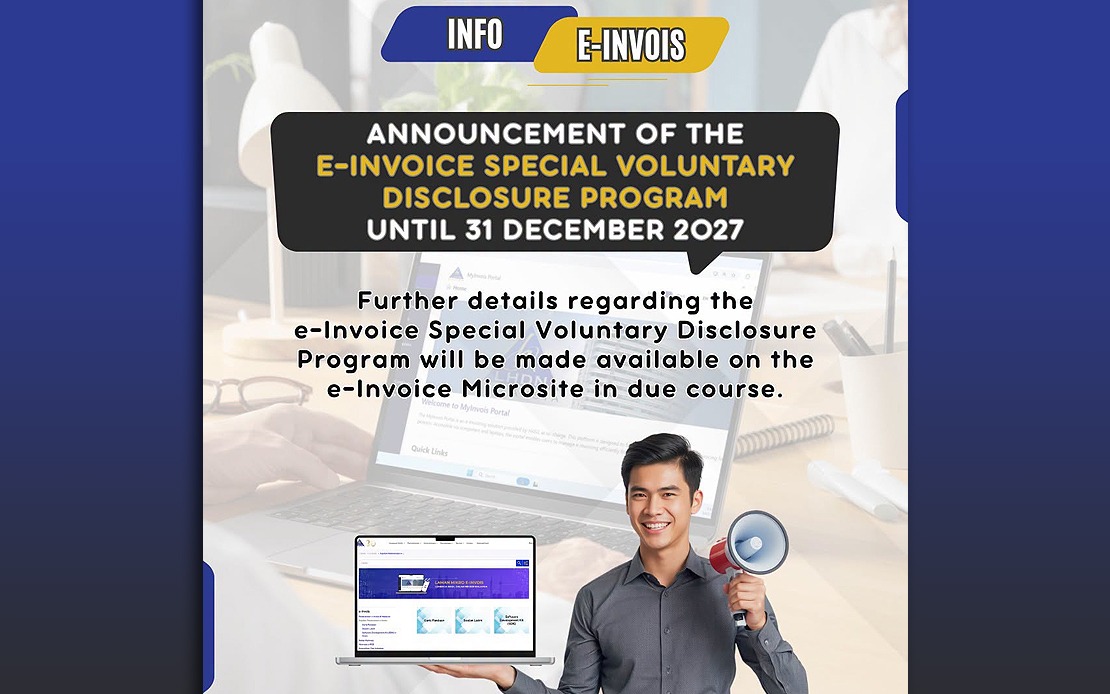
Prime Minister Datuk Seri Anwar Ibrahim has announced the rollout of the e-Invoice Special Voluntary Disclosure Programme, which will remain open until December 31, 2027, positioning it as a significant measure to ease compliance burdens on businesses operating within Malaysia's digital tax ecosystem. As Finance Minister, Anwar outlined the initiative during the announcement in Putrajaya, emphasising that the programme extends particular relief to micro, small, and medium enterprises—sectors that form the backbone of Malaysia's economy but frequently struggle with rapid regulatory transitions. The timing of the announcement underscores the government's recognition that the mandatory transition to e-Invoicing, while essential for modernising tax administration, requires a grace period for genuine correction and remediation rather than punitive enforcement.
The Inland Revenue Board has clarified that the Special Voluntary Disclosure Programme applies to three distinct categories of non-compliant taxpayers. The first encompasses businesses that failed to submit e-Invoices for transactions that fell within the mandatory scope of the regulation. The second category includes those who did submit e-Invoices but committed substantive errors or failed to meet the technical and procedural requirements stipulated by the IRB. The third group comprises taxpayers who omitted to file e-Invoices across entire periods spanning from the date mandatory compliance became effective. This three-tiered structure reflects a pragmatic policy design that acknowledges different failure modes—whether through deliberate avoidance, negligent errors, or systemic oversight—without imposing a blanket penalty regime that might undermine voluntary compliance.
A cornerstone benefit of the programme is the complete waiver of penalties during the disclosure period. Anwar confirmed that the IRB will refrain from imposing any monetary sanctions on taxpayers who voluntarily submit updates, revisions, or corrections to their e-Invoice filings. This penalty amnesty removes a critical deterrent that might otherwise discourage businesses from coming forward with incomplete or erroneous submissions. The absence of financial punishment fundamentally shifts the incentive structure, transforming voluntary disclosure from a risky admission of fault into a rational choice for rectification. For many small business operators who fear substantial back-penalties and reputational damage, this arrangement provides breathing room to align their tax records with legal requirements without compounding their financial obligations.
The IRB has issued guidance emphasising that all voluntary disclosures must be accurate and must conform to the General and Specific e-Invoice Guidelines published by the board. This requirement ensures that the programme does not become a vehicle for submitting false information; rather, it functions as a correction mechanism for genuine errors and omissions. Businesses utilising the scheme must invest effort in ensuring their revised submissions meet regulatory standards, a condition that maintains the integrity of Malaysia's digital invoice ecosystem. The board's insistence on compliance quality reflects awareness that a permissive approach to disclosure could create perverse incentives, incentivising sloppy initial filings knowing that later correction carries no cost.
Beyond penalty waivers, the government has introduced accelerated tax incentives to encourage full compliance with e-Invoice implementation. These incentives permit taxpayers to claim capital allowances on a fully deductible basis within a single financial year for expenditures incurred in purchasing information and communication technology equipment dedicated to e-Invoice processing. Additionally, businesses may immediately deduct costs associated with developing, customising, or modifying computer software systems necessary to meet e-Invoice requirements. These provisions effectively subsidise the operational and technological costs of transition, lowering the net expense of compliance and acknowledging that many enterprises, particularly smaller ones, face genuine capital constraints in upgrading their tax administration infrastructure.
The e-Invoice system itself represents a major modernisation of Malaysia's tax administration and business compliance landscape. By requiring digital submission of invoices rather than paper-based or unstructured electronic formats, the system enables real-time tax data collection, reduces fraud, and facilitates compliance verification by the IRB. From a Malaysian perspective, the initiative aligns with the country's broader digital economy agenda and positions Malaysia comparably to other ASEAN and developed economies that have implemented similar systems. However, the transition has proven challenging for less sophisticated businesses, particularly in rural areas and among sole proprietors operating with minimal administrative support. The voluntary disclosure programme acknowledges these implementation difficulties whilst maintaining forward momentum on digitalisation.
The IRB has established multiple channels through which businesses can seek assistance during the disclosure period. These include consultation at IRB offices located throughout Malaysia, a dedicated e-Invoice helpdesk accessible at 03-8682 8000, live chat functionality through the MyInvois platform, and electronic mail support. This multi-channel approach recognises that businesses have varying levels of digital literacy and prefer different modes of engagement. A construction contractor in Johor may find in-person guidance at a local IRB office more accessible than email correspondence, whilst a technology-enabled enterprise in Kuala Lumpur might prefer real-time chat support. By offering diverse contact mechanisms, the IRB reduces friction in the disclosure process and increases the likelihood that eligible businesses will participate.
From a Southeast Asian perspective, Malaysia's approach reflects a growing regional trend toward carrot-and-stick tax administration. Rather than relying solely on enforcement and penalties to drive compliance, revenue authorities increasingly combine mandatory requirements with temporary relief programmes and incentive-based measures. Thailand, Indonesia, and Singapore have implemented comparable voluntary disclosure schemes in recent years, recognising that cooperation typically yields better outcomes than confrontation in digital tax transitions. Malaysia's programme sits within this regional context, suggesting that policymakers have studied international experience and learned that businesses are more likely to invest in compliant systems when the regulatory environment offers both clear requirements and reasonable accommodation periods for implementation errors.
The extension of the programme until the end of 2027 provides a substantial window—nearly three and a half years from the announcement date—for businesses to rectify their e-Invoice submissions. This extended timeframe is considerably generous compared to disclosure windows in some neighbouring jurisdictions and reflects either confidence that most compliance issues will be resolved quickly or awareness that a significant tail of late adopters and struggling businesses may require extended assistance. The lengthy programme duration also signals that the government's intent is genuine compliance and digitalisation of business operations rather than revenue maximisation through penalties. Enterprises that have struggled with implementation can plan remediation activities without urgency-induced panic.
For multinational corporations operating within Malaysia with complex supply chains and high transaction volumes, the programme offers valuable insurance against potential penalties arising from technical compliance failures—for instance, formatting inconsistencies or system integration issues that generate systematic e-Invoice errors. These larger entities typically have dedicated tax and compliance functions and can readily utilise the disclosure window to audit their e-Invoice processes and submit comprehensive corrections. Conversely, the programme's primary intended beneficiaries are likely the thousands of small retailers, manufacturers, and service providers throughout Malaysia for whom the mandatory e-Invoice transition has created genuine operational difficulty. The IRB's framing of the initiative as specifically supportive of MSMEs reinforces this targeting.
The combination of penalty waivers, accelerated tax deductions for compliance costs, and accessible support channels represents a comprehensive approach to reducing friction in Malaysia's digital tax transition. Rather than treating non-compliance as primarily a law enforcement matter, the government has constructed a programme that acknowledges both rational economic factors and practical implementation challenges. This stance improves the likelihood of achieving the underlying policy objective—a fully digitalised, transparent, and tax-efficient Malaysian business ecosystem—more effectively than a purely punitive approach would achieve. As the programme unfolds, its success will depend partly on uptake rates among eligible businesses and partly on the quality of guidance and support that the IRB manages to deliver through its various channels.

