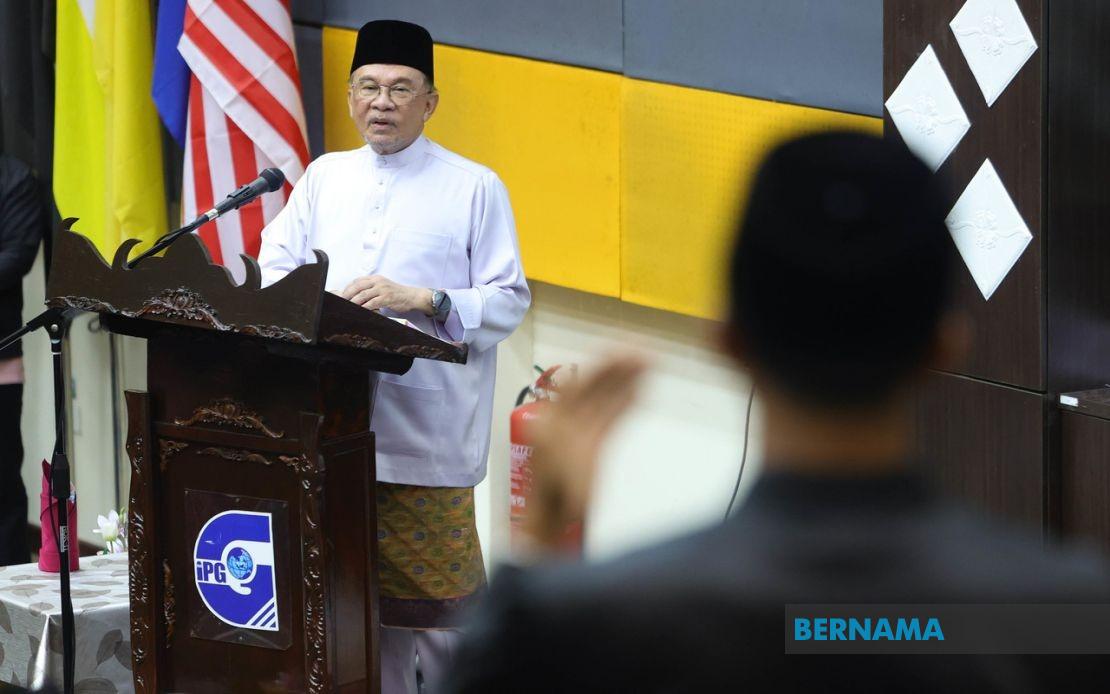
Prime Minister Datuk Seri Anwar Ibrahim has called for a fundamental reimagining of educator preparation in Malaysia, insisting that the nation's teachers must command expertise in cutting-edge technological fields whilst simultaneously embodying and transmitting core ethical principles and humanistic values. Speaking at an event in Nilai on July 17, Anwar underscored the tension that modern education systems face: the urgent necessity to embrace innovations in Science, Technology, Engineering and Mathematics including artificial intelligence, set against the equally critical imperative to ensure that technological prowess does not come at the expense of moral grounding and cultural integrity.
The Prime Minister's remarks reflect a growing recognition across Southeast Asia and globally that technical competence alone cannot sustain meaningful educational outcomes or social cohesion. Malaysia's competitive positioning in the digital economy requires a workforce fluent in emerging technologies and capable of navigating complex, AI-driven industries. Yet Anwar's framing suggests concern that focusing exclusively on technical skills whilst neglecting character formation could produce academically accomplished but ethically adrift professionals. This balancing act represents one of the central challenges facing education policymakers in the region as they attempt to position their systems for both economic relevance and social stability.
Anwar articulated his vision through the metaphor of reaching for the skies while maintaining roots on the ground, a formulation that captures the dual orientation he envisions for Malaysian education. This approach demands that curriculum designers, teacher trainers, and school administrators rethink how they integrate modern technologies into pedagogical frameworks without allowing technological change to erode foundations in religion, cultural awareness, moral reasoning, and interpersonal values. The implication is that Malaysia's education transformation cannot proceed as a purely technical or economic exercise but must remain deeply connected to the nation's social fabric and shared values.
Education Minister Fadhlina Sidek and IPGKPT director Dr Kartini Abdul Mutalib, both present at the occasion, will play instrumental roles in translating these principles into concrete institutional change. The Institut Pendidikan Guru Kampus Perempuan Tuanku (IPGKPT) and broader teacher training infrastructure face the challenge of designing programmes that simultaneously expose future educators to artificial intelligence, data science, and advanced engineering concepts whilst creating structured opportunities for reflection on ethics, professional responsibility, and human-centred values. This dual curriculum represents a departure from conventional teacher preparation models and signals recognition that the teaching profession itself must evolve to meet contemporary demands.
Anwar's emphasis on education as the nation's paramount priority reflects a strategic assessment of Malaysia's long-term development trajectory. In an era where technological disruption reshapes labour markets and redefines competitive advantage, human capital development through education becomes not merely a social good but an economic imperative. However, the Prime Minister's insistence that education serve purposes beyond economic productivity—that it should strengthen social cohesion, deepen understanding across communal lines, and cultivate moral reasoning—suggests a vision of education as fundamentally tied to national stability and collective flourishing. This holistic framing carries particular resonance in Malaysia's multiethnic context.
Critically, Anwar invoked the risks of sectarian division within educational spaces, warning that teachers and students influenced by racial or religious hatred would undermine education's foundational purpose. This warning addresses real tensions that can emerge when rapid social change, technological disruption, or political polarisation create anxiety within communities. Educational institutions can either become forums where such anxieties harden into prejudice or sites where exposure to diverse perspectives, coupled with ethical guidance rooted in universal human values, helps individuals transcend tribal instincts. The Prime Minister's intervention suggests deliberate commitment to steering Malaysia's educational evolution toward the latter path.
The proposition that Malaysia's multiracial society must leverage diversity as a strength rather than permit it to become a source of fracture reflects strategic thinking about national resilience. No modern economy can compete globally whilst hobbled by internal communal conflict, and no society can sustain stability indefinitely if substantial populations harbour entrenched distrust across ethnic or religious lines. By positioning teachers as custodians not only of technical knowledge but also of intercultural understanding and common humanity, Anwar frames educator development as foundational to both Malaysia's economic aspirations and its social cohesion. This integrated vision distinguishes his approach from narrower competency-focused models.
The challenge of implementation remains formidable. Malaysian teacher training institutions must recruit and develop educators themselves capable of navigating this dual mandate. They require curricula that integrate AI literacy with philosophical inquiry into ethics and values. Practising teachers demand professional development opportunities that update technical skills whilst also deepening reflection on how to transmit ethical reasoning. Schools require leadership and resources sufficient to foster environments where technological innovation and humanistic education genuinely reinforce rather than compete with one another. These demands extend beyond rhetorical commitment to concrete policy design, resource allocation, and institutional capability-building.
Regionally, Anwar's formulation carries implications extending beyond Malaysia's borders. Throughout Southeast Asia, policymakers grapple with similar tensions between technological advancement and social stability, economic modernisation and cultural preservation. Malaysia's approach to resolving these tensions through education could serve as a model or cautionary tale for neighbouring nations with comparable demographic diversity and development aspirations. The region's capacity to harness technological innovation whilst maintaining social cohesion may ultimately depend on whether educators can effectively balance technical mastery with ethical grounding—precisely the challenge the Prime Minister has identified.
Looking forward, the translation of Anwar's vision into institutional practice will require sustained collaboration among policymakers, educators, and curriculum designers. Teacher preparation programmes must be substantially redesigned; in-service professional development must shift to accommodate both technical and ethical dimensions; school cultures must explicitly value and reward educators who model the integration of technological fluency with principled moral reasoning. The success of this endeavour will shape not only Malaysia's competitive position in the global knowledge economy but also the nation's capacity to maintain social harmony and democratic function amid rapid change. In effect, the Prime Minister has identified education as the primary arena where Malaysia's future trajectory—economically, socially, and ethically—will be fundamentally determined.

