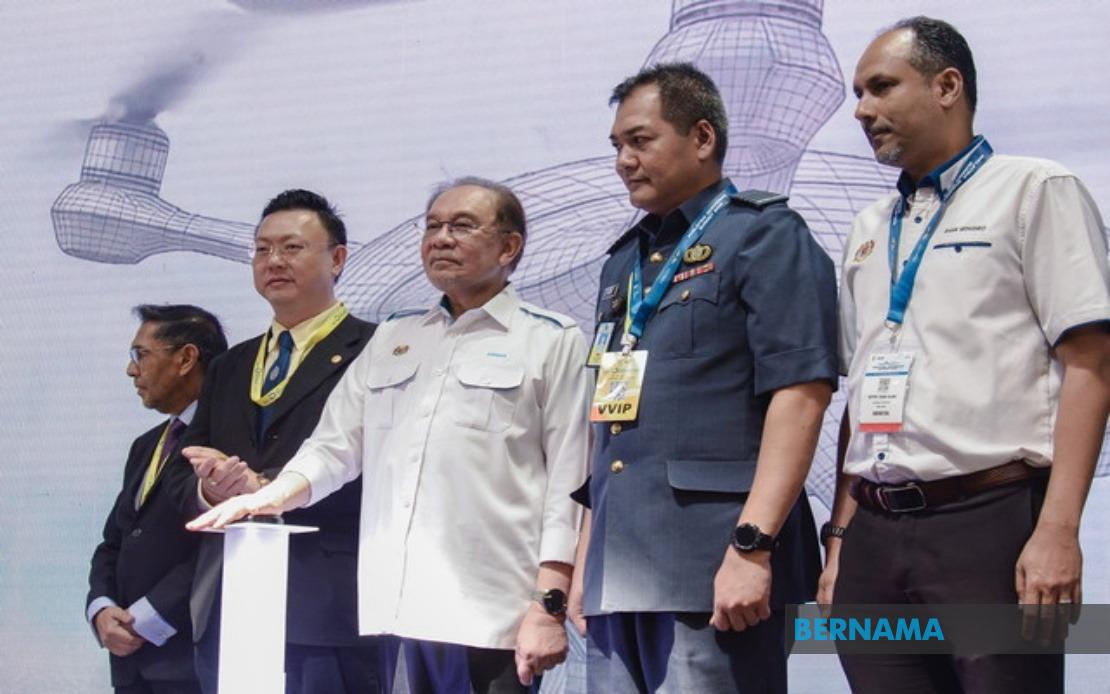
Prime Minister Datuk Seri Anwar Ibrahim has sounded an urgent call for Malaysia to quicken its pace in developing drone technology and related unmanned aerial vehicle (UAV) systems, framing this sector as critical to the nation's future economic competitiveness. Speaking at the closing ceremony of MyDrone Expo 2026 (MDX2026) in Sepang on June 27, Anwar characterised the drone industry as a transformative field that sits at the intersection of artificial intelligence and digital transformation, positioning it as a powerful engine for innovation, productivity gains and sustained economic expansion.
The Prime Minister's remarks come against the backdrop of a dramatically expanding global market. Anwar highlighted that the worldwide UAV sector is anticipated to surpass USD55 billion in value by 2030, signifying both the immense scale of opportunity ahead and the urgency for Malaysia to establish itself as a significant participant rather than a mere observer. Beyond raw market size, he emphasised that the low-altitude economy—the emerging ecosystem enabled by drone operations—represents an increasingly attractive investment frontier that nations cannot afford to ignore without risking competitive disadvantage.
Central to Anwar's vision is a recognition that technological advancement alone is insufficient; Malaysia must construct a comprehensive ecosystem designed to support the drone industry's growth. This includes creating a regulatory environment that is both enabling and practical, acknowledging that excessive bureaucratic barriers can stifle innovation while inadequate oversight invites operational risks. The Prime Minister articulated this balance by noting that policy support extends across multiple sectors—from national defence and aerospace applications to civilian use cases in agriculture, where drones can substantially elevate productivity in plantation operations and resource management.
To translate this strategic intent into tangible outcomes, Anwar has instructed Cabinet-level ministers, key policymakers, scientific research institutions and relevant government agencies to provide comprehensive support to stakeholders across the drone sector. This top-down directive signals the administration's seriousness about removing regulatory bottlenecks and creating favourable conditions for industry expansion. The instruction encompasses improvements to regulatory frameworks that govern drone operations, augmentation of research funding to support technical advancement, and the establishment of robust testing and certification infrastructure that can validate new technologies and operational procedures.
The MyDrone Expo 2026 itself provided concrete evidence of growing momentum in this space. Organised jointly by the World UAV Federation (WUAVF) Malaysia Chapter and the Malaysia UAV Development Association (MUDA), the three-day exposition exceeded initial expectations by assembling more than 100 exhibition booths and drawing thousands of visitors alongside industry delegates representing 46 countries. This scale of international participation underscores the global appetite for innovation in this sector and positions Malaysia as an emerging hub for UAV-related activity.
An often-overlooked dimension of technology sector development lies in human capital formation and skills development. Anwar recognised this by calling for enhanced collaboration between private sector enterprises, government-funded research institutions and universities to establish a robust pipeline of talented professionals capable of advancing the industry. He cited the successful models already established in adjacent fields such as artificial intelligence and quantum computing, where dedicated academic programmes have helped nurture specialised expertise and attracted international recognition.
For Malaysian businesses and investors, the policy direction outlined by the Prime Minister represents a significant shift towards state-backed acceleration of the drone sector. Companies operating in UAV manufacturing, software development, service provision and support sectors can expect a more supportive regulatory environment alongside potential government funding opportunities. This creates an opportunity window for domestic entrepreneurs to scale operations and build international competitiveness before global competition intensifies.
From a regional perspective, Malaysia's push into the drone industry carries implications for Southeast Asia's technological positioning. As neighbouring countries also pursue digital transformation agendas, establishing leadership in a high-growth sector like UAVs could reinforce Malaysia's role as a technology hub within the Association of Southeast Asian Nations (ASEAN), potentially attracting investment and talent from across the region.
The practical applications of drone technology across Malaysian industries—particularly in agriculture, logistics, urban planning and infrastructure inspection—suggest that government support for this sector aligns with broader productivity improvement objectives. Rural areas in particular could benefit from drone-enabled services that address labour shortages and enhance agricultural yields, making this not purely an economic play but also a tool for inclusive development.
However, realising this ambition will require sustained commitment and coordinated execution across multiple stakeholders. The regulatory framework must evolve quickly enough to keep pace with technological innovation without creating uncertainty. Academic institutions must adjust curricula to produce graduates with relevant expertise. And private companies must have confidence that government support will persist beyond electoral cycles, enabling long-term investment commitments.
The government's articulated support for both defence-oriented and civil applications of drone technology reflects sophisticated thinking about market diversification. While aerospace and defence represent established markets with established procurement pathways, civilian applications—from precision agriculture to infrastructure maintenance to emergency response—represent newer frontiers where Malaysia can differentiate itself and build export capabilities.
Anwar's push for rapid drone industry development also signals the administration's understanding that technology leadership cannot wait. As other nations—both developed economies and ambitious emerging markets—accelerate their own programmes, Malaysia risks falling behind if action is delayed. The five-year window until 2030, when the global UAV market reaches USD55 billion, represents both a deadline and an opportunity for establishing the regulatory frameworks, industrial capabilities and human expertise that will determine whether Malaysia captures meaningful share of this expanding sector.

