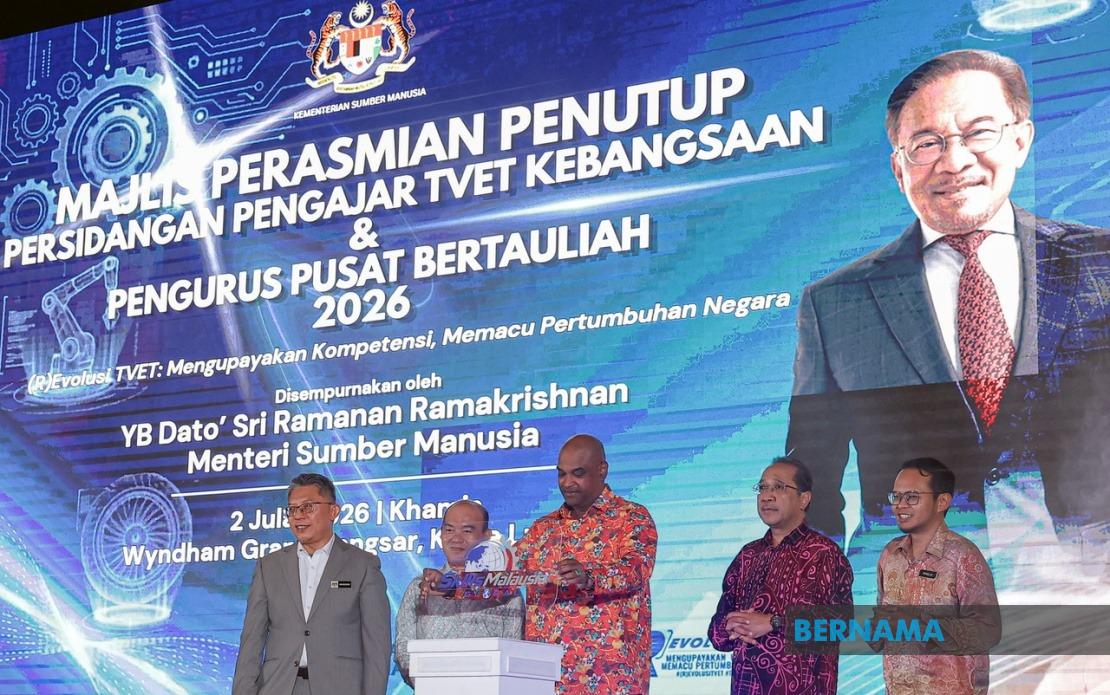
Malaysia's commitment to vocational and technical education is deepening with a significant policy shift that could reshape how the nation finances skills development. The Ministry of Human Resources (KESUMA) has signalled its intention to transform the financing model of the Skills Development Fund Corporation (PTPK) from a loan-based system to an entirely grant-based approach, addressing long-standing concerns about the financial strain imposed on trainees pursuing technical qualifications.
Datuk Seri R. Ramanan, the minister overseeing KESUMA, outlined the proposal during his address at the National TVET Instructors and 2026 Accredited Centre Managers Conference in Kuala Lumpur on July 2. The proposal centres on converting a RM100 million allocation currently disbursed as loans into outright grants, pending Cabinet approval. This potential restructuring reflects a recognition within government circles that the existing repayment obligations create genuine hardship for individuals undertaking technical and vocational education and training programmes.
The rationale underpinning this shift is straightforward yet compelling. TVET participants often must leave their employment to pursue full-time training, immediately eliminating their primary source of income. Simultaneously requiring these individuals to service loan repayments places them in a precarious financial position that extends well beyond their training period. By converting loans to grants, the government would eliminate this dual burden, allowing trainees to focus entirely on skill acquisition without the concurrent pressure of debt obligations. This approach recognises that financial anxiety during training can undermine educational outcomes and discourage talented individuals from pursuing vocational pathways.
Ramanan's broader vision for TVET extends considerably beyond this single financing mechanism. He positioned vocational and technical education as a cornerstone of Malaysia's human capital strategy within the Malaysia MADANI development framework. TVET, he argued, functions as a transformative force capable of addressing skills mismatches that have long plagued the Malaysian labour market. By aligning workforce capabilities with genuine employer needs, vocational programmes can propel the nation toward its ambition of establishing a Regional Innovation Hub whilst simultaneously attracting high-value foreign investment.
The financial targets underpinning this strategy are ambitious. The ministry has established a clear objective of elevating Malaysia's Gross National Income per capita to approximately RM77,200 annually. Such targets are achievable only through a workforce equipped with highly specialised, market-responsive competencies that vocational education uniquely provides. Unlike traditional academic pathways, TVET programmes offer hands-on, industry-aligned training that translates directly into productive employment capacity.
To bolster Malaysia's competitive positioning globally, KESUMA has launched an Internationalisation Action Plan spanning 2026 to 2030, structured around six strategic pillars. This plan aspires to secure global recognition for Malaysian skills credentials and infrastructure. Central to this ambition is the proposed elevation of the Centre for Instructor and Advanced Skill Training (CIAST) to world-class standing, ensuring that Malaysian instructors themselves meet international benchmarks. The plan simultaneously promotes international innovation and excellence within TVET programmes, embedding these principles throughout the educational ecosystem.
Governance mechanisms supporting this internationalisation agenda reflect contemporary development priorities. The framework explicitly incorporates Sustainable Development Goals alignment, alongside Environmental, Social and Governance (ESG) principles, and diversity, equity and inclusion (DEI) standards. This integration signals that Malaysia's TVET expansion is not merely economically motivated but aligned with broader global sustainability and social responsibility imperatives. Such positioning strengthens Malaysia's appeal to multinational corporations and international partners evaluating regional hubs for operations and investment.
A particularly significant dimension of the internationalisation strategy concerns skills standards harmonisation. KESUMA has prioritised systematic mapping of National Occupational Skills Standards (NOSS) against international benchmarks, enabling direct comparison and reciprocal recognition. The Malaysian Skills Certificate (SKM) currently functions primarily within domestic contexts, but the renewed strategic focus aims to secure foreign professional body recognition with Global Excellence status. Such international validation would dramatically enhance mobility opportunities for Malaysian-trained technicians and skilled workers, permitting them to pursue career opportunities across regional and international labour markets without requiring additional certification.
This push for international credential recognition carries particular significance for Southeast Asian economies like Malaysia. The region increasingly functions as a competitive labour market where workers move fluidly across borders seeking improved remuneration and career advancement. Malaysian vocational graduates competing against counterparts from Singapore, Thailand, and other regional economies require credentials that demonstrate equivalent or superior capability. International recognition of the SKM would strengthen Malaysia's position as a vocational education destination, potentially attracting foreign students and boosting the nation's soft power within technical education spheres.
The conference Ramanan addressed represented more than an ordinary professional gathering; it embodied governmental commitment to elevating TVET's status and visibility within the broader education hierarchy. Historically, vocational pathways have carried less prestige than academic routes in Malaysian society, a perception that has deterred many capable students from considering TVET options. By hosting high-level national conferences featuring ministerial participation and launching significant strategic initiatives, the government consciously signals that TVET deserves equal standing with traditional academic pathways.
The proposed loan-to-grant conversion must navigate Cabinet approval processes, and success remains contingent upon securing broader government support. However, the minister's public commitment suggests this proposal has already undergone preliminary vetting and enjoys sufficient support to warrant formal submission. Should Cabinet approve the conversion, it would represent a watershed moment in Malaysian skills policy, fundamentally reorienting how the state finances workforce development and demonstrating responsiveness to the genuine financial obstacles confronting vocational learners.
For Malaysian policymakers contemplating this initiative, the conversion aligns with international best practices. Several developed economies have adopted grant-based models for vocational training, finding that removing financial barriers increases programme completion rates, accelerates entry into productive employment, and ultimately generates stronger returns on public investment through increased tax revenue and reduced social welfare expenditures. By emulating these approaches, Malaysia positions itself as a nation seriously committed to democratising access to high-quality skills training irrespective of trainees' initial financial circumstances.

