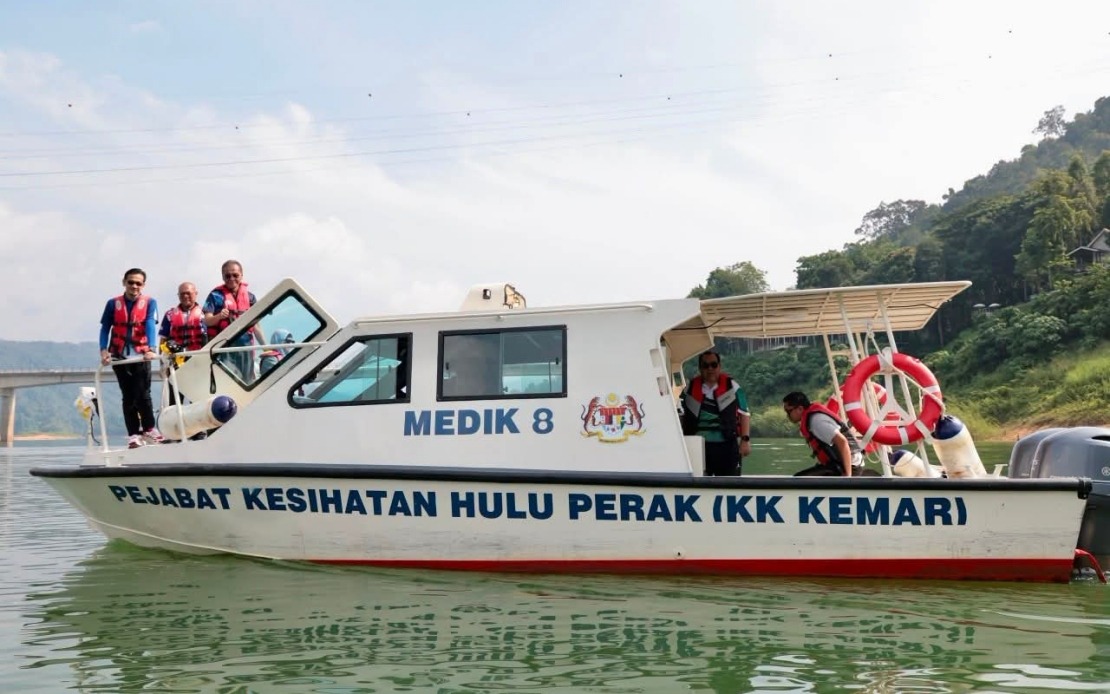
The Malaysian Ministry of Health has taken a significant step in bridging healthcare disparities in peninsular Malaysia's most remote regions by deploying a purpose-built medical vessel to serve indigenous communities in Hulu Perak. Medic Boat 8, which cost RM350,000 to acquire, represents the government's continued commitment to extending quality healthcare to populations where geographical isolation has historically created severe access barriers. The 12-passenger multipurpose vessel was officially launched at the Belum Rainforest Resort jetty and will operate primarily within the Kemar Resettlement Scheme in Gerik, where more than 4,500 Orang Asli residents depend almost exclusively on waterway navigation for movement and connectivity with external services.
Health Minister Datuk Seri Dr Dzulkefly Ahmad emphasised that the new boat augments the MOH's existing operational fleet of six vessels already serving interior communities across the country. The minister's statement underscored a critical principle underlying Malaysia's healthcare policy framework: that infrastructure investments mean little without the human commitment of frontline workers willing to operate under demanding conditions. The launch event acknowledged not only the technological addition but also the dedication required from medical personnel, boat crews, and emergency responders who regularly navigate challenging river conditions and unpredictable weather patterns to deliver care to isolated populations.
The deployment reflects broader challenges in delivering equitable healthcare to Malaysia's indigenous communities, who constitute approximately 0.4 per cent of the national population but face disproportionately higher rates of preventable diseases, maternal mortality, and limited access to specialist services. Orang Asli settlements in Hulu Perak, particularly those dependent on riverine geography, have historically experienced response times measured in hours rather than minutes during medical emergencies. The introduction of dedicated boat transport directly addresses this temporal barrier, potentially transforming outcomes in acute situations where speed of intervention proves determinative.
The Kemar Resettlement Scheme itself represents a complex historical reality within Orang Asli policy in Malaysia. Resettlement programmes, while intended to improve living conditions through proximity to government services and infrastructure, have also involved displacement from ancestral territories and traditional resource bases. The healthcare component of such schemes thus carries additional significance as a tangible government commitment to compensate for these broader structural changes affecting indigenous livelihoods and social cohesion.
Dr Dzulkefly Ahmad's invocation of Malaysia MADANI, the government's social contract framework, positions healthcare accessibility as a foundational principle of contemporary governance. The minister's statement that challenging terrain should not obstruct access to quality care represents an aspirational commitment that, if sustained through budgetary allocation and operational maintenance, could establish meaningful benchmarks for measuring success in inclusive healthcare delivery. This framing also acknowledges that geography alone should not determine health outcomes, a principle with implications extending beyond Hulu Perak to other remote regions including Sabah and Sarawak's interior populations.
The practical logistics of operating eight boats across multiple interior regions simultaneously presents ongoing operational challenges. Maintenance of vessels operating in freshwater environments requires specialized expertise and consistent funding. Crew training for medical emergency situations, particularly for conditions that may require stabilization before reaching hospital facilities, demands investment in continuous professional development. The availability of fuel, spare parts, and backup vessels should primary craft require repairs all constitute recurring operational considerations that determine whether such initiatives sustain impact over multi-year periods.
For the 4,500 Orang Asli residents in this particular area, the arrival of Medic Boat 8 signals measurable improvement in their capacity to access emergency care and scheduled medical consultations. Community health outcomes in remote areas typically reflect not merely the presence of healthcare infrastructure but its reliability and accessibility. A dedicated boat service provides predictability, reducing reliance on ad-hoc arrangements that previously may have involved substantial delays or costs borne by individual families.
The healthcare workforce implications deserve particular attention. Doctors, nurses, and paramedics willing to serve in remote postings with inherent logistical complications require not only adequate compensation but also psychological support and career development pathways that do not penalize their choice of underserved postings. The minister's specific acknowledgment of healthcare workers' sacrifice suggests recognition that staffing remote medical services involves genuine professional sacrifice, a reality that Australian, Canadian, and other developed nations address through targeted incentive schemes and career support mechanisms.
Regional implications extend to Southeast Asia's broader healthcare landscape, where multiple nations encompass large indigenous populations with limited service access. Malaysia's investment in maritime healthcare delivery models could potentially offer lessons for neighbouring countries with similar geographical and demographic challenges. Indonesia, Thailand, and the Philippines all operate healthcare systems serving remote and island-based populations where conventional transport infrastructure proves inadequate.
Sustainability of such initiatives depends fundamentally on budgetary consistency and political continuity. Healthcare funding allocated through annual parliamentary appropriations remains vulnerable to competing priorities during economic downturns or political transitions. Establishing enduring healthcare delivery mechanisms in remote areas requires not merely initial capital investment but sustained operational funding that persists across budget cycles and administrative changes.
The deployment of Medic Boat 8 also reflects evolving recognition within Malaysian healthcare policy that universal health coverage requires tailored solutions accounting for local geography and demographics. A one-size-fits-all approach to healthcare delivery inherently disadvantages populations occupying territories where standard transport and infrastructure models prove impractical. This particular initiative demonstrates how targeted investment addressing specific geographical barriers can meaningfully advance equity objectives embedded within health policy frameworks.

