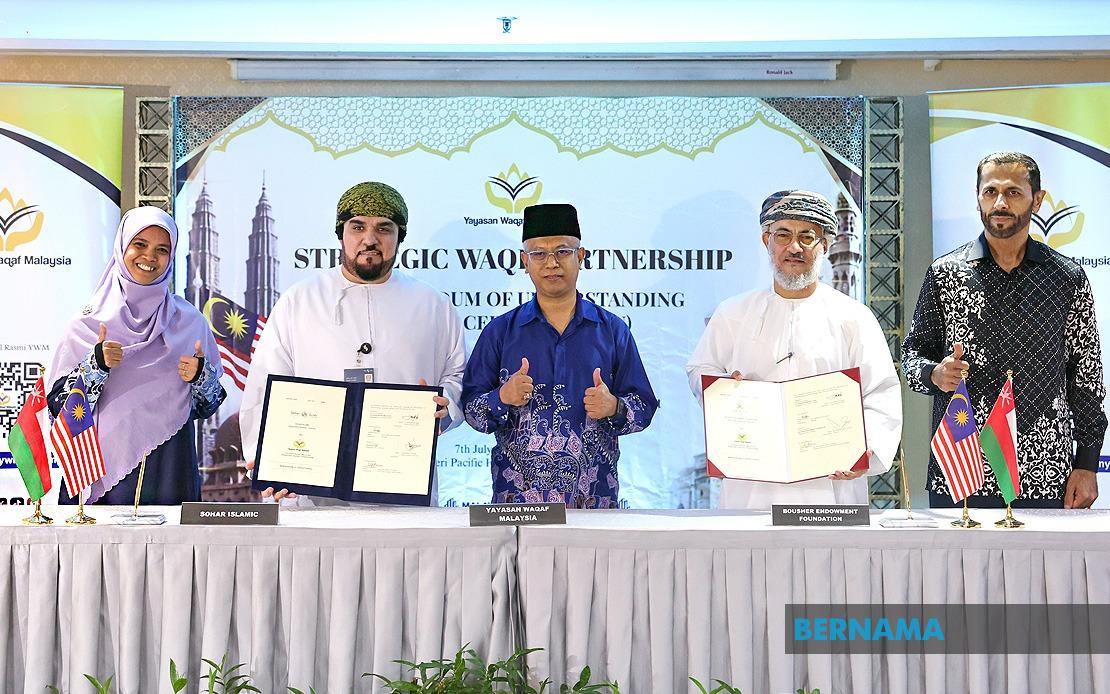
Malaysia has moved to strengthen its standing as a centre of Islamic social finance expertise through a comprehensive collaboration with two major Omani institutions. The Malaysian Waqf Foundation, commonly known as YWM, signed a memorandum of understanding with Sohar Islamic and the Boushar Endowment Foundation, establishing a framework for sustained knowledge exchange in waqf governance, asset management, and innovative financing approaches. The agreement, formalized in Kuala Lumpur, represents a significant milestone in positioning Malaysian practices and institutional knowledge as a reference point for waqf development across the Gulf region and broader Muslim world.
The initiative carries considerable symbolic weight beyond the immediate scope of the formal agreement. Deputy Minister in the Prime Minister's Department (Religious Affairs) Marhamah Rosli characterized the partnership as a reflection of international acknowledgment of Malaysia's capacity to build a structured, technologically-enabled and outcomes-focused waqf ecosystem. Her remarks underscored a notable inversion in the customary flow of expertise, where Malaysia typically imports specialized knowledge from established Gulf financial centres. Instead, this arrangement positions Malaysian institutional practices and regulatory frameworks as sufficiently sophisticated to merit adoption and adaptation in an internationally-respected jurisdiction.
A particularly notable element of the collaboration involves the appointment of YWM chief executive officer Dr Ridzwan Bakar as Waqf Adviser to the Sultanate of Oman by both signatory institutions. This advisory role signals confidence in Malaysian approaches to waqf modernization and governance structures. Ridzwan elaborated on the genesis of the partnership, explaining that Malaysian delegations visited Oman in 2023 and 2024 to evaluate cooperative possibilities in waqf capital development and strategic investment opportunities. The receptivity of Omani counterparts led to repeated invitations for Malaysian expertise, resulting in the formalized partnership.
The collaboration should be understood within the context of YWM's broader internationalization strategy. Ridzwan disclosed that the Omani engagement forms part of a wider network expansion incorporating established relationships with Kuwait, Qatar, and the United Arab Emirates. This diversified approach to international partnerships reflects a deliberate strategy to position Malaysia as an indispensable hub for Islamic social finance within the Middle Eastern and North African corridor. By establishing multiple bilateral relationships with significant Islamic financial centres, Malaysia creates redundancy and resilience in its regional influence while building institutional networks capable of attracting capital flows toward domestic investment vehicles.
The financial architecture supporting this international positioning includes three distinct investment products currently offered through Kenanga Investors under the YWM umbrella. These platforms are designed to channel international investment capital, particularly from Arab institutional investors, into Malaysian opportunities. This structure addresses a fundamental challenge in waqf development across the Islamic world: mobilizing capital for productive asset acquisition that generates sustainable returns benefiting specified beneficiary communities. By offering professionally-managed investment vehicles with proven track records, Malaysia presents itself as a trustworthy intermediary between wealthy Gulf investors seeking Sharia-compliant deployment opportunities and domestic Malaysian entities requiring growth capital.
The deeper rationale for waqf asset development extends beyond immediate charitable distribution. Ridzwan articulated a developmental perspective in which waqf institutions must first concentrate on building productive assets and strengthening underlying economic foundations before meaningful returns can reach beneficiary populations. This economic growth phase necessarily precedes the charitable benefit distribution phase. The perspective reflects sophisticated understanding of waqf as an institution for long-term wealth accumulation and intergenerational asset preservation rather than merely immediate relief provision. This temporal dimension distinguishes contemporary waqf thinking from popular conceptions treating waqf primarily as a charitable mechanism for instantaneous aid delivery.
The potential beneficiary base extends considerably beyond traditional asnaf categories, which conventionally encompass the poor, needy, and other religiously-defined groups. YWM's framework contemplates extending waqf benefits to broader population segments, specifically middle and lower-middle income categories designated as B40 and M40 income cohorts in Malaysian policy terminology. This expansion reflects recognition that economic vulnerability extends beyond absolute poverty into population segments earning modest incomes insufficient for secure asset accumulation or protection against financial shocks. By positioning waqf as an instrument for wealth democratization across wider socioeconomic strata, Malaysia advances a model of Islamic social finance addressing contemporary inequality patterns.
The Oman partnership occurs within a regional environment increasingly attentive to Islamic finance as both ethical economic practice and development instrument. Gulf states including Oman possess substantial capital reserves seeking ethical investment outlets, while simultaneously confronting challenges in economic diversification beyond hydrocarbon sectors. Malaysia's articulated expertise in waqf development appeals to this context by offering institutional mechanisms for mobilizing capital toward productive economic engagement. The partnership demonstrates recognition that Islamic financial innovation requires ongoing experimentation and institutional learning, positioning countries like Malaysia as laboratories for evolving approaches rather than merely recipients of prescriptive guidance from established centres.
For Malaysian stakeholders, the arrangement carries implications for domestic waqf development and institutional capacity. International partnerships create incentives for institutional professionalization, technology adoption, and best-practice implementation. As YWM positions itself as an adviser to foreign jurisdictions, domestic expectations for institutional performance and innovation necessarily intensify. Malaysian regulatory frameworks governing waqf must maintain competitive sophistication relative to international standards YWM projects abroad, creating virtuous cycles of continuous improvement. This dynamic transforms international partnerships from external validation into catalysts for sustained institutional evolution.
The collaboration also addresses perennial challenges in Islamic social finance regarding scale and sustainability. Individual waqf properties or modest endowments often struggle to generate sufficient returns for meaningful community benefit. Pooled investment vehicles managed by professional asset managers operating across multiple jurisdictions create economies of scale enabling smaller waqf contributions to access sophisticated investment opportunities. The Omani partnership provides Malaysian asset managers with exposure to significant investment capital, potentially enabling expansion of these pooled vehicles and extension of their reach to additional waqf contributors seeking professional management of endowed assets.
Marhamah's assertion that the arrangement reflects bilateral relationship strengthening carries diplomatic dimensions extending beyond financial cooperation. Enhanced engagement with Oman advances Malaysian positioning within the Organisation of Islamic Cooperation and related multilateral frameworks where Gulf states exercise considerable influence. Positioning Malaysia as an exporter of institutional expertise rather than merely a consumer of imported practices elevates national status within these networks. This soft power dimension complements hard economic benefits, as enhanced regional standing translates into preferential treatment in subsequent commercial negotiations and policy coordination.
Looking forward, the sustainability of this partnership depends on demonstrated delivery of promised benefits to Omani partners. YWM's performance as adviser and the returns generated through collaborative investment vehicles will establish whether Malaysian approaches merit broader regional adoption. Success could catalyze expansion of the partnership beyond current parameters, potentially incorporating additional Omani institutions or extending to other Gulf jurisdictions. Conversely, underperformance would constrain enthusiasm for Malaysian models, emphasizing the stakes inherent in the initial implementation phase. The partnership thus represents opportunity but also vulnerability, requiring sustained institutional excellence to consolidate Malaysia's emerging positioning as a regional Islamic finance leader.

